
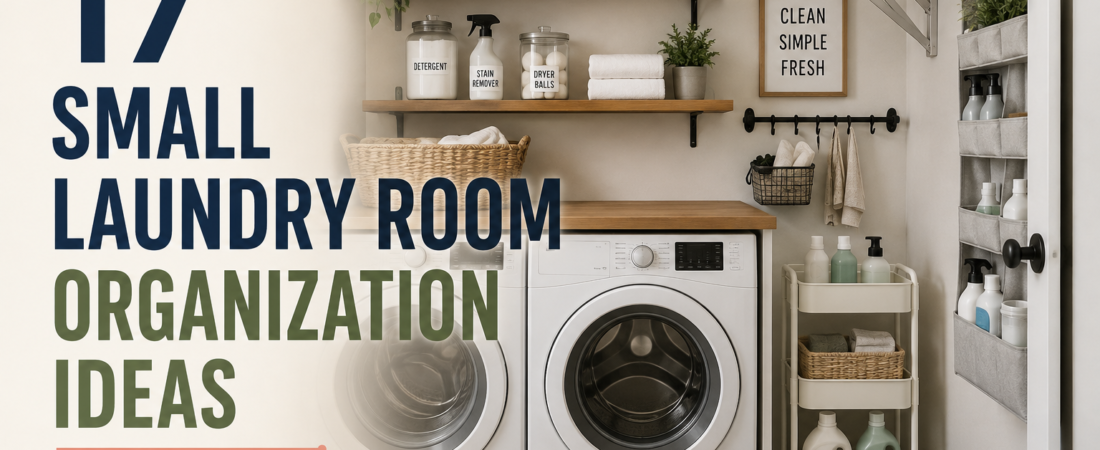
A small laundry room can get overwhelmed fast.
Detergent bottles crowd the washer. Cleaning supplies end up wherever they’ll fit. Laundry baskets take over the floor. And if the room doubles as a utility closet, mudroom, or household storage area, it doesn’t take long before the entire space feels cramped.
The problem isn’t always that the room is too small.
Often, it’s that the most useful storage space isn’t being used.
Walls, doors, narrow gaps, the area above your washer and dryer, and even a few inches beside a cabinet can all become useful storage. The key is choosing solutions that make laundry easier instead of simply squeezing more stuff into the room.
Here are 17 small laundry room organization ideas that can help you reclaim space and make laundry day a little less chaotic.
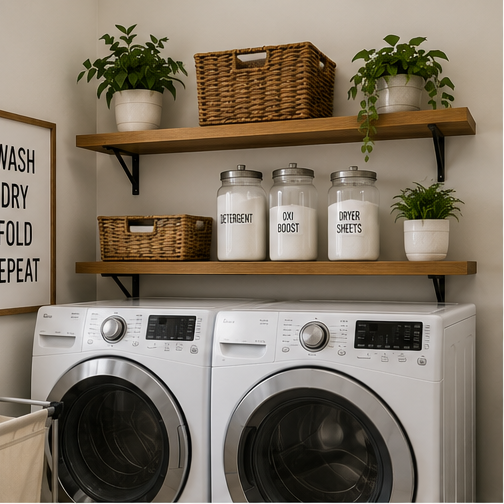
1. Use the Space Above Your Washer and Dryer
If the wall above your washer and dryer is empty, start there.
It’s some of the most valuable storage space in a small laundry room because adding storage there doesn’t consume any additional floor space.
One or two wall-mounted shelves can hold:
- Detergent
- Stain remover
- Dryer sheets
- Laundry additives
- Cleaning cloths
- Small baskets
- Extra household supplies
Keep the products you use regularly on the easiest-to-reach shelf. Backstock and less frequently used supplies can go higher.
If open shelving tends to look cluttered, use a few simple baskets to contain smaller items.
Space Well Used Tip: Don’t automatically install the deepest shelf that will fit. A shallower shelf can be easier to reach over a washer or dryer and may make the room feel less cramped.
2. Add a Folding Surface Over Front-Loading Machines
If you have front-loading machines positioned side by side, the space directly above them can become a useful work surface.
A countertop or removable laundry topper creates an instant place to:
- Fold clothes
- Sort laundry
- Treat stains
- Set down baskets
- Organize supplies
Washer/dryer countertop → View on Amazon
It also prevents the tops of the machines from becoming random catch-all surfaces.
A custom countertop looks great, but you don’t necessarily need one. Removable wood laundry toppers and other ready-made options can create the same basic function without a renovation.
Whatever you use, make sure you maintain any ventilation, clearance, and service-access requirements specified by your appliance manufacturer.
3. Use Baskets to Contain Loose Supplies
Laundry rooms accumulate a surprising number of small items.
Dryer balls. Mesh bags. Cleaning cloths. Stain sticks. Clothespins. Vacuum attachments. Extra sponges.
When all of those things sit loose on a shelf, even a fairly organized room can look cluttered.
Instead, create a few broad basket categories.
For example:
LAUNDRY
CLEANING
RAGS
BACKSTOCK
PET
You don’t need a separate labeled container for every object you own.
Broad categories make it easy to put things away without turning laundry-room organization into a filing system.
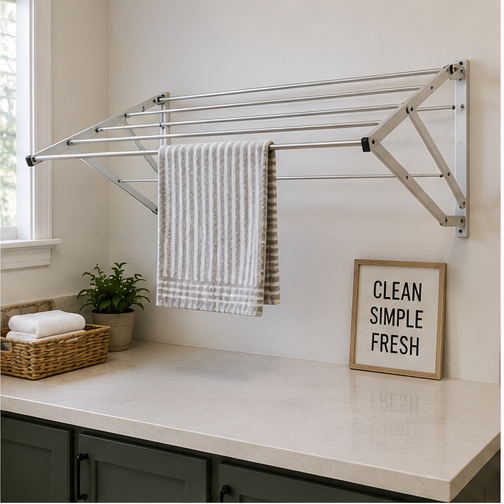
4. Install a Wall-Mounted Drying Rack
A freestanding drying rack works perfectly well — until you have nowhere to put it.
In a small laundry room, consider moving that function onto the wall.
Fold-down and accordion-style drying racks can provide several feet of drying space when they’re open and sit relatively flat against the wall when they’re not needed.
Fold-down drying rack → View on Amazon
They’re useful for:
- Delicates
- Workout clothes
- Swimsuits
- Hand-washed items
- Clothes that shouldn’t go in the dryer
Instead of permanently sacrificing floor space to something you use only occasionally, you’re borrowing wall space when you need it.
That’s exactly the kind of tradeoff that works well in a small room.
5. Turn the Back of the Door Into Storage
The back of a laundry-room door is easy to overlook because it doesn’t look like storage space.
It can be.
An over-the-door organizer can hold lightweight supplies without requiring another cabinet or shelving unit.
Over-door organizer → View on Amazon
Depending on the organizer, you might store:
- Cleaning sprays
- Dryer sheets
- Lint rollers
- Cleaning cloths
- Small laundry bags
- Brushes
- Ironing supplies
If your laundry room doubles as household cleaning storage, the door can be especially useful for keeping smaller cleaning products together.
Just be careful with heavy bottles. Use an organizer that’s actually designed to support the weight you’re putting on it.
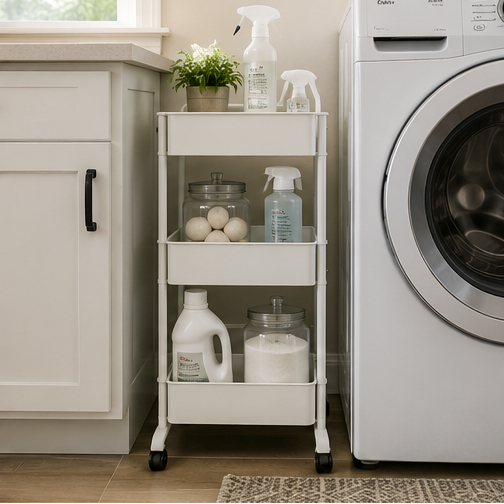
6. Use a Slim Rolling Cart in a Narrow Gap
That weird gap beside your washing machine might be more useful than it looks.
Slim rolling storage carts are designed to fit into narrow spaces where a normal shelving unit won’t.
Slim rolling cart → View on Amazon
They can hold things like:
- Detergent
- Stain remover
- Dryer products
- Cleaning sprays
- Cloths
- Small household supplies
When you need something, roll the cart out. When you’re finished, slide it back into the gap.
Measure carefully before buying one.
If space is tight, measure for storage organizers before you buy so doors, appliances, and walkways still have enough clearance.
And if you’re putting storage beside an appliance, make sure you’re not blocking required airflow, hookups, drains, or service access.
A six-inch gap doesn’t look like much.
Used vertically, it can hold a surprising amount.
7. Get Small Items Onto the Wall
Not everything needs to live on a shelf.
Hooks, small wall baskets, pegboards, and mounted containers can organize lightweight supplies while keeping counters and shelves clear.
Consider wall storage for:
- Lint rollers
- Mesh laundry bags
- Clothespins
- Small cleaning brushes
- Reusable dryer balls
- Dusting tools
- Reusable shopping bags
The important part is being selective.
Don’t cover an entire wall in storage just because you can.
Mount the things that are genuinely easier to use when they’re visible and accessible.
8. Create a Home for Lost Socks
There are few certainties in life, but one of them is that a washing machine will eventually produce a sock with no known partner.
Instead of letting unmatched socks accumulate on top of the dryer, give them a temporary home.
A small basket works perfectly.
So does a hanging pouch or wall-mounted container.
Label it LOST SOCKS if you want to make its purpose obvious.
Every so often, empty the basket and see whether any pairs have reunited.
Anything that’s been waiting six months for its soulmate may need to accept that the relationship is over.
9. Keep Everyday Laundry Products Within Easy Reach
The products you use for almost every load should occupy your best storage space.
That sounds obvious, but it’s easy to organize a room based on what looks nice instead of how you actually use it.
If you use detergent three or four times a week, don’t put it on the highest shelf behind a decorative basket.
Keep frequently used products somewhere easy to reach.
Reserve less convenient areas for:
- Backup detergent
- Specialty stain treatments
- Extra cleaning products
- Seasonal supplies
- Bulk purchases
Think of storage space as real estate.
Your everyday products deserve the best location.
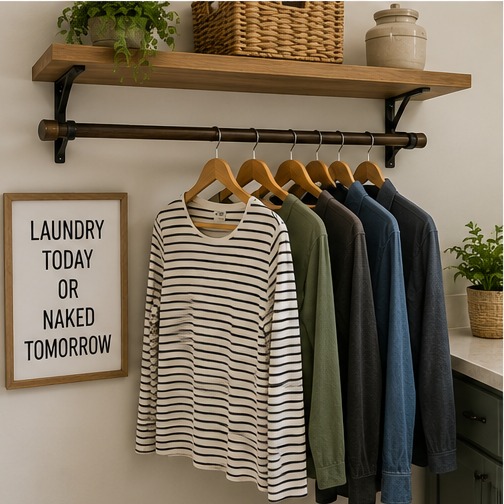
10. Add a Hanging Rod
Even a short hanging rod can make a small laundry room much more functional.
Install one:
- Under a shelf
- Between two cabinets
- Above a countertop
- Across a narrow alcove
It gives you somewhere to hang shirts directly from the dryer, air-dry clothing, or temporarily hold freshly ironed pieces.
If you frequently carry wet clothes to another room because there’s nowhere to hang them, this is one of those small upgrades you’ll probably appreciate immediately.
A rod mounted beneath an existing shelf is especially efficient because two functions occupy essentially the same wall space.
11. Store Flat Items Vertically
Some of the most awkward things in a laundry or utility room are the flat items.
Think:
- Ironing boards
- Folding drying racks
- Step stools
- Cleaning trays
- Reusable bags
- Narrow laundry accessories
Stacking these horizontally usually means pulling several things out to reach whatever is on the bottom.
Instead, look for opportunities to stand them vertically.
A narrow divider, wall-mounted holder, tall cabinet compartment, or gap beside a shelving unit can keep them upright and individually accessible.
It’s the same principle that makes storing baking sheets vertically easier than stacking them.
12. Move Excess Backstock Somewhere Else
Buying detergent in bulk can make sense.
Keeping four giant containers beside the washer usually doesn’t.
A small laundry room shouldn’t have to function as a warehouse for every household product you own.
Keep the product you’re actively using nearby and move unopened duplicates somewhere else if you have the space.
Possible backstock locations include:
- A utility closet
- Basement shelving
- Garage storage
- A hall closet
- A high storage shelf
When the active bottle runs out, replace it from backstock.
This frees up prime laundry-room space without forcing you to buy less economically.
13. Replace Multiple Hampers With One Sorting System
Three or four separate laundry baskets can consume an enormous amount of floor space.
If you sort laundry before washing it, look for a hamper that divides vertically rather than spreading horizontally across the room.
Divided laundry hamper → View on Amazon
A divided hamper might separate:
- Lights
- Darks
- Towels
- Delicates
If you have cabinetry, pull-out hampers can hide the entire sorting system when it’s not being used.
For renters or rooms without built-ins, a tall two- or three-section hamper can accomplish much of the same thing.
The goal is to consolidate the footprint.
14. Use the Side of a Cabinet
Small rooms often contain skinny vertical surfaces that don’t seem useful enough to matter.
They can.
The side of a laundry cabinet can hold:
- Hooks
- A small lint container
- Mesh bags
- Cleaning brushes
- Ironing accessories
- A narrow wall basket
You may also be able to use magnetic storage on the side of certain appliances, as long as it doesn’t interfere with ventilation, controls, doors, connections, or service access.
You aren’t going to double your laundry-room storage this way.
But in a small space, even a few newly useful inches can solve an annoying problem.
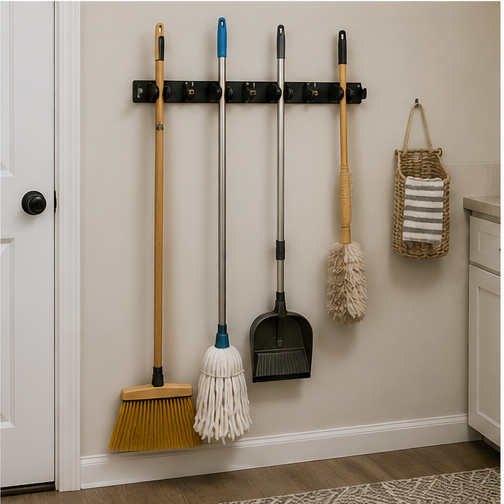
15. Store Brooms and Mops Vertically
If your laundry room doubles as a utility area, long-handled cleaning tools can become one of the biggest sources of clutter.
Lean a broom against a wall and eventually it falls over.
Add a mop, duster, and floor cleaner, and suddenly you’ve built a small obstacle course.
A wall-mounted tool holder keeps these items upright and off the floor.
Broom & mop holder → View on Amazon
Look for unused vertical space:
- Behind the door
- Beside a cabinet
- On an empty wall
- Inside an adjacent closet
Getting cleaning tools off the floor immediately makes a utility-heavy laundry room feel more organized.
16. Keep as Much as Possible Off the Floor
Floor space has an outsized effect on how big a small room feels.
When baskets, detergent bottles, cleaning tools, and miscellaneous supplies cover the floor, the laundry room feels even tighter.
Whenever possible, move storage:
up the wall
onto shelves
behind the door
inside cabinets
or into narrow vertical organizers
You don’t need an empty floor.
You just want enough clear space that you’re not constantly stepping around things.
There’s another benefit: the room becomes much easier to sweep, vacuum, and mop.
17. Create One Everyday Laundry Station
After you’ve added shelves, baskets, hooks, and organizers, there’s one more thing worth doing:
Put your everyday laundry supplies together.
Create one small routine station containing whatever you use for most loads.
That might include:
- Detergent
- Stain remover
- Dryer sheets or dryer balls
- A mesh bag
- A lint container
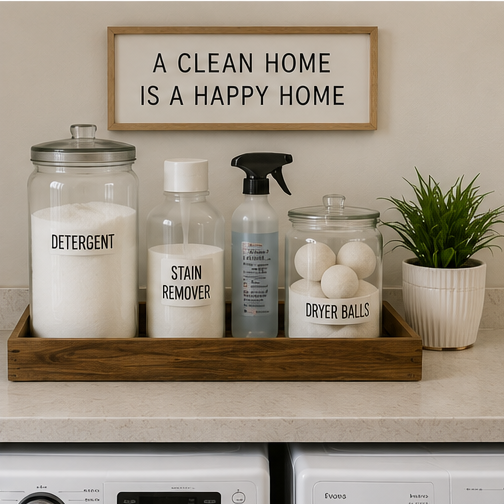
You shouldn’t have to visit four different areas of the room to start one load of laundry.
Keeping the basics together turns organization into something practical rather than decorative.
And that’s really the test for every storage idea in this article.
Does it make the room easier to use?
If the answer is no, you probably don’t need it.
Where Should You Start in a Cluttered Laundry Room?
Don’t try to implement all 17 ideas at once.
Look at the room and identify the thing that annoys you most.
If detergent and supplies are covering the appliances, start with shelving.
If a drying rack constantly blocks the walkway, look at wall-mounted options.
If you have an unused gap beside the washer, measure it for a slim cart.
If brooms and mops keep falling over, mount them.
If the room is simply packed with products, move the unopened backstock somewhere else before buying another organizer.
Solve the biggest problem first.
Then use the room for a while.
You’ll have a much better idea of what you actually need next.
Small Laundry Room Organization Ideas: Quick Problem Solver
Problem: No storage above the appliances
Try: Wall-mounted shelves or cabinets
Problem: No place to fold clothes
Try: A countertop over front-loading machines
Problem: Drying rack takes up the floor
Try: A wall-mounted fold-down drying rack
Problem: Narrow unused gap beside the washer
Try: A slim rolling cart
Problem: Loose supplies make shelves look messy
Try: Broad-category baskets
Problem: Too many laundry baskets
Try: One divided sorting hamper
Problem: Brooms and mops constantly fall over
Try: A wall-mounted tool holder
Problem: Everyday laundry products are scattered everywhere
Try: One simple laundry routine station
Frequently Asked Questions
How do you organize a very small laundry room?
Start with vertical space before adding anything else to the floor.
Shelves above the washer and dryer, wall-mounted organizers, hooks, hanging rods, over-the-door storage, and narrow rolling carts can create useful storage without making the room harder to move through.
Keep your most frequently used laundry products easy to reach and move unnecessary backstock somewhere else when possible.
What should I store above the washer and dryer?
The area above your appliances is a good place for detergent, stain treatments, dryer supplies, cleaning cloths, baskets, and lightweight household products.
Put frequently used items on the easiest-to-reach shelf.
Less frequently used or backup supplies can go higher.
Avoid storing very heavy objects somewhere they’ll be difficult or unsafe to retrieve.
How can I organize a laundry room without cabinets?
You don’t need cabinets to create a functional laundry room.
Open shelving, baskets, wall-mounted drying racks, hanging rods, hooks, over-the-door organizers, pegboards, and slim rolling carts can provide plenty of storage.
The advantage of open storage is that it can also be easier and less expensive to add.
How do I make a small laundry room look less cluttered?
Start by getting loose items off the floor and appliance tops.
Group smaller supplies into a few baskets, relocate excess backstock, and keep only regularly used products easily accessible.
You can also create a calmer look by limiting the number of different containers and organizers visible at once.
That doesn’t mean everything needs to match.
It just means every available surface doesn’t need to hold something.
Where should laundry detergent be stored?
Keep detergent in a cool, dry location that’s easy for the person doing laundry to reach but safely inaccessible to children and pets.
Follow the storage and safety instructions on the product packaging.
If you use detergent frequently, it usually makes sense to keep the active container near the washer and store unopened backstock elsewhere.
If you’re also struggling with the cabinet below your utility sink, these under-sink organization ideas can help you use that awkward space better.
How can I add storage to a laundry room without remodeling?
Look for unused surfaces before considering construction.
The wall above your appliances, the back of the door, narrow gaps beside machines, cabinet sides, and empty vertical wall sections can often accommodate organizers without changing the room itself.
Many useful additions — hooks, carts, freestanding shelves, and over-the-door organizers — can also work well for renters.
Make the Laundry Room Work Harder, Not Feel Fuller
A small laundry room doesn’t need to hold everything.
It needs to hold the right things in the right places.
Use the walls before sacrificing more floor space. Take advantage of narrow gaps. Keep everyday supplies accessible. Move bulk backstock out of prime storage. And choose organizers because they solve a problem — not because somebody’s laundry room looked good on Pinterest.
The goal isn’t to squeeze something into every available inch.
It’s to make the inches you use actually work.
For more ways to squeeze useful storage out of a smaller home, see these storage ideas for small homes.
That’s space well used.