
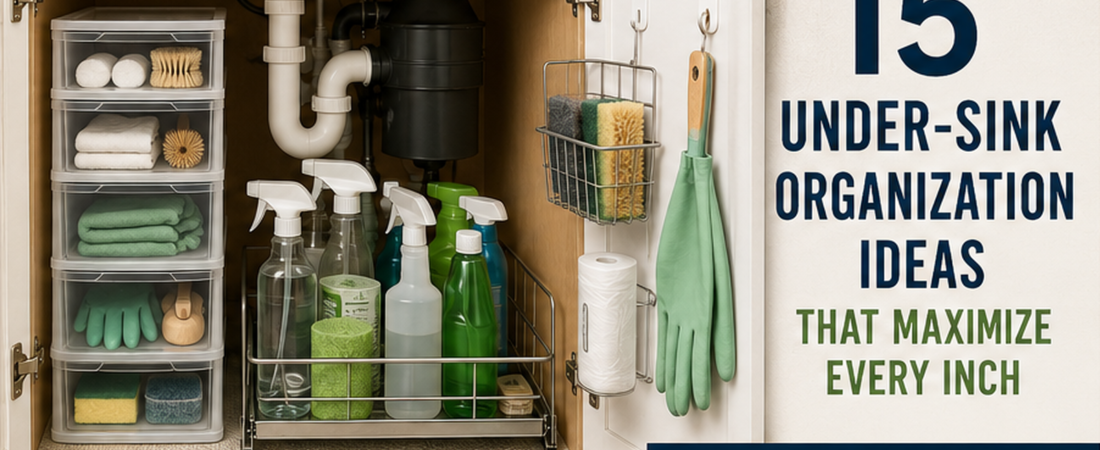
The cabinet under the sink has a way of becoming one of the most frustrating storage spaces in the house.
It looks roomy when it’s empty. Then you add a few cleaning sprays, dishwasher tablets, trash bags, sponges, and an awkwardly placed plumbing pipe, and suddenly everything is piled on top of everything else.
The real problem isn’t necessarily that the cabinet is too small. It’s that under-sink storage is unusually difficult to use efficiently. Pipes divide the space, the cabinet is deep, and most of what you’re storing is relatively small compared with the height of the cabinet.
Fortunately, you don’t need a custom cabinet or an expensive organization system to fix it.
The best under-sink organization ideas focus on making better use of vertical space, keeping frequently used supplies accessible, and working around the plumbing instead of pretending it isn’t there.
Here are 15 under-sink organization ideas that maximize every inch without making the cabinet harder to use.
1. Empty the Cabinet Before You Organize Anything
It isn’t exciting, but start by taking everything out.
Trying to organize an already-packed cabinet usually means rearranging the same clutter into slightly neater piles.
Once the cabinet is empty, you can see how much usable space you actually have.
Check for old products, nearly empty bottles, duplicate supplies, and anything that doesn’t really belong under the sink.
This is also a good opportunity to wipe down the cabinet and check around the plumbing for moisture or signs of a slow leak.
Then group what remains into simple categories such as:
- Everyday cleaning supplies
- Dishwasher supplies
- Sponges and brushes
- Trash bags
- Specialty cleaners
- Extra supplies
Don’t buy organizers until you know what needs to fit back inside.
2. Measure Around the Plumbing, Not Just the Cabinet
One of the easiest under-sink organization mistakes is buying a beautiful organizer that doesn’t fit because a drainpipe is directly in its path.
Measure the usable areas of the cabinet rather than only its overall dimensions.
You’ll want to know:
- Interior width
- Interior depth
- Cabinet height
- Distance from the cabinet wall to the pipes
- Height underneath horizontal plumbing
- Clearance around the garbage disposal, if applicable
A cabinet might technically be 30 inches wide while only having two narrow sections where a shelf or drawer can actually sit.
Treat those sections as separate storage zones.
That makes choosing organizers much easier.
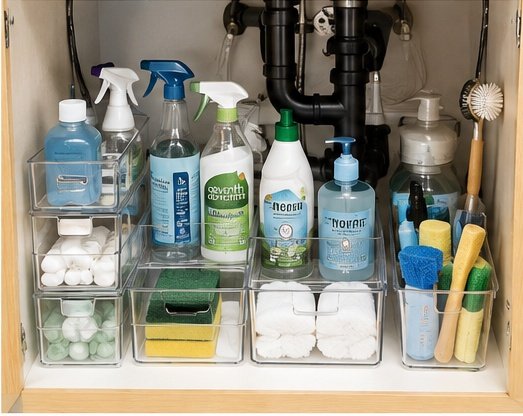
3. Use Stackable Drawers for Small Supplies
Deep cabinets are especially bad for small items.
A sponge placed near the back can disappear for months behind bottles and cleaning products.
Stackable drawers solve that problem by turning some of the empty vertical space into accessible storage.
Stackable storage drawers → View on Amazon
They’re particularly useful for:
- Dishwasher tablets
- Sponges
- Scrub pads
- Cleaning cloths
- Gloves
- Small brushes
- Garbage disposal supplies
Clear drawers make it easy to see what’s inside, but opaque drawers work perfectly well if they’re labeled.
The important part is choosing drawers that can sit beside or underneath the plumbing without blocking access to it.
4. Add a Pull-Out Organizer for Bottles
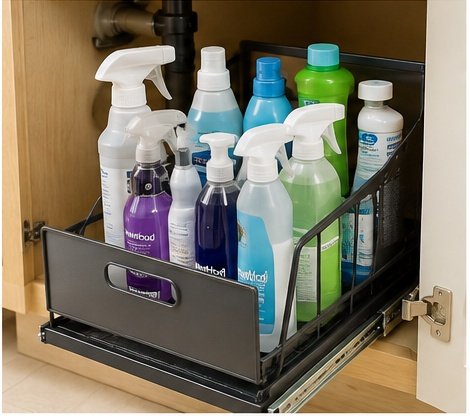
If you regularly have to remove four bottles to reach the cleaner sitting in the back, a pull-out organizer can make an enormous difference.
Instead of reaching into the cabinet, you pull the entire group toward you.
2-tier pull-out under-sink organizer → View on Amazon
This works especially well for taller items such as:
- Multipurpose cleaner
- Glass cleaner
- Dish soap
- Stainless-steel cleaner
- Disinfectant
- Floor cleaner
Look for narrow pull-out organizers rather than one giant unit.
Two smaller organizers can often fit around plumbing more easily than one wide organizer.
They also let you separate supplies by purpose—for example, everyday cleaners on one side and less frequently used products on the other.
5. Turn the Cabinet Door Into Storage
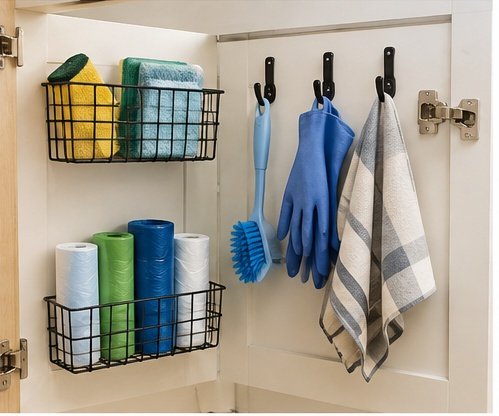
The inside of the cabinet door is one of the most overlooked storage areas under a sink.
It’s also prime real estate because anything stored there is immediately accessible when you open the cabinet.
Depending on the available clearance, you can add:
- Adhesive hooks
- Small baskets
- Slim door-mounted bins
- Sponge holders
- Trash-bag dispensers
Use this space for relatively lightweight items.
A pair of cleaning gloves, dish brush, microfiber cloth, or small roll of trash bags is ideal.
Just make sure anything mounted to the door clears the shelves and products inside when the door closes.
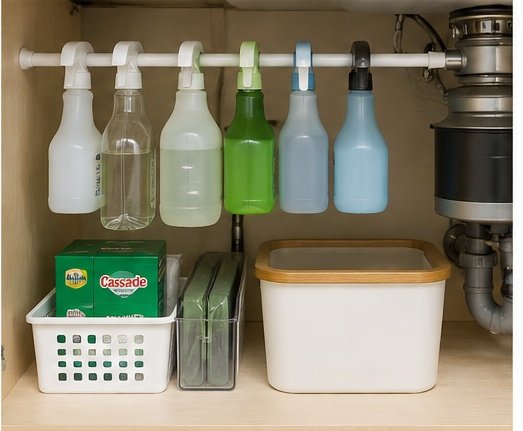
6. Hang Spray Bottles From a Tension Rod
Spray bottles take up a surprising amount of shelf space.
A small tension rod installed across an open section of the cabinet can create another storage level without requiring permanent installation.
Small tension rod → View on Amazon
Hang spray bottles from their triggers so the bottles are suspended above the cabinet floor.
That leaves the area underneath available for bins, backup supplies, or other cleaning products.
This works best when you have a relatively open cabinet without plumbing running directly through the area where the rod would sit.
Don’t overload it. A tension rod is useful for several lightweight bottles, not your entire collection of household chemicals.
7. Use Open-Top Bins to Create Categories
You don’t need fifteen different containers under the sink.
A few strategically placed open-top bins can keep the cabinet organized without turning it into a complicated storage system.
Handled open-top storage bins → View on Amazon
For example, you might have:
Everyday Cleaning: multipurpose cleaner, glass cleaner, microfiber cloths
Dishwashing: dishwasher tablets, rinse aid, dish soap
Extras: unopened sponges, replacement brushes, backup cleaning products
The advantage of a bin is that you can pull the entire category out at once.
That’s especially useful in deep cabinets where items stored in the back would otherwise be difficult to reach.
Choose bins with handles when possible.
8. Use a Lazy Susan for Frequently Used Products
A small turntable can work surprisingly well under a sink—provided you have an open section without plumbing interfering with its rotation.
Instead of lining bottles two or three rows deep, arrange frequently used products around the turntable.
Spin it to bring whatever you need to the front.
This works particularly well for collections of medium-size bottles such as:
- Dish soap
- Hand soap refills
- Cleaning sprays
- Furniture polish
- Specialty cleaners
Before buying one, measure carefully.
Under-sink Lazy Susan/turntable → View on Amazon
A lazy Susan needs enough clearance to rotate completely, so it’s less forgiving around plumbing than rectangular organizers.
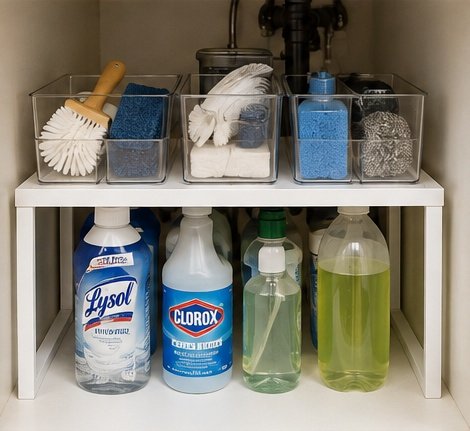
9. Add a Small Shelf to Use Vertical Space
Look inside most messy under-sink cabinets and you’ll see the same thing:
A crowded cabinet floor with a huge amount of empty space above it.
A small freestanding shelf can immediately create a second storage level.
Place taller bottles underneath or beside it and use the shelf for smaller items.
Expandable shelves are particularly useful because they can sometimes be adjusted around plumbing.
Expandable cabinet shelf → View on Amazon
Another option is using two narrow shelves—one on either side of the drainpipe—rather than trying to span the entire cabinet.
The goal isn’t to fill every cubic inch.
It’s to make the space you already have easier to access.
10. Store Trash Bags Vertically
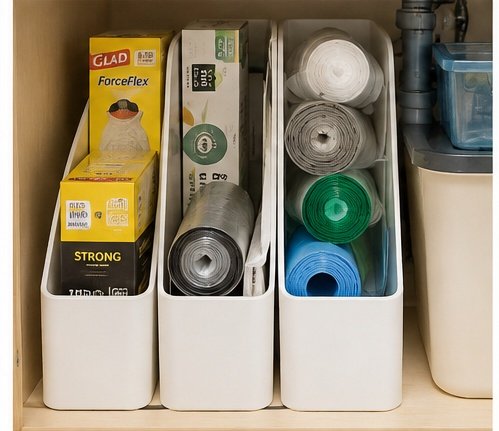
Boxes and rolls of trash bags are awkward.
They’re usually shoved into the back of the cabinet or stacked underneath something else, which means you have to dig them out every time the trash can needs a new liner.
Instead, dedicate a narrow vertical space to them.
Depending on your cabinet, that could mean:
- A magazine holder
- A narrow bin
- A door-mounted dispenser
- A vertical file organizer
- A simple basket
If you use more than one size of trash bag, keeping them upright next to one another also makes it easier to grab the correct roll.
This is a small change, but it’s exactly the kind of improvement that makes an organized cabinet stay organized.
11. Keep Everyday Supplies in Front
Not everything deserves equally convenient storage.
The products you use several times a week should be the easiest things to reach.
That might include:
- Dishwasher tablets
- Dish soap
- Multipurpose spray
- Sponges
- Trash bags
Backup bottles and specialty products can go farther back.
This sounds obvious, but many cabinets become frustrating because items are organized by size rather than by frequency of use.
A perfectly aligned row of bottles isn’t particularly useful if the bottle you use every day is sitting behind six products you barely touch.
Organize for how you actually live.
12. Use Hooks for Gloves and Cleaning Tools
Small hanging items are easy to lose inside a cabinet.
A couple of adhesive hooks can give them permanent homes without consuming shelf space.
Hooks work well for:
- Rubber cleaning gloves
- Small scrub brushes
- Bottle brushes
- Dustpan brushes
- Cleaning cloths with hanging loops
They can be installed on the inside wall of the cabinet or on the back of a door.
Just avoid placing hooks where hanging items could interfere with plumbing or prevent the cabinet door from closing.
This is another inexpensive way to use vertical surfaces instead of crowding the cabinet floor.
13. Protect the Bottom of the Cabinet
Organization isn’t only about fitting more things inside.
Under-sink cabinets are vulnerable to spills, dripping bottles, and plumbing leaks.
A waterproof or water-resistant liner makes cleanup easier and can help protect the cabinet material from minor spills.
Waterproof under-sink mat → View on Amazon
You can also use a shallow under-sink mat or tray.
This is particularly helpful beneath cleaning products that sometimes develop sticky residue around their caps.
If you ever notice unexplained moisture, staining, swelling, or persistent dampness under the sink, don’t simply cover it with an organizer. Find the source of the moisture first.
Storage should never make plumbing problems harder to notice.
14. Don’t Overstock Cleaning Supplies
You can install every organizer imaginable and still run out of room if you’re storing six months’ worth of cleaning products under the sink.
Small-space organization gets much easier when you limit backups.
For frequently used products, one replacement is usually plenty.
When possible, store bulk refills somewhere with more room—a utility closet, basement shelf, garage cabinet, or laundry area—and keep only the active bottle under the sink.
The same principle applies to sponges, dishwasher tablets, trash bags, and other consumables.
Your under-sink cabinet doesn’t have to function as a miniature warehouse.
15. Leave Some Empty Space
This may be the most counterintuitive under-sink organization idea of all:
Don’t fill the entire cabinet.
An organizer isn’t successful because it allows you to cram 37 things into a space that previously held 25.
It’s successful because you can easily find, remove, and replace the things you actually use.
Leaving a little breathing room also makes it easier to inspect plumbing and notice leaks.
Ideally, you should be able to open the cabinet and immediately understand where everything belongs.
If removing one bottle causes three other things to fall over, the cabinet is still too crowded.
Under-Sink Organization Ideas: A Simple Setup That Works
You don’t need to use all 15 ideas.
For many kitchens, a simple setup is enough:
Put a pull-out organizer on one side of the plumbing for frequently used cleaning bottles.
Use stackable drawers on the other side for dishwasher tablets, sponges, gloves, and other small supplies.
Add one or two hooks to the cabinet door for lightweight tools.
Keep trash bags in a narrow vertical organizer.
Place a washable liner or mat across the cabinet floor.
That’s it.
The result may not look like an elaborate social-media pantry makeover, but it solves the problems that actually matter: wasted vertical space, inaccessible products, and supplies constantly getting lost behind one another.
What Should You Store Under the Kitchen Sink?
The best items to keep under the kitchen sink are things you use in or around the kitchen.
That commonly includes dishwashing supplies, everyday cleaners, sponges, brushes, trash bags, gloves, and a limited number of backup products.
Avoid using this cabinet as miscellaneous household storage simply because there’s room available.
Every unrelated item makes the supplies you actually need harder to reach.
It’s also smart to think carefully about anything that could be affected by moisture. The area contains plumbing, which means leaks are always possible.
If an item would be ruined by water, another storage location is probably better.
How to Keep an Under-Sink Cabinet Organized
The hardest part isn’t organizing the cabinet once.
It’s keeping it that way.
Fortunately, you don’t need an elaborate maintenance routine.
When you finish a bottle, throw it away instead of leaving the empty container in the cabinet. When you open your last backup, add the product to your shopping list. If something consistently ends up in the wrong place, reconsider whether its designated storage spot makes sense.
Every few months, pull the bins or drawers out and quickly wipe down the cabinet.
That also gives you a chance to inspect the plumbing.
Most importantly, resist the urge to continually add new products without removing old ones.
An under-sink cabinet has a fixed amount of space.
No organizer can change that.
Frequently Asked Questions About Under-Sink Organization
How do I organize under the sink with lots of pipes?
Treat the areas around the pipes as separate storage zones rather than trying to fit one large organizer across the entire cabinet. Narrow drawers, small shelves, bins, and pull-out organizers can often fit on either side of the plumbing.
Measure the actual usable spaces before buying anything.
Are pull-out drawers good for under-sink storage?
Yes. Pull-out drawers and organizers are particularly useful in deep cabinets because they let you access supplies in the back without removing everything in front.
Make sure the drawer has enough clearance to slide completely forward without hitting the plumbing or cabinet hinges.
What should not be stored under the kitchen sink?
Avoid storing food, paper goods that could be damaged by moisture, or anything particularly valuable or sensitive to leaks.
If you have children or pets, also consider whether household cleaning products need to be stored somewhere more secure or behind an appropriate child-resistant cabinet lock.
How can I organize under the sink without buying organizers?
Start with decluttering and rearranging what you already have.
Group similar supplies together, move rarely used products elsewhere, place frequently used products in front, and use containers you already own when appropriate.
Even an empty shoebox-sized bin can help keep a category of supplies together.
You can add specialized organizers later if you identify a specific problem they would solve.
How do I maximize vertical space under the sink?
Freestanding shelves, stackable drawers, tension rods, hooks, and door-mounted storage can all use space above the cabinet floor.
The best option depends on where your plumbing is located.
Thinking about tackling your pantry next? Check out our guide to 21 Small Pantry Organization Ideas That Actually Save Space.
Make the Space Work for You
The awkward shape of an under-sink cabinet doesn’t mean it has to stay cluttered.
Start by removing what you don’t need. Then build storage around the plumbing, use some of the empty vertical space, and make your most frequently used supplies the easiest to reach.
You don’t need matching containers.
You don’t need a custom system.
And you definitely don’t need to buy an organizer for every item in the cabinet.
A few intentional changes can turn one of the most annoying cabinets in the kitchen into a space that actually works.
The goal isn’t to fit more stuff under the sink. It’s to make better use of every inch you already have.