
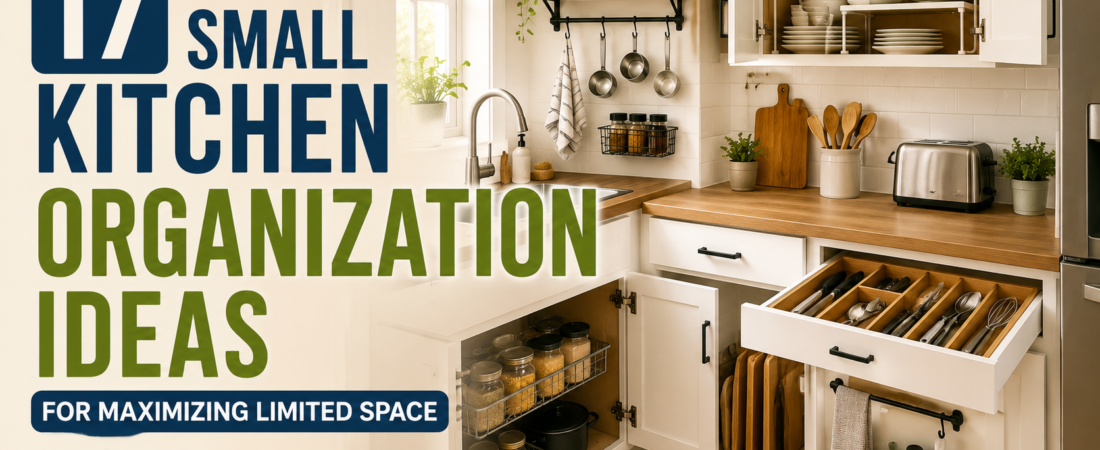
A small kitchen doesn’t leave much room for wasted space.
When cabinets are limited, counters are narrow, and drawers fill up quickly, even everyday items can make the room feel cluttered. Add small appliances, food storage containers, cookware, cleaning supplies, and groceries, and suddenly it feels like the kitchen needs twice as much storage as it actually has.
But a small kitchen doesn’t necessarily need more cabinets.
It needs the existing space to work harder.
The best small kitchen organization ideas make use of vertical space, cabinet doors, awkward gaps, walls, and overlooked storage areas while keeping the things you use every day easy to reach.
Here are 17 practical ways to organize a small kitchen and maximize limited space without turning every available surface into storage.
1. Start With What You Actually Use
Before buying organizers, take a hard look at what’s already taking up space.
Small kitchens don’t have much room for items that rarely get used.
Look for:
- Duplicate utensils
- Food storage containers without lids
- Lids without containers
- Chipped mugs
- Appliances you haven’t used in years
- Expired pantry food
- Duplicate spices
- Cookware you consistently avoid using
You don’t need to become a minimalist.
The goal is simply to make sure your limited storage isn’t being consumed by things you don’t actually need.
Every item you remove creates space without requiring you to install anything.
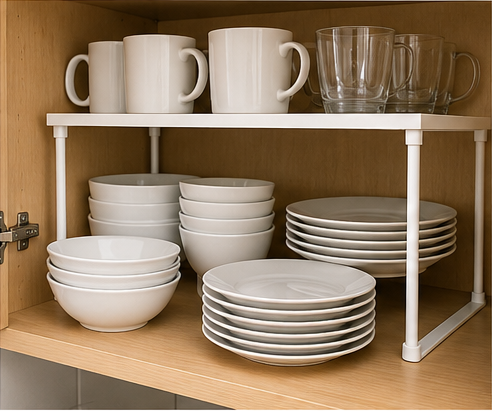
2. Use Shelf Risers Inside Cabinets
Many kitchen cabinets have far more vertical space than the items stored inside them require.
You might have one row of mugs sitting beneath ten inches of empty air.
Shelf risers turn that unused height into another storage level.
Expandable cabinet shelf riser → View on Amazon
They’re particularly useful for:
- Plates and bowls
- Mugs
- Canned goods
- Small pantry items
- Glassware
- Food storage containers
Instead of stacking everything into tall piles, a riser lets you separate items into shorter, easier-to-access layers.
Measure the cabinet before buying one, especially if your shelves aren’t adjustable.
3. Add Pull-Out Storage to Deep Cabinets
Deep cabinets sound useful until you realize half of their contents are permanently hiding in the back.
Pull-out baskets and drawers bring those items toward you.
Pull-out cabinet organizer → View on Amazon
They’re especially helpful in lower cabinets where reaching into the back can be awkward.
Use them for:
- Pots and pans
- Pantry staples
- Cleaning supplies
- Food storage containers
- Small appliances
You don’t necessarily need expensive built-in drawers.
Freestanding sliding organizers can provide much of the same function and are easier to add to an existing kitchen.
The goal is simple: bring the back of the cabinet to you.
4. Turn Cabinet Doors Into Storage
Cabinet doors are valuable vertical surfaces that are often completely unused.
Depending on the cabinet, you can add:
- Adhesive hooks
- Slim baskets
- Lid organizers
- Measuring-spoon holders
- Cutting-board racks
- Cleaning-supply holders
Keep door-mounted storage relatively shallow so it doesn’t collide with shelves when the cabinet closes.
This works especially well beneath the kitchen sink, where cabinet-door storage can hold lightweight cleaning supplies, gloves, brushes, or trash bags.
Thinking about tackling the cabinet under your sink? See our guide to 15 Under-Sink Organization Ideas That Maximize Every Inch.
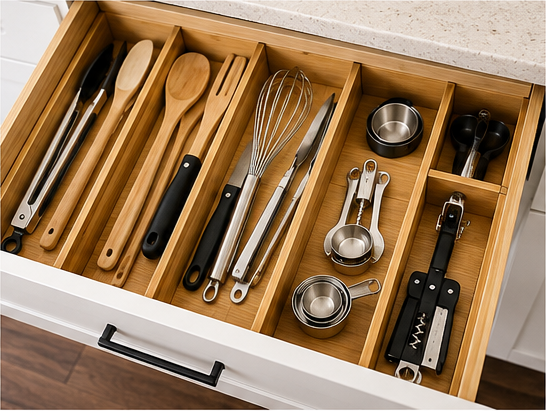
5. Use Drawer Dividers for More Than Silverware
A junk drawer becomes a junk drawer because everything inside it is allowed to move wherever it wants.
Dividers create boundaries.
And they’re useful for much more than forks and spoons.
Adjustable kitchen drawer dividers → View on Amazon
Use adjustable dividers to organize:
- Cooking utensils
- Measuring tools
- Food-storage accessories
- Dish towels
- Reusable bags
- Small kitchen gadgets
The goal isn’t to create a picture-perfect drawer.
It’s to prevent one spatula from somehow becoming intertwined with twelve other utensils every time you need it.
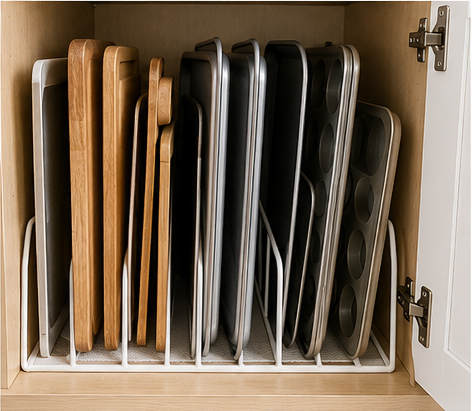
6. Store Cutting Boards and Baking Sheets Vertically
Stacking cutting boards, sheet pans, and baking dishes horizontally usually creates one problem:
You always need the item at the bottom.
Vertical storage lets you slide out one piece without moving everything else.
Adjustable bakeware organizer → View on Amazon
Use:
- Cabinet dividers
- Tension rods
- Vertical racks
- File-style organizers
This works particularly well in narrow lower cabinets.
You can use the same approach for:
- Muffin tins
- Cooling racks
- Cutting boards
- Baking sheets
- Serving trays
Vertical storage often takes up roughly the same amount of room as stacking while making everything significantly easier to access.
7. Make Better Use of Kitchen Corners
Corners are notorious for becoming dead space.
A countertop corner can collect random appliances. A cabinet corner can become a dark cave containing things nobody remembers owning.
Instead, give the corner a specific job.
On a countertop, you might use a compact corner shelf for frequently used items.
Inside a cabinet, a turntable or corner organizer can make awkward areas easier to reach.
The important thing is avoiding the temptation to fill the corner simply because it’s empty.
Useful storage should solve an accessibility problem, not create a new pile.
8. Use a Lazy Susan for Bottles and Jars
Turntables aren’t just for corner cabinets.
A small lazy Susan can make bottles, condiments, oils, spices, or pantry items much easier to reach.
Instead of creating several rows of products, arrange them around the turntable and rotate what you need toward the front.
Non-slip cabinet turntable → View on Amazon
They’re useful in:
- Upper cabinets
- Pantry shelves
- Refrigerators
- Under-sink cabinets
Measure before buying one.
A turntable needs enough clearance to rotate completely, so rectangular storage may work better in particularly tight spaces.
9. Use the Sides of Cabinets
The exposed side of a kitchen cabinet can become useful storage without consuming counter space.
Depending on your kitchen, it could hold:
- Hooks
- A towel rail
- A narrow spice rack
- A paper-towel holder
- Small baskets
- Measuring tools
The side of an upper cabinet near the stove can sometimes work for lightweight cooking tools.
The side of a lower cabinet may be useful for towels or reusable bags.
Think of these areas as bonus storage, not somewhere to hang everything that doesn’t have a home.
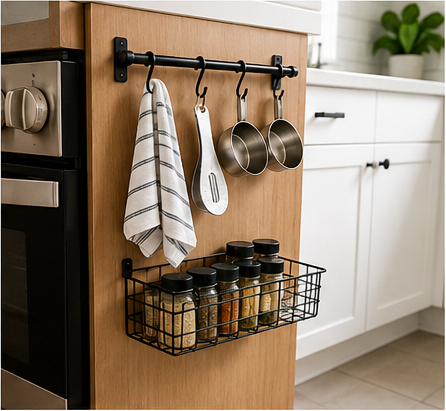
10. Get Frequently Used Utensils Off the Counter
Utensil crocks are convenient, but they can take up a surprising amount of counter space.
If your kitchen has very little prep space, consider moving some utensils onto the wall or inside a drawer.
Kitchen utensil rail with hooks → View on Amazon
A rail with hooks can hold:
- Spatulas
- Ladles
- Tongs
- Measuring cups
- Small strainers
You could also install hooks beneath an upper cabinet.
Keep only genuinely useful items visible.
If you haven’t used that giant decorative whisk since 2019, it probably doesn’t deserve premium wall space.
11. Create a Dedicated Small-Appliance Zone
Toasters, coffee makers, blenders, air fryers, mixers, and other appliances can consume nearly every inch of a small countertop.
Decide which appliances actually deserve permanent counter space.
An appliance you use every morning probably does.
Something you use twice a month probably doesn’t.
Store less frequently used appliances together in a cabinet, pantry, shelving unit, or appliance garage if you have one.
Creating a dedicated appliance zone also prevents them from slowly spreading across every available surface.
A small kitchen feels dramatically larger when there’s actually somewhere to prepare food.
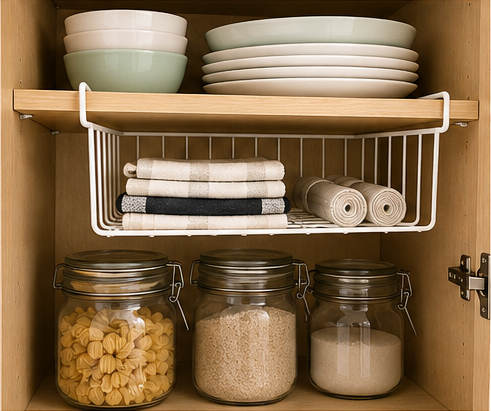
12. Add Under-Shelf Storage
The bottom of a cabinet shelf can sometimes provide another layer of storage.
Under-shelf baskets slide onto an existing shelf and hang below it.
Slide-on under-shelf storage basket → View on Amazon
They’re useful for lightweight items such as:
- Dish towels
- Wraps and bags
- Small food containers
- Coffee supplies
- Lightweight pantry items
There are also under-shelf hooks designed for mugs.
Just don’t add so many hanging organizers that the shelf below becomes difficult to use.
The point is to reclaim genuinely unused space.
13. Organize Food Storage Containers by Shape
Food storage containers can consume an absurd amount of cabinet space when every container is stored with its lid attached.
Nest containers whenever possible.
Then store lids separately.
A narrow bin, divider, or lid organizer can keep lids standing vertically so you can quickly find the right one.
You can also group containers by shape:
- Round
- Square
- Rectangular
- Small snack containers
And periodically get rid of orphaned pieces.
If a lid hasn’t found its container in six months, their relationship probably isn’t going to work out.
14. Use a Rolling Cart When Cabinets Are Limited
A narrow rolling cart can add useful storage without committing to permanent cabinetry.
Slim rolling kitchen storage cart → View on Amazon
Depending on your kitchen, use one for:
- Pantry staples
- Produce
- Coffee supplies
- Baking ingredients
- Small appliances
- Dish towels
The advantage is flexibility.
You can move the cart when you need additional floor space or roll it closer to your prep area while cooking.
Look for a cart that’s narrow enough to stay out of your primary walkway.
Storage that makes you squeeze sideways through the kitchen isn’t helping.
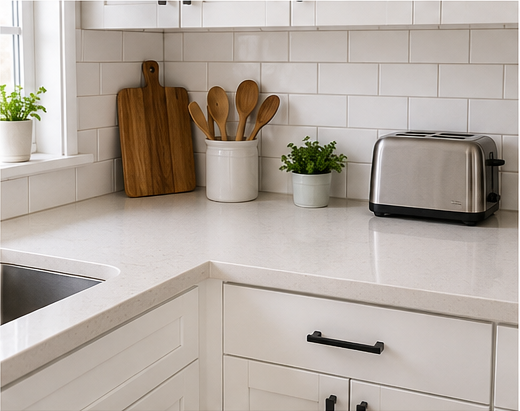
15. Keep Counters as Clear as Possible
Counter space is one of the most valuable resources in a small kitchen.
It’s also one of the easiest places for clutter to accumulate.
Try to keep only frequently used items on the counter.
That might include:
- Coffee maker
- Toaster
- Knife block
- Fruit bowl
Everything else should ideally have a designated storage location.
This doesn’t mean your counters need to look empty.
It means they should remain functional.
If you have to relocate five things every time you want to chop an onion, too much stuff is living there.
16. Create Zones Based on How You Use the Kitchen
A small kitchen becomes easier to use when related items live near one another.
Create simple zones such as:
COFFEE ZONE
Coffee maker, mugs, coffee, filters
COOKING ZONE
Oils, utensils, frequently used spices
BAKING ZONE
Flour, sugar, measuring tools, baking supplies
FOOD STORAGE ZONE
Containers, wraps, bags
You don’t need labels or matching bins to create zones.
You simply want to reduce unnecessary movement.
If you make coffee every morning, mugs shouldn’t be stored on the opposite side of the kitchen from the coffee maker.
Organize around your habits.
17. Use Pantry Space Strategically
If your kitchen includes a pantry—even a tiny one—don’t treat it as completely separate from your kitchen organization.
Move items into the pantry that don’t need to occupy prime cabinet space.
That might include:
- Bulk food
- Backup ingredients
- Small appliances
- Paper products
- Less frequently used cookware
Then reserve your easiest-to-reach kitchen cabinets for everyday essentials.
A pantry is most useful when it supports the kitchen rather than simply becoming another place to accumulate things.
Working on your pantry too? Check out our guide to 21 Small Pantry Organization Ideas That Actually Save Space.
Small Kitchen Organization Ideas: Start With Your Biggest Problem
You don’t need to reorganize the entire kitchen this weekend.
Start with the thing that’s currently making the room hardest to use.
If your counters are covered with appliances, create an appliance zone.
If lower cabinets are impossible to reach, add pull-out storage.
If baking sheets collapse every time you open the cabinet, store them vertically.
If drawers are overflowing, add dividers and remove duplicates.
If food is disappearing into a crowded pantry, reorganize that area first.
Solving one frustrating problem often creates enough breathing room to see what actually needs attention next.
Quick Small Kitchen Organization Problem Solver
Problem: Cabinets have lots of unused height
Try: Shelf risers or under-shelf baskets
Problem: Items disappear in deep cabinets
Try: Pull-out organizers
Problem: Drawers are constantly messy
Try: Adjustable drawer dividers
Problem: Baking sheets are difficult to access
Try: Vertical dividers
Problem: Counters are covered with appliances
Try: A dedicated appliance zone
Problem: No room in cabinets
Try: Cabinet-door storage, wall storage, or a narrow rolling cart
Problem: Food containers are chaotic
Try: Nest containers and store lids vertically
Problem: Pantry items are overflowing into the kitchen
Try: Reorganize the pantry around frequently used versus backstock items
Frequently Asked Questions About Small Kitchen Organization
How do I organize a kitchen with very little storage?
Start by removing items you rarely use and prioritizing your existing storage for everyday essentials.
Then look for unused vertical surfaces. Shelf risers, cabinet-door organizers, hooks, wall rails, pull-out drawers, and under-shelf baskets can create additional usable storage without adding more cabinets.
How can I maximize cabinet space in a small kitchen?
Use the full height and depth of the cabinet.
Shelf risers can create additional levels, while pull-out organizers make deep storage easier to access.
Store flat items such as baking sheets vertically, nest food containers, and use cabinet doors for lightweight storage when clearance allows.
How do I organize a small kitchen without a pantry?
Dedicate specific cabinets to pantry staples and organize them by broad categories.
Use shelf risers, turntables, bins, and pull-out organizers to make food easier to see.
A narrow freestanding shelving unit or rolling cart can also provide additional food storage if floor space allows.
What should stay on the counter in a small kitchen?
Keep items on the counter if you use them frequently enough to justify the space.
For many households, that means a coffee maker, toaster, knife block, or fruit bowl.
Less frequently used appliances and accessories should ideally have another home so the counter remains available for food preparation.
How can I organize a small kitchen on a budget?
Declutter before buying anything.
Simply removing duplicates, nesting containers, grouping similar items, and rearranging cabinets based on frequency of use can make a substantial difference.
When you do buy organizers, target specific problems rather than purchasing a complete matching system.
Simple shelf risers, hooks, dividers, and bins can solve many storage problems inexpensively.
How do I make a small kitchen look less cluttered?
Clear as much unnecessary stuff from the countertops as possible.
Group related items together, limit the number of products left visible, and avoid filling every wall and cabinet surface with organizers.
A small kitchen can have plenty of storage without looking like storage is covering every available inch.
Make Every Inch Earn Its Place
Small kitchens require choices.
You probably won’t have room to keep every appliance on the counter, every pan within arm’s reach, and every bulk grocery purchase in the easiest cabinet.
That’s okay.
Good organization isn’t about fitting the maximum possible number of things into a room.
It’s about making the things you actually use easier to find, reach, and put away.
Start with the biggest frustration. Use the vertical space you’re currently wasting. Keep your best storage locations for everyday essentials. And don’t be afraid to leave a little breathing room.
Because in a small kitchen, every inch should earn its place