
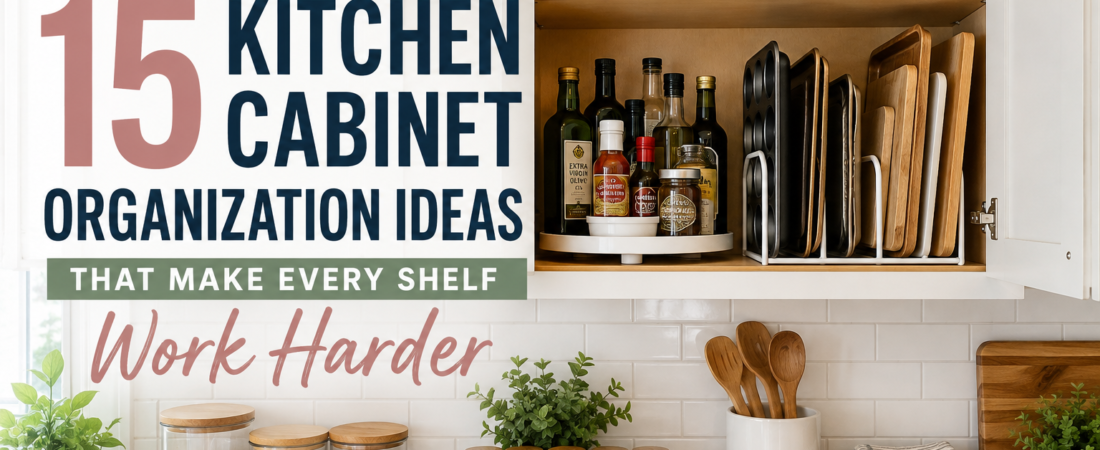
Kitchen cabinets can hold a surprising amount of stuff.
They can also become one of the easiest places in the house to lose control of.
A few mismatched containers, a stack of pans, some rarely used appliances, and suddenly you’re digging through three layers of things just to find one bowl.
The good news is that better cabinet organization usually doesn’t require a complete kitchen remodel.
A few strategic changes can make cabinets easier to use, easier to maintain, and much more efficient.
The best kitchen cabinet organization ideas focus on three things:
- Using vertical space
- Making deep storage easier to access
- Keeping everyday items where you can actually reach them
Here are 15 practical kitchen cabinet organization ideas that can help you make every shelf work harder.
1. Start by Removing What Doesn’t Belong
Before adding organizers, empty one cabinet at a time and look at what’s actually inside.
You may find:
- Duplicate mugs
- Food storage containers with missing lids
- Appliances you never use
- Serving pieces you forgot you owned
- Expired pantry items
- Chipped dishes
- Random items that belong somewhere else
The goal isn’t to throw away half your kitchen.
It’s to stop valuable cabinet space from being occupied by things you don’t use.
If an item only comes out once a year, it probably doesn’t need to live in your easiest-to-reach cabinet.
Put everyday items in prime storage and move less frequently used pieces higher up or farther away.
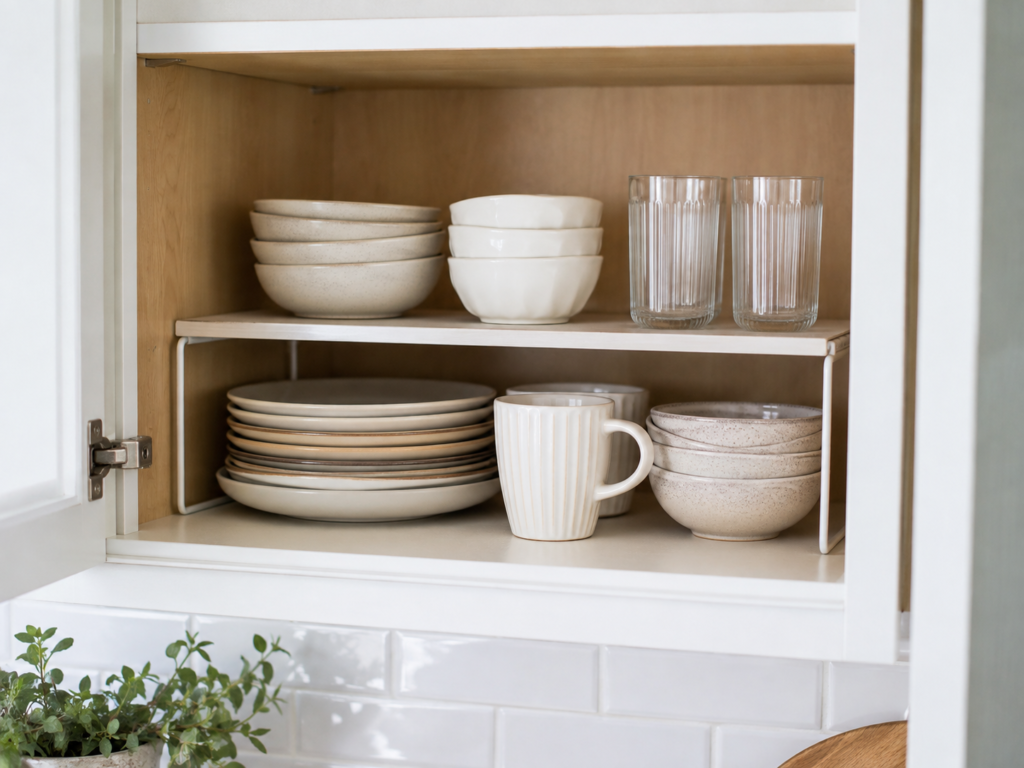
2. Add Shelf Risers to Double Usable Space
One of the easiest ways to improve a kitchen cabinet is to stop wasting the empty space above short items.
Shelf risers create a second level inside the cabinet.
Expandable cabinet shelf riser → View on Amazon
They work especially well for:
- Plates
- Bowls
- Mugs
- Canned goods
- Small pantry items
- Glassware
Instead of stacking everything into one tall pile, you can separate categories across multiple levels.
That makes items easier to see and reduces the need to lift several things just to reach what’s underneath.
3. Use Pull-Out Organizers in Deep Lower Cabinets
Deep lower cabinets can hold a lot, but they’re often frustrating to use.
Items placed in the back disappear behind everything else.
Pull-out organizers solve that problem by bringing the contents of the cabinet toward you.
Pull-out cabinet organizer → View on Amazon
They’re useful for:
- Pots and pans
- Mixing bowls
- Pantry staples
- Small appliances
- Food storage containers
You can install permanent sliding drawers, but freestanding pull-out baskets also work well if you don’t want to modify the cabinet.
The biggest advantage is accessibility.
If you can see and reach everything without unloading half the cabinet, you’re much more likely to keep it organized.
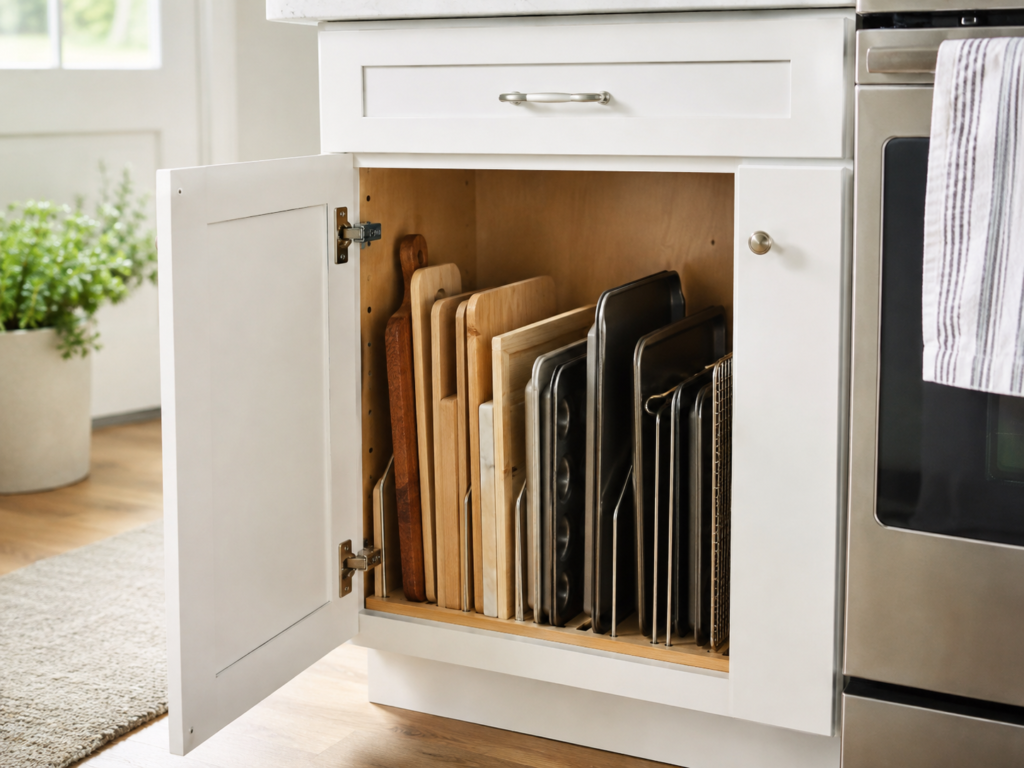
4. Store Baking Sheets and Cutting Boards Vertically
Flat kitchen items are much easier to manage when they’re stored upright.
Adjustable bakeware organizer → View on Amazon
Use cabinet dividers, tension rods, or vertical racks to separate:
- Baking sheets
- Muffin tins
- Cutting boards
- Cooling racks
- Serving trays
Horizontal stacks usually force you to remove several items just to reach the one at the bottom.
Vertical storage lets you pull out exactly what you need.
This works especially well in narrow lower cabinets.
5. Use Turntables for Bottles, Oils, and Condiments
A turntable can make awkward cabinet space dramatically easier to use.
Non-slip cabinet turntable → View on Amazon
Instead of reaching behind several bottles, simply rotate the organizer until the item you need comes to the front.
Use one for:
- Cooking oils
- Vinegars
- Sauces
- Spices
- Condiments
- Baking ingredients
Turntables work especially well in upper cabinets and corner cabinets.
Just make sure there’s enough clearance for the organizer to rotate without hitting the cabinet walls or other items.
If you’re organizing a small kitchen overall, this is one of those simple changes that can make a surprisingly big difference.
Looking for more ways to maximize a compact kitchen? Check out our guide to 17 Small Kitchen Organization Ideas for Maximizing Limited Space.
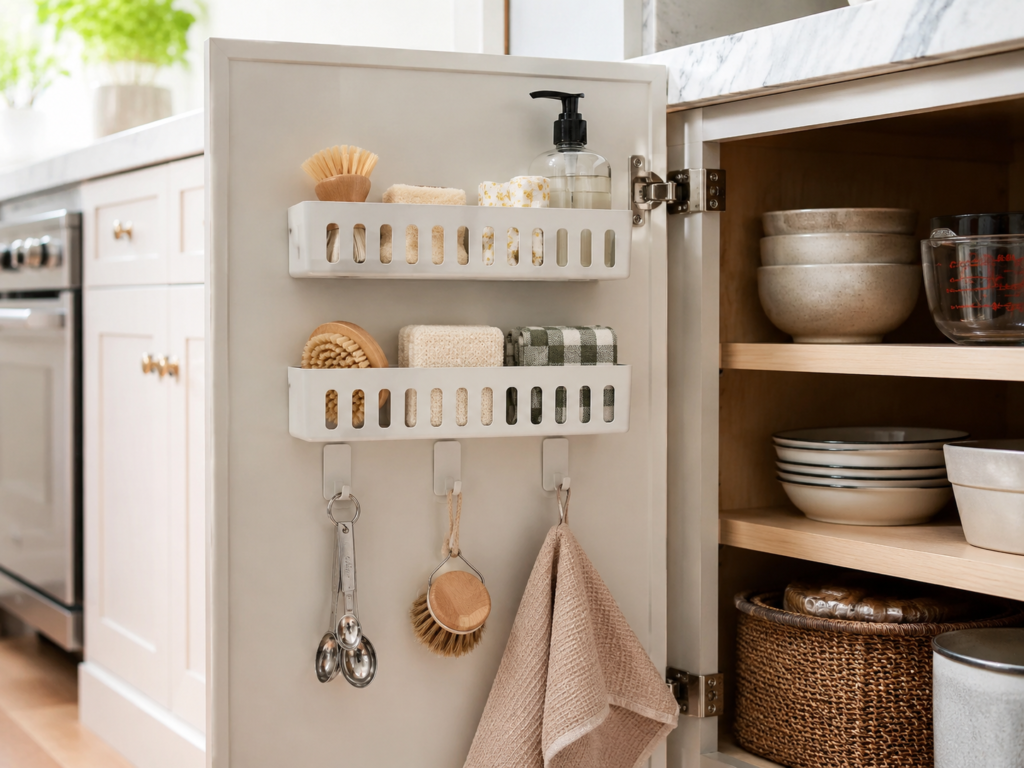
6. Use the Inside of Cabinet Doors
Cabinet doors are often completely unused.
That makes them valuable storage space, especially in a small kitchen.
Depending on the cabinet, you can add:
- Hooks
- Slim baskets
- Lid holders
- Measuring spoon racks
- Cutting board holders
- Small cleaning-supply baskets
Keep anything mounted on the door relatively shallow so the cabinet can still close properly.
This strategy works especially well underneath the sink.
Need help with that awkward cabinet? See 15 Under-Sink Organization Ideas That Maximize Every Inch.
7. Group Similar Items Together
A cabinet is much easier to use when you know what belongs there.
Instead of spreading similar things throughout the kitchen, create simple categories.
For example:
Breakfast cabinet
- Cereal
- Oatmeal
- Coffee
- Tea
Baking cabinet
- Flour
- Sugar
- Baking powder
- Measuring tools
Food storage cabinet
- Containers
- Lids
- Reusable bags
- Wraps
You don’t necessarily need labels.
The biggest improvement comes from giving each category a consistent home.
That makes it easier to find things and much easier to put them away.
8. Nest Mixing Bowls and Cookware
Large bowls and cookware can take up a huge amount of cabinet space if they’re stored individually.
Whenever possible, nest similar pieces together.
This works well for:
- Mixing bowls
- Pots
- Colanders
- Measuring cups
- Food storage containers
Be careful not to create enormous stacks that become difficult to lift.
The goal is compact storage without sacrificing accessibility.
If you use one bowl constantly, keep it near the top instead of burying it underneath five others.
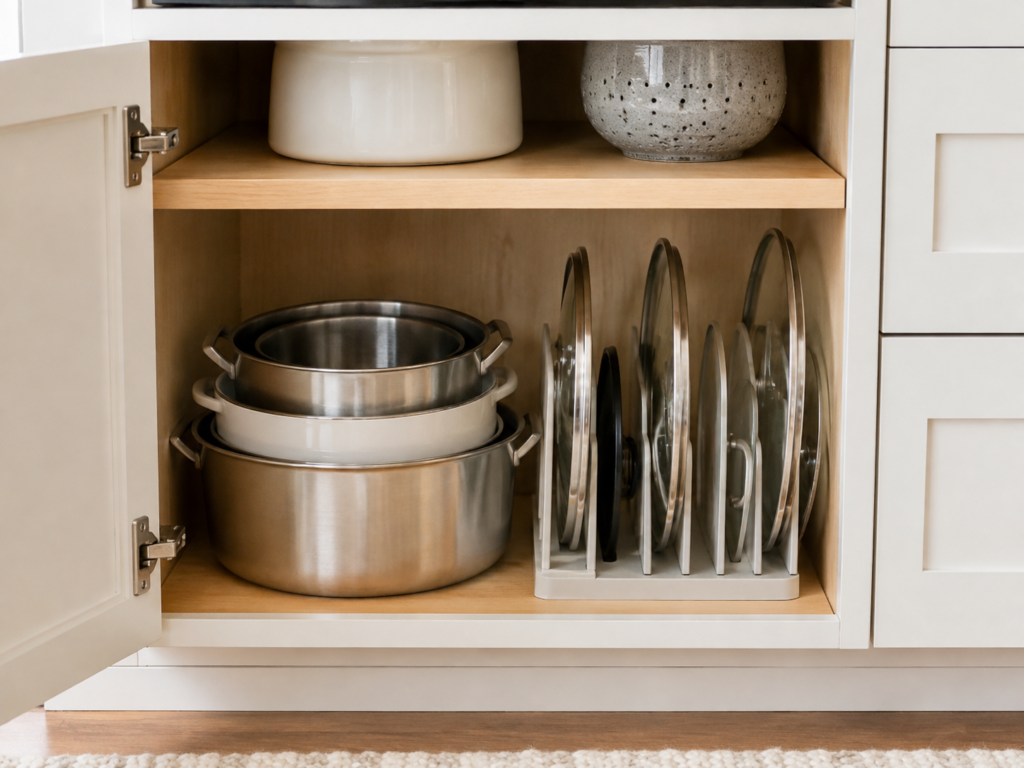
9. Separate Pots From Their Lids
Pot lids are one of the most common sources of cabinet chaos.
Stacking lids on top of pots seems logical until one slides sideways and brings the entire pile with it.
Instead, store lids separately.
You can use:
- Lid racks
- Vertical dividers
- Door-mounted organizers
- Narrow bins
Store lids upright whenever possible so you can see the sizes quickly.
Adjustable pot-lid organizer → View on Amazon
This also makes it easier to stack or nest the pots themselves.
10. Give Food Storage Containers a System
Food storage containers can take over an entire cabinet if they aren’t organized.
Start by matching every container with a lid.
Anything missing its partner can probably go.
Then nest containers by size and store lids separately.
A narrow bin or vertical lid organizer works well.
You can also group containers by shape:
- Round
- Square
- Rectangular
- Small snack containers
Keeping the system simple is more important than making everything perfectly matched.
If everyone in the house can understand where the lids go, the cabinet has a better chance of staying organized.
11. Use Clear Bins for Small Pantry Items
Small pantry items often become difficult to manage inside kitchen cabinets.
Packets, snacks, seasoning mixes, and baking supplies can scatter across shelves.
Clear bins can help contain them.
Use bins for categories such as:
- Snacks
- Baking supplies
- Pasta
- Rice
- Breakfast items
- Packets and mixes
Avoid using bins just because they look nice.
They should make a category easier to pull out and use.
Clear cabinet storage bins → View on Amazon
If you have a pantry, you may be able to move some of these items out of your kitchen cabinets entirely.
Thinking about reorganizing your pantry too? Check out 21 Small Pantry Organization Ideas That Actually Save Space.
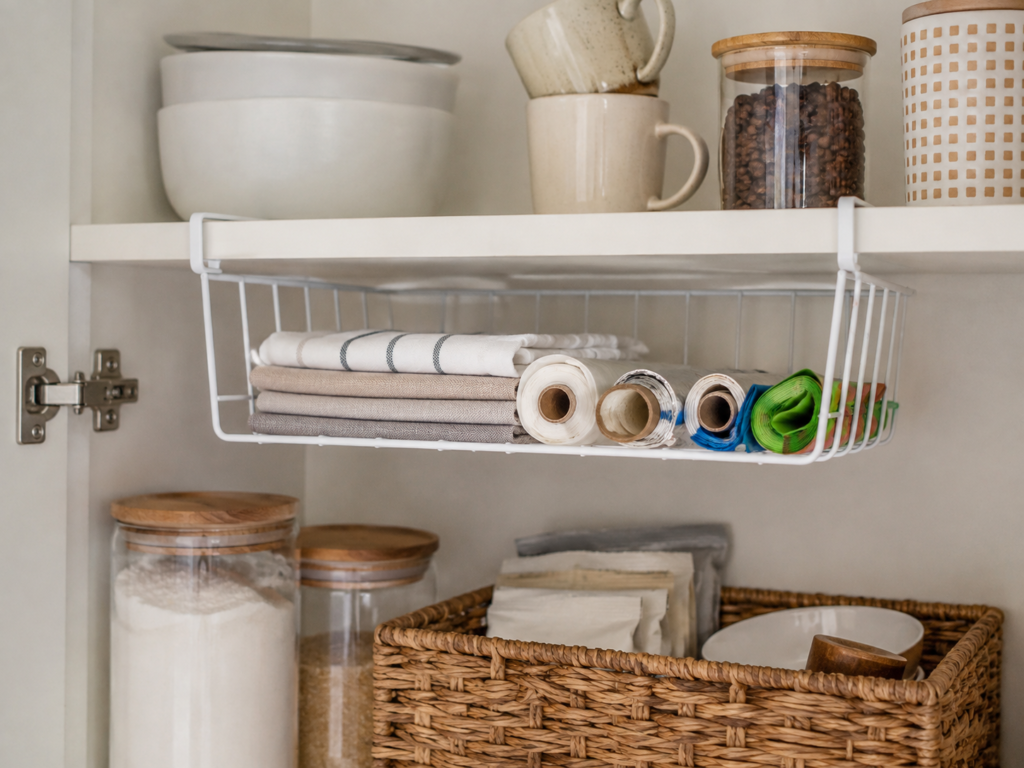
12. Add Under-Shelf Baskets
The space beneath a cabinet shelf often goes unused.
Under-shelf baskets slide onto the shelf above and create a shallow second layer.
Slide-on under-shelf basket → View on Amazon
They’re useful for lightweight items such as:
- Dish towels
- Wraps
- Small containers
- Reusable bags
- Coffee supplies
This is especially helpful when the items on the shelf below are short and don’t need the full cabinet height.
Just avoid overfilling the basket.
If it hangs too low, it can make the shelf beneath it harder to use.
13. Put Everyday Items at Eye Level
Not every shelf should be treated equally.
The easiest-to-reach shelves should hold the things you use most often.
That might include:
- Everyday plates
- Bowls
- Coffee mugs
- Glasses
- Common pantry staples
Less frequently used items can go higher.
Examples include:
- Holiday dishes
- Specialty baking pans
- Serving platters
- Extra glassware
- Rarely used appliances
This simple change can make a kitchen feel much more functional without adding a single organizer.
Organize around frequency of use, not just category.
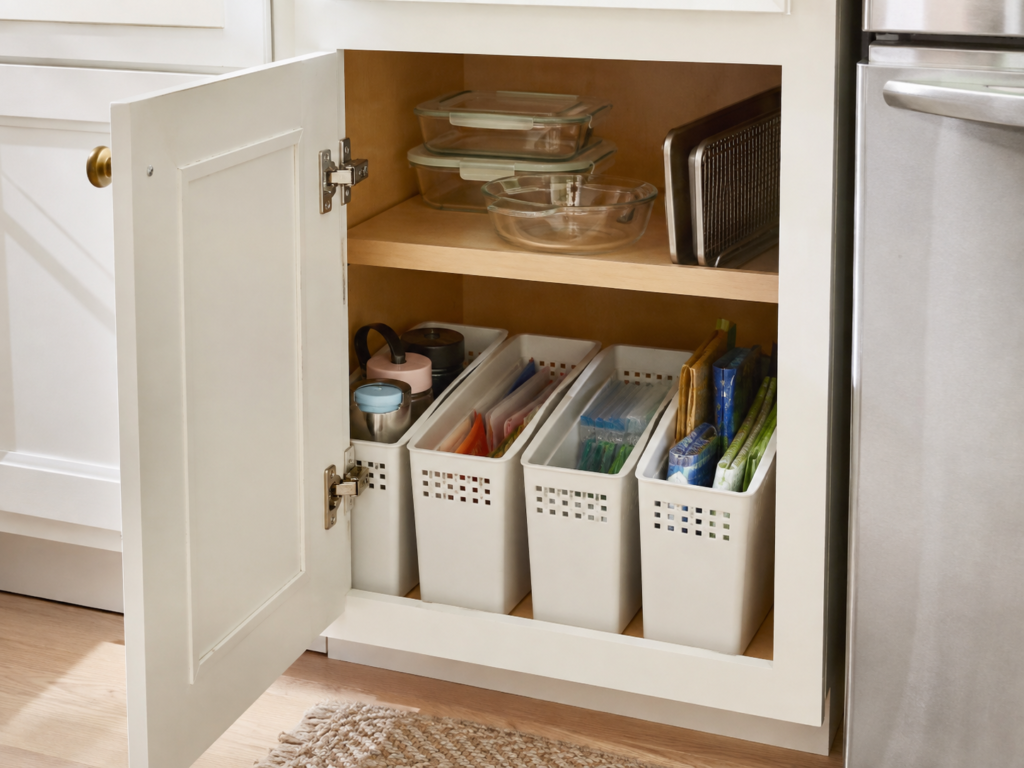
14. Use Narrow Bins for Awkward Spaces
Some cabinets have narrow gaps or shelves that don’t work well for traditional stacks.
Slim bins can help turn those areas into usable storage.
Slim cabinet organizer bins → View on Amazon
They’re useful for:
- Water bottles
- Cutting boards
- Food wraps
- Baking supplies
- Small pantry items
- Reusable bags
The key is matching the organizer to the space.
Measure first.
A slightly-too-wide bin can waste more space than it saves.
15. Leave a Little Empty Space
One of the easiest mistakes to make is trying to use every single inch of every cabinet.
That usually creates cabinets that are technically full but difficult to use.
A little empty space gives you room to:
- Put groceries away
- Add something new
- Remove items without disturbing everything else
- See what you already have
You don’t need to maximize storage at the expense of function.
A cabinet that’s 85% full and easy to use is better than one that’s 100% full and constantly frustrating.
Kitchen Cabinet Organization Ideas That Actually Work
The best kitchen cabinet organization isn’t about making everything look perfect.
It’s about making everyday tasks easier.
If you can quickly grab a pan, find the right lid, pull out a container, and put everything back without rearranging half the cabinet, the system is working.
Start with your most frustrating cabinet.
That might be:
- The cabinet with falling baking sheets
- The food container cabinet
- The deep lower cabinet
- The pantry cabinet
- The cabinet under the sink
Fix that one first.
Then move on.
Small improvements tend to build on each other.
Quick Kitchen Cabinet Problem Solver
Problem: Too much empty vertical space
Try: Shelf risers or under-shelf baskets
Problem: Can’t reach items in the back
Try: Pull-out organizers
Problem: Baking sheets are stacked awkwardly
Try: Vertical dividers
Problem: Pot lids are everywhere
Try: A vertical lid rack
Problem: Small pantry items are scattered
Try: Clear bins
Problem: Cabinets feel crowded
Try: Move rarely used items higher and leave some breathing room
Problem: Food containers are chaotic
Try: Nest containers and store lids separately
Problem: Under-sink cabinet is a mess
Try: Door storage, pull-outs, and vertical organizers
Frequently Asked Questions About Kitchen Cabinet Organization
What is the best way to organize kitchen cabinets?
Start by grouping similar items together and placing frequently used items in the easiest-to-reach locations.
Then use shelf risers, pull-out organizers, vertical dividers, turntables, and bins where they solve a specific storage problem.
The best system is one that makes everyday items easy to find and put away.
How do I organize deep kitchen cabinets?
Pull-out baskets or drawers are one of the best options.
They allow you to bring items in the back of the cabinet forward instead of reaching around everything in front.
Turntables can also work well for bottles and smaller items.
How can I maximize vertical space in kitchen cabinets?
Use shelf risers, stackable organizers, and under-shelf baskets.
Vertical dividers are useful for flat items like cutting boards and baking sheets.
The goal is to use cabinet height without creating unstable stacks.
How should I organize pots and pans?
Nest pots whenever possible and store lids separately.
Vertical lid racks, narrow bins, or cabinet-door organizers can keep lids organized and make the cookware easier to access.
Should I use bins inside kitchen cabinets?
Bins are useful when they contain a specific category and make items easier to pull out.
They work especially well for small pantry items, packets, baking supplies, and reusable bags.
Avoid adding bins everywhere if they reduce usable space.
How do I organize a small kitchen with limited cabinet space?
Prioritize everyday items, use vertical storage, move rarely used pieces out of prime cabinet locations, and use overlooked areas such as cabinet doors and under-shelf space.
For a broader approach, see 17 Small Kitchen Organization Ideas for Maximizing Limited Space.
Make Your Cabinets Easier to Live With
A well-organized cabinet doesn’t need to look like a showroom.
It just needs to make your kitchen easier to use.
Use vertical space where it helps.
Bring deep storage forward.
Store flat items upright.
Keep everyday items within easy reach.
And give yourself enough breathing room that putting something away doesn’t become a puzzle.
Those simple changes can make even a small kitchen feel more organized, more functional, and a lot less frustrating.