
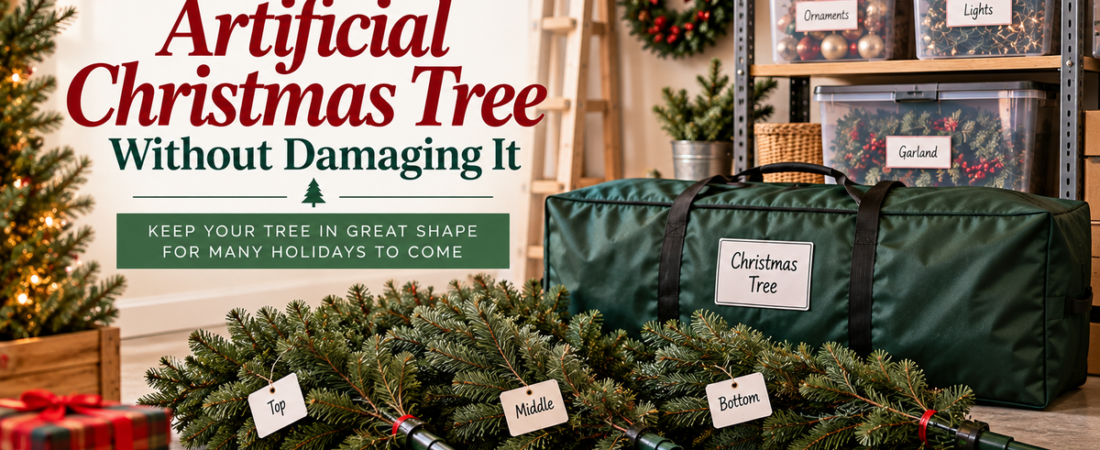
Learning how to store an artificial Christmas tree properly can save you from crushed branches, bent tips, damaged lights, and a tree that somehow takes up twice as much room as it did when you bought it.
The challenge is that artificial trees are awkward.
They are long, bulky, surprisingly heavy, and often difficult to compress without putting stress on branches or wiring. Pre-lit trees add another problem because cords, connectors, and bulbs can be damaged if the sections are packed too tightly.
The right storage method depends on your tree’s size, how it comes apart, where you plan to store it, and how much lifting you want to do every year.
1. Let the Tree Dry Completely Before Storing It
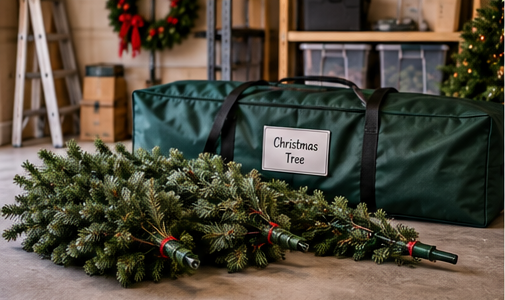
Before packing anything away, make sure the tree is completely dry.
This matters most if the tree was:
- stored near an exterior door
- decorated with artificial snow
- exposed to condensation
- used on a covered porch
- cleaned with a damp cloth
Trapping moisture inside a tree bag or plastic container can create musty odors and encourage mildew on fabric, flocking, or other decorative materials.
If you cleaned the branches, let the tree air-dry fully before compressing and storing it.
2. Remove Every Decoration Before You Start Compressing the Tree
Do not leave ornaments, hooks, garland, ribbon, or loose light accessories attached just because they seem secure.
Small decorations can get buried inside branches and break when the tree is compressed.
Remove:
- ornaments
- ornament hooks
- ribbon
- garland
- tree picks
- loose lights
- extension cords
- tree toppers
- skirts and collars
Store those items separately.
If you need a better overall system for the rest of your holiday decor, see How to Store Christmas Decorations Without Taking Over Your House.
3. Label the Tree Sections Before You Take Everything Apart
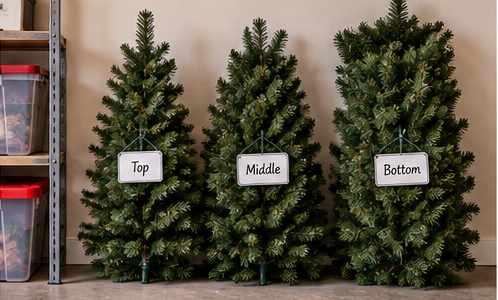
Most artificial Christmas trees break down into several sections.
Labeling them before storage makes next year’s setup easier.
A simple system might be:
- Section A — Bottom
- Section B — Middle
- Section C — Top
You can use removable tags or reusable labels near the trunk connection points.
If your tree has matching electrical connections between sections, avoid covering plugs, sockets, or manufacturer labels.
For pre-lit trees, taking a quick phone photo before disassembly can also help you remember how the sections connect.
4. Measure the Tree Sections Instead of Relying Only on Tree Height
One of the biggest mistakes when choosing artificial tree storage is shopping only by the advertised tree height.
A bag labeled for a 7.5-foot tree does not automatically fit every 7.5-foot tree.
Tree fullness matters.
A slim pencil tree and a wide, full 7.5-foot tree may compress to very different sizes.
Before buying a storage bag, measure:
- length of the longest tree section
- approximate compressed branch diameter
- number of sections
- widest trunk connection
- total tree weight if available
Then compare those measurements with the actual dimensions of the storage bag.
The SWU guide on how to measure for storage organizers is useful here because the same principle applies: measure the object and the storage space, not just the product label.
5. Fold or Compress Branches Gently
Most artificial trees are designed for their branches to fold inward.
That does not mean they should be crushed as tightly as possible.
Start at one end of each tree section and gently bring the branches toward the trunk.
Work gradually around the section.
Avoid:
- sharply bending branch tips
- forcing branches backward
- sitting or kneeling on the tree to compress it
- wrapping straps so tightly that branches permanently bend
- twisting wired branches around each other
A little compression is necessary.
Extreme compression is not.
If the tree has memory-wire or molded branches, follow the direction the branches naturally fold rather than fighting the shape.
6. Be Extra Careful With Pre-Lit Trees
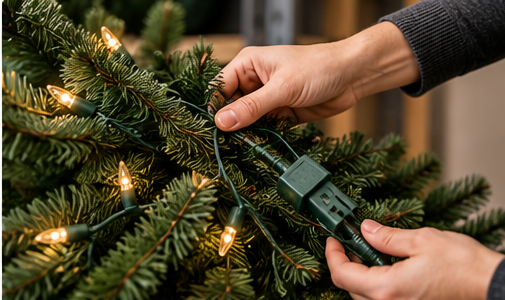
Pre-lit artificial trees need more careful storage because the wiring is built into the branches.
When folding the tree:
- avoid sharp bends in light wires
- keep plugs from being crushed between tree sections
- do not pull branches by the wires
- protect connectors and control boxes
- avoid wrapping compression straps directly over fragile plugs
If possible, position electrical connectors toward the interior of the tree section where they are less likely to catch on the storage bag.
You also want enough room inside the bag that the zipper closes without putting excessive pressure on the branches.
7. Use Storage Straps Before Fighting With the Bag
One simple trick makes tree storage considerably easier:
Secure each tree section before putting it into the bag.
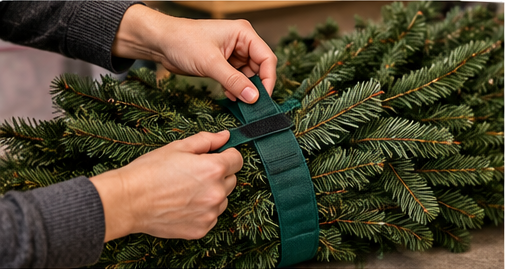
Soft reusable straps can hold branches closer to the trunk while you slide the section into storage.
This prevents branches from constantly springing outward and catching on the zipper.
Do not overtighten them.
The goal is to control the shape—not crush the tree.
Reusable Christmas tree storage straps → Buy on Amazon
8. Choose a Tree Storage Bag That Opens Wide Enough
A narrow zipper opening can turn storing a tree into a wrestling match.
Look for a bag with a wide opening so sections can be lowered or slid inside rather than forced through a small opening.
Useful features include:
- full-length zipper
- reinforced handles
- multiple carrying handles
- durable fabric
- internal or external compression straps
- wheels for heavier trees
- reinforced seams
Artificial Christmas tree storage bag → Buy on Amazon
For small-space storage, the bag dimensions matter just as much as the features.
A huge bag may fit your tree but fail to fit your shelving.
The next article in this holiday cluster will compare the best Christmas tree storage bags for artificial trees by actual dimensions, compatibility, handles, wheels, materials, and storage orientation.
9. Do Not Overstuff the Bag
If you need to sit on the bag to close the zipper, it is probably too small.
Overstuffing can:
- bend branches permanently
- damage flocking
- stress zippers
- crush light bulbs
- bend electrical connectors
- tear seams
A properly sized bag should contain the tree securely without requiring extreme compression.
It is often better to use two smaller bags than one overloaded bag for a particularly large or heavy tree.
10. Consider Two Bags for Large Trees
Large trees become awkward long before they become impossible to fit into one bag.
A 9-foot tree may technically fit in one oversized tree bag, but that bag could be very heavy and difficult to move.
Splitting the tree between two bags can make storage easier if you:
- use stairs
- have narrow doorways
- store the tree overhead
- need to lift it onto shelving
- have limited physical clearance
Two smaller packages can also fit around obstacles better than one enormous bag.
The downside is having two pieces to track and label.
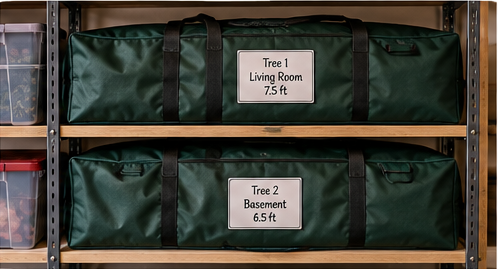
Label both bags clearly so sections stay together.
11. Decide Between Horizontal and Vertical Storage
Most artificial Christmas trees are stored horizontally.
That works well on:
- basement shelves
- garage shelving
- closet floors
- storage-room racks
Horizontal storage is simple, but long bags require a lot of shelf width.
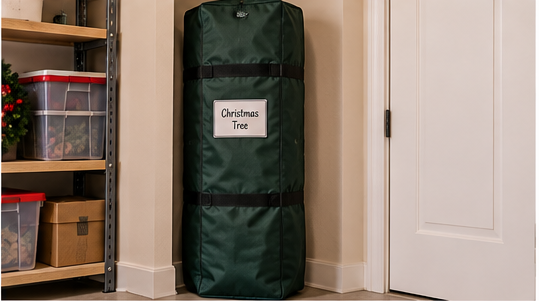
Vertical storage can save floor area if the tree bag is designed for it.
Before storing a tree upright, make sure:
- the bag is designed to stand vertically
- the base is stable
- the tree cannot fall
- the weight is supported properly
- the storage location has enough ceiling height
Do not simply stand a soft horizontal bag on end and hope it stays there.
12. Measure the Storage Location Too
A bag can fit the tree perfectly and still be useless if it does not fit the place where you planned to store it.
Measure:
- shelf width
- shelf depth
- available height
- doorway width
- stair clearance
- space needed to lift the bag into position
This matters especially with wheeled bags, because wheels and handles increase the exterior dimensions.
If your tree will live on high shelving or in another awkward area, the 15 Vertical Storage Ideas for Small Spaces guide may help you rethink where seasonal items can go.
For less obvious storage locations, see 15 Hidden Storage Ideas for Small Homes.
13. Be Careful With Garage and Attic Storage
Artificial trees are commonly stored in garages, attics, and basements.
Whether that is a good idea depends on the tree and the conditions.
Potential issues include:
- extreme heat
- humidity
- rodents
- insects
- dust
- water exposure
Heat can be especially rough on some plastics, adhesives, flocking, and light components.
A sealed or well-constructed bag helps with dust and pests, but it does not control temperature.
If your attic becomes extremely hot during summer, consider storing a valuable or heavily flocked tree somewhere more climate-controlled.
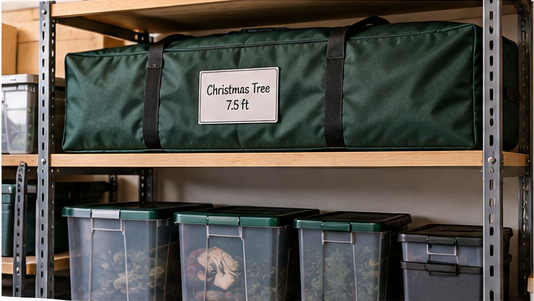
14. Keep the Tree Off a Damp Floor
Basement and garage floors can experience moisture even when the room generally feels dry.
Avoid placing a fabric tree bag directly on concrete if possible.
Store it on:
- shelving
- a raised rack
- a pallet-style platform
- a sturdy elevated storage surface
This also reduces the chance that a minor leak or wet floor reaches the tree bag.
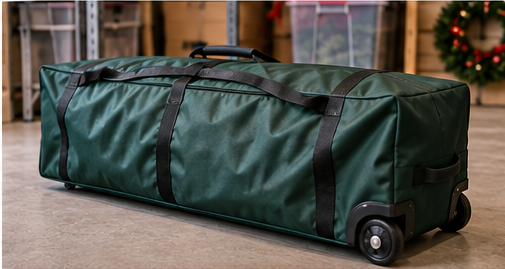
15. Wheels Are Worth Considering for Heavy Trees
Artificial trees can be deceptively heavy.
Once the entire tree is compressed inside one large bag, carrying it may be the hardest part of the process.
A rolling tree storage bag can be useful when the route between the room and storage area includes long flat stretches.
Wheels help most when:
- the tree is large
- the storage area is on the same floor
- you have a long hallway
- you store the tree in a garage
- the bag would otherwise require two people to carry
They help much less when you still need to carry the tree up narrow stairs.
Rolling artificial Christmas tree storage bag → Buy on Amazon
16. Protect Flocked Trees From Excessive Compression
Flocked trees need extra care.
Compressing flocked branches too tightly can cause the artificial snow coating to rub, crack, or shed.
Use a roomy bag and reduce the amount of pressure you place on the branches.
Avoid wrapping the tree tightly in plastic film.
A breathable protective storage bag is usually a better choice because it protects the tree without pressing directly against every branch.
17. Store the Stand With the Tree
Tree stands are surprisingly easy to lose.
Keep the stand:
- inside the tree bag if space allows
- in a small attached accessory pouch
- strapped securely to the outside
- immediately beside the tree bag
Do not toss it into a generic Christmas bin unless that bin is clearly labeled.
Nothing slows down decorating like finding the entire tree and realizing the stand is in another part of the house.
18. Label the Bag Clearly
Even if the tree bag is obviously a tree bag, label it.
Include useful details such as:
Living Room Tree — 7.5 ft — Sections A/B/C + Stand
This becomes especially helpful if you eventually own:
- multiple Christmas trees
- tabletop trees
- porch trees
- spare trees
- different tree stands
The label should tell you exactly what is inside without opening the bag.
A Simple Artificial Christmas Tree Storage Routine
When Christmas is over, use this order:
- Remove all decorations.
- Unplug and inspect pre-lit sections.
- Let the tree dry completely.
- Label the sections.
- Gently fold branches inward.
- Secure sections loosely with storage straps.
- Protect plugs and connectors.
- Place the sections into a properly sized tree bag.
- Add the stand.
- Label the bag.
- Store it off the floor in a dry, appropriate location.
That routine takes a little longer than stuffing the tree back into the original cardboard box.
But it greatly reduces the chances of opening the bag next year to find bent branches, broken lights, or a tree that has been crushed into an unrecognizable shape.
Should You Keep the Original Christmas Tree Box?
You can.
But the original cardboard box is rarely the easiest long-term solution.
Boxes tend to:
- weaken over time
- lose their shape
- require the tree to be compressed exactly like it was at the factory
- offer little protection from moisture
- become difficult to close after the tree has been fluffed
A dedicated tree storage bag is usually easier to handle and more forgiving.
If the original box still works well and fits your storage area, there is no need to replace it immediately.
Looking for more ways to keep holiday decor organized? We rounded up our favorite Christmas storage solutions on Amazon, including practical options for ornaments, lights, wrapping supplies, wreaths, artificial trees, and more—all with small spaces in mind.
Frequently Asked Questions – How to Store an Artificial Christmas Tree
What is the best way to store an artificial Christmas tree?
Disassemble the tree, label the sections, gently fold the branches toward the trunk, protect any light connectors, secure the sections loosely with straps, and place them in a properly sized storage bag. Keep the tree in a dry location and off damp floors.
Can you store an artificial Christmas tree upright?
Yes, but use a storage system specifically designed for upright storage. The tree must remain stable and supported. Do not simply stand a standard horizontal tree bag vertically.
Should I wrap my artificial Christmas tree in plastic?
Plastic can protect against dust, but tightly wrapping the tree can compress branches and may trap moisture. A properly sized fabric tree storage bag is generally more practical for long-term storage.
Can I store an artificial Christmas tree in the garage?
Many people do, but temperature, humidity, pests, and water exposure matter. Durable unflocked trees may tolerate garage storage better than delicate flocked or heavily pre-lit trees.
How do you store a pre-lit artificial Christmas tree?
Avoid sharply bending the light wires, protect plugs and connectors, fold branches gently, and use a roomy storage bag so the lights are not crushed.
How do you keep an artificial Christmas tree from getting crushed in storage?
Do not overcompress the branches or overfill the bag. Choose a bag large enough for the compressed tree sections, use light straps to control the branches, and avoid stacking heavy objects on top of the tree.
Should I buy a storage bag based on tree height?
Tree height is only a starting point. Measure the longest section and the approximate compressed branch diameter because two trees with the same advertised height can have very different storage volumes.