
Storage organizers are surprisingly easy to buy wrong, so here is how to measure for storage organizers.
A bin can fit perfectly between two cabinet walls but still be impossible to pull out.
A shelf riser can fit the width of a cabinet but leave no room for the plates sitting on top.
An under-sink organizer can match the cabinet dimensions and immediately collide with the drain pipe.
A closet drawer unit can fit inside the closet but refuse to open because the sliding door blocks half of it.
The problem is that “Does it fit?” and “Will it actually function?” are two different questions.
Learning how to measure for storage organizers before you buy can save you from wasted money, returns, and a house full of products that technically fit but make your storage harder to use.
This guide walks through the measurements that matter, the clearances people commonly forget, and how to match organizer dimensions to the real usable space inside cabinets, closets, shelves, pantries, and other tight areas.
Start With Usable Space, Not Total Space -How to Measure for Storage Organizers Correctly
This is the most important idea in the entire guide.
The inside of a cabinet may measure:
- 30 inches wide
- 22 inches deep
- 24 inches high
That does not automatically mean you have a usable 30 × 22 × 24-inch storage area.
Inside that space may be:
- hinges
- plumbing
- shelf supports
- door frames
- trim
- electrical outlets
- drawer slides
- pipes
- protruding hardware
Those reduce the amount of space an organizer can actually occupy.
So whenever you measure storage, think in terms of:
Total dimensions
The overall dimensions of the space.
Usable dimensions
The dimensions available after accounting for obstructions and movement.
Organizers should be chosen from the second set of numbers.
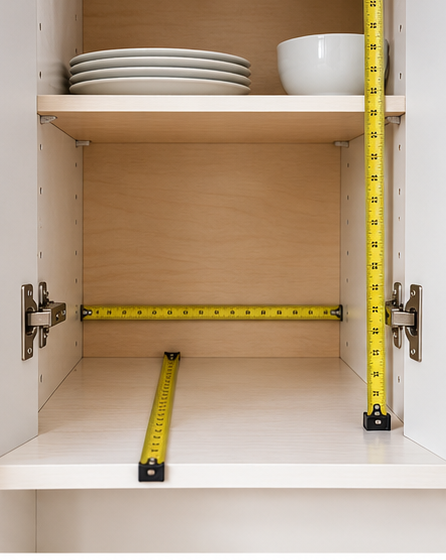
The 3 Basic Measurements: Width, Depth and Height
Almost every storage organizer requires three basic measurements.
Width
Measure horizontally from side to side.
Don’t measure only once.
Measure:
- near the front
- near the middle
- near the back
This matters in older cabinets, closets, and alcoves where walls may not be perfectly square.
If the measurements differ, use the smallest usable width.
Depth
Measure from the front of the usable storage area to the back.
But think about whether the organizer needs to move.
For example, a pull-out bin may need almost the full depth.
A turntable may need much less.
A storage bin placed on a deep pantry shelf may technically fit the full depth but become annoying if you have to pull it completely out every time you want something from the back.
Height
Measure from the supporting surface to the lowest obstruction above it.
That might be:
- the shelf above
- a pipe
- a drawer bottom
- a closet rod
- hanging clothing
Use the lowest point that affects the organizer.
Measure the Opening Separately From the Interior
This is one of the most common storage mistakes.
A cabinet can be wider inside than it is at the opening.
Imagine a lower kitchen cabinet with:
Interior width: 24 inches
Opening width: 21 inches
A 23-inch-wide organizer might fit beautifully inside.
The problem?
You may not be able to get it through the opening.
This matters particularly for:
- pull-out cabinet organizers
- bins
- drawer systems
- under-sink shelves
- large baskets
- rigid turntables
Measure the narrowest part of the opening separately.
If the organizer needs to be inserted through that opening, the opening dimension may matter more than the interior dimension.
This is especially important for kitchen cabinetry. Our 15 Kitchen Cabinet Organization Ideas That Make Every Shelf Work Harder includes several organizer types where cabinet geometry directly affects whether the solution works.
Account for Hinges
Cabinet hinges are small, but they can ruin the fit of an organizer.
A bin may fit between the cabinet walls but collide with the hinge every time you pull it forward.
A slide-out organizer may need to be shifted several inches inward.
A shelf unit may need enough clearance to pass around the hinge.
Measure how far the hinge protrudes into the usable space.
Then determine whether the organizer will:
- remain behind the hinge
- pass beside it
- slide past it
- collide with it
This is one reason it’s risky to buy an organizer that matches the cabinet width almost exactly.
A little clearance can make the difference between fits and functions.
Measure Door Clearance
Storage products don’t remain frozen in place.
Doors move.
Drawers move.
Bins slide.
Turntables rotate.
Before buying an organizer, ask:
What needs to move around this product?
For a cabinet, open the door fully.
Measure how far it swings into:
- the room
- an adjacent cabinet
- the organizer itself
For furniture with doors or drawers, measure the space required when they’re completely open.
A 12-inch-deep storage cabinet may require 24 or 30 inches of usable floor space once the door or drawer is open.
This matters enormously in:
- small bathrooms
- narrow kitchens
- bedrooms
- closets
- laundry rooms
A product that fits when closed can still make the room unusable when opened.
Check for Baseboards and Trim
Floor-level measurements are often smaller than measurements higher on the wall.
Why?
Baseboards.
A narrow shelving unit may appear to fit a 10-inch gap when measured at waist height.
Then you slide it into place and discover the baseboard reduces the opening to 9¼ inches.
The same thing can happen with:
- door trim
- window trim
- cabinet molding
- floor transitions
For freestanding organizers, always measure at the actual height where the product will sit.
Don’t assume the wall is perfectly flat from floor to ceiling.
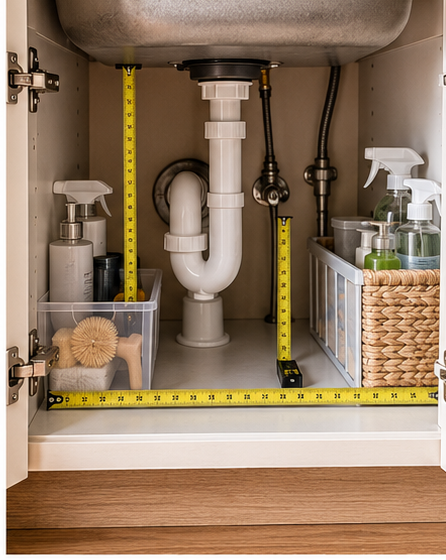
Measure Under-Sink Plumbing as Its Own Obstacle
Under-sink cabinets require a different strategy.
You cannot measure them like an empty rectangular box.
Plumbing divides the interior into irregular usable zones.
Adjustable under-sink organizer → Buy on Amazon
Measure:
- cabinet width
- cabinet depth
- cabinet height
- drain pipe location
- water supply lines
- disposal dimensions if present
- valves
- pipe distance from side walls
- pipe distance from cabinet floor
It can help to sketch the cabinet.
For example:
Cabinet: 30 inches wide
Drain: 14 inches from left wall
Pipe clearance: 8 inches beneath drain bend
Now you know a full-width shelf probably isn’t appropriate.
You may need:
- two narrow organizers
- an adjustable U-shaped shelf
- pull-outs positioned around the pipes
For a deeper look at this specific constraint, see our 15 Under-Sink Organization Ideas That Maximize Every Inch.
Measure Shelf Spacing
Shelf spacing matters whenever you’re adding:
- shelf risers
- stacked bins
- baskets
- tiered organizers
Measure the distance between shelves.
Then measure the height of the actual items you’re planning to store.
Suppose you have:
Shelf clearance: 12 inches
Shelf riser height: 6 inches
That sounds reasonable.
But if the plates or containers placed on the riser are 7 inches tall:
6 + 7 = 13 inches
Your setup doesn’t fit.
Always combine the organizer dimensions with the dimensions of the stored item.
You’re not measuring for the empty organizer.
You’re measuring for the organizer while it’s being used.
Measure the Items You Want to Store
This step gets skipped all the time.
People measure the shelf but not the stuff going on it.
Before choosing bins or organizers, measure representative items from the category.
For pantry bins, measure:
- cereal boxes
- snack bags
- pasta boxes
- jars
- cans
For closet organizers:
- folded sweaters
- shoes
- handbags
- hanging garments
For kitchen organizers:
- plates
- pans
- cutting boards
- food containers
The storage product should match both:
the space
and
the thing being stored
That’s why universal recommendations like “buy 12-inch pantry bins” aren’t particularly useful.
The correct size depends on the shelf and the inventory.
For more pantry-specific applications, see our 21 Small Pantry Organization Ideas That Actually Save Space.
Exterior Dimensions vs. Usable Interior Dimensions
This distinction is easy to miss when shopping online.
A storage bin advertised as:
12 × 8 × 6 inches
may have exterior dimensions of 12 × 8 × 6.
But the inside might be noticeably smaller because of:
- tapered sides
- thick walls
- handles
- lids
- rounded corners
That matters when you’re trying to store something with rigid dimensions.
For example, an 11-inch-wide object does not necessarily fit inside a bin with a listed width of 12 inches.
Check whether the manufacturer provides:
- exterior dimensions
- interior dimensions
- base dimensions
For tapered baskets and bins, the bottom can be several inches narrower than the top.
Handles Count as Part of the Organizer
Handles are another sneaky measurement problem.
A bin itself may be 10 inches wide.
But molded handles may make the overall width 11½ inches.
That difference matters in a narrow cabinet.
Handles can also affect depth.
A pull-out bin with a large front handle may protrude farther than the listed body dimensions.
When possible, look for diagrams showing the maximum exterior dimensions.
If they aren’t provided, product-review photos can sometimes reveal how far handles protrude.
Leave Clearance Instead of Buying an Exact Fit
Suppose a shelf opening measures exactly 16 inches wide.
Should you buy a 16-inch organizer?
Usually not.
Real homes aren’t engineered laboratories.
Shelves flex.
Walls bow.
Products have manufacturing tolerances.
Your hand needs room to grip the organizer.
Leave some working clearance.
There isn’t one universal amount because the right clearance depends on how the product works.
A stationary shelf may need relatively little.
A sliding bin needs more.
A turntable needs room to rotate.
A basket needs enough space to lift.
A drawer needs enough space not to scrape.
Think about movement, not merely dimensions.
Measure for Pull-Out Organizers Differently
Pull-outs are particularly sensitive to measurements.
Cabinet pull-out organizer → Buy on Amazon
Check:
Cabinet opening width
Not just interior width.
Interior depth
Make sure the slides fit.
Hinge clearance
The pull-out must pass the hinges.
Door opening angle
The door needs to open far enough for the pull-out to clear it.
Plumbing or other obstructions
Especially under sinks.
Mounting surface
Some organizers mount to the cabinet floor. Others attach to shelves or walls.
A pull-out organizer that is ½ inch too wide may be completely unusable.
This is one product category where measuring twice is absolutely worth the effort.
Measure for Turntables by Diameter
Turntables are round.
Cabinets and shelves usually aren’t.
A 12-inch turntable requires a square area at least slightly larger than 12 × 12 inches to rotate freely.
If the turntable has raised handles or lips, those can also affect clearance.
For corner cabinets, make sure the door opening allows you to insert the turntable in the first place.
Remember that round organizers naturally leave some unused corner space.
That’s not necessarily inefficient.
If rotating the organizer makes the stored items significantly easier to reach, the tradeoff may be worth it.
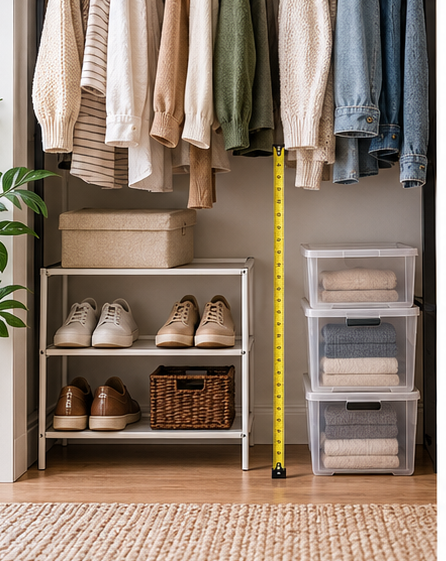
Measure Closet Hanging Space With Clothes on the Rod
Closets create another misleading empty-space measurement.
An empty closet might have 40 inches between the rod and floor.
But once shirts are hanging from the rod, much of that space disappears.
Measure actual hanging clothes.
For example:
Rod-to-floor: 40 inches
Average shirt length: 27 inches
Usable storage beneath shirts: about 13 inches
That measurement determines whether you can add:
- shoe storage
- drawers
- bins
- another hanging rod
If you’re trying to make a tight closet work harder, our 17 Small Closet Organization Ideas That Make the Most of Limited Space covers additional ways to use rods, shelves, doors, and floor space.
Measure Under-Bed Clearance at the Lowest Point
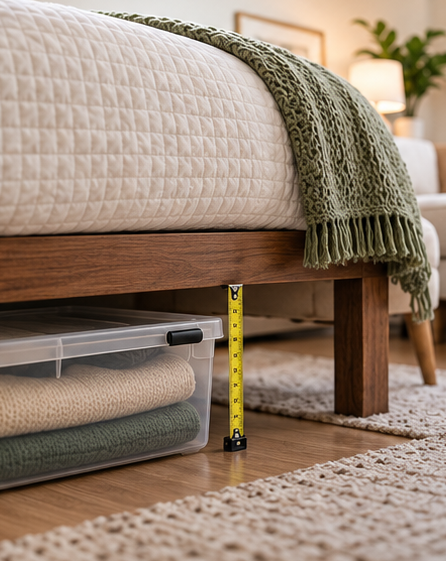
Under-bed storage looks straightforward.
Measure floor to bed frame.
Buy bin.
Low-profile under-bed storage bins → Buy on Amazon
Done.
Except many bed frames have:
- center supports
- cross rails
- slats
- hardware
that hang lower than the outer frame.
Measure at multiple points beneath the bed.
Use the lowest clearance that the bin must pass beneath.
Also check:
- bin handle height
- lid thickness
- floor covering
A bin that clears hardwood may drag across a thick rug.
If the container has wheels, account for the wheel height as part of the total product height.
Think About Weight, Not Just Size
A giant bin may fit beautifully.
Then you fill it with canned goods and discover you can barely lift it.
The amount of storage a container provides is not the same thing as the amount you can comfortably use.
For heavy categories such as:
- canned food
- books
- tools
- cleaning products
smaller bins may be more functional than one huge container.
Also check:
- shelf weight limits
- drawer capacities
- wall-anchor ratings
- organizer weight capacities
This becomes particularly important with wall-mounted and pull-out storage.
Check Stackability Before Planning Vertical Storage
Some containers are designed to stack.
Others technically stack but become unstable.
If vertical storage is part of your plan, look at:
- lid shape
- bottom shape
- locking features
- maximum recommended stack height
- access when stacked
Ask how you will retrieve the bottom container.
A stack of four bins may fit the shelf perfectly but require removing three containers every time you need something from the bottom.
Vertical space is useful only when access remains reasonable.
Write the Measurements Down
Don’t trust yourself to remember them while shopping.
Use your phone or a simple storage measurement note.
For each space, record something like:
Kitchen lower cabinet
- Opening width: 18¼”
- Interior width: 21″
- Usable depth: 20½”
- Height: 23″
- Left hinge intrusion: 1½”
- Door opens fully: yes
That gives you much better information than:
“Cabinet is around 20 inches.”
Keep the measurements with you while shopping online or in stores.
You can even take a photo of the storage area so you remember where obstacles are located.
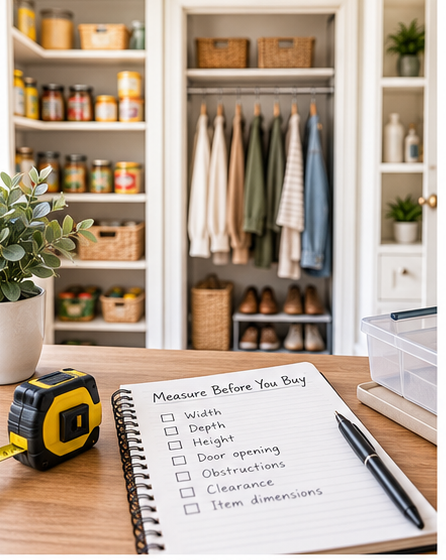
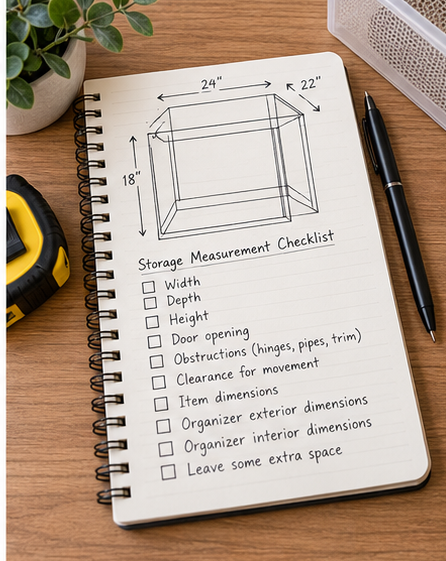
A Simple Storage Measurement Checklist
Before buying an organizer, record:
Space measurements
- Width
- Depth
- Height
Opening measurements
- Door or cabinet opening width
- Opening height
Obstructions
- Hinges
- Plumbing
- Trim
- Baseboards
- Electrical outlets
- Shelf supports
Movement
- Door swing
- Drawer extension
- Bin removal
- Turntable rotation
- Pull-out travel
Stored-item measurements
- Item width
- Item height
- Item depth
Organizer details
- Exterior dimensions
- Interior dimensions
- Handle dimensions
- Required installation clearance
- Weight capacity
If all of those work together, you have a much better chance of buying the right product the first time.
Common Storage Measuring Mistakes
These are the mistakes most likely to cause problems.
Measuring only once
Widths can vary from front to back.
Measuring the cabinet but not the opening
Large organizers may not fit through the door frame.
Ignoring hinges
Pull-outs and bins often collide with them.
Forgetting baseboards
Freestanding storage may not sit flush against the wall.
Measuring an empty closet
Hanging clothes reduce usable space.
Ignoring plumbing
Under-sink cabinets aren’t empty rectangles.
Buying an exact fit
Most functional organizers need clearance.
Ignoring stored-item dimensions
The organizer may fit while the stuff inside it doesn’t.
Ignoring movement
Drawers, doors and bins require space to operate.
Assuming listed dimensions mean usable dimensions
Exterior dimensions can be substantially larger than interior capacity.
When a Custom Fit Isn’t Necessary
You do not need every organizer to perfectly fill the available space.
Sometimes using 16 inches of an 18-inch shelf is better than forcing in an organizer that barely moves.
Storage efficiency is not:
percentage of space physically occupied
It’s:
how easily the space lets you store and retrieve what you need
A little unused clearance can improve:
- visibility
- airflow
- movement
- cleaning
- access
Empty space isn’t always wasted space.
For broader ways to think about making limited storage more functional, see our 25 Storage Ideas for Small Homes That Make Every Inch Count.
Measure Before You Shop, Not After
The wrong order is:
See organizer → love organizer → buy organizer → figure out where it fits
The better order is:
Identify storage problem → measure space → measure items → determine required function → find organizer
That changes storage shopping from guesswork into a decision.
You know:
- how much space you have
- what obstacles exist
- what you’re storing
- how the organizer needs to move
- what dimensions will actually work
Then you can evaluate products instead of hoping.
Frequently Asked Questions
How much smaller should an organizer be than the space?
There is no universal clearance because it depends on the organizer. Stationary shelves may need relatively little clearance, while pull-out bins, turntables and removable baskets need enough room to move comfortably. Avoid choosing a product that exactly matches the available dimensions unless the manufacturer specifically designed it for that space.
Do I measure the inside or outside of a cabinet?
Measure both the interior storage area and the cabinet opening. The interior tells you what can fit once inside, while the opening determines what can physically pass through the cabinet frame.
How do I measure around pipes under a sink?
Measure the cabinet first, then record the location and dimensions of each plumbing obstruction. Note how far pipes sit from the side walls, cabinet floor and back wall. Choose organizers that work around those usable zones rather than assuming the entire cabinet is available.
Should storage-bin dimensions include the handles?
Yes. Use the organizer’s maximum exterior dimensions, including handles, lids, wheels and other protruding parts, when determining whether it will fit.
How do I measure for under-bed storage?
Measure from the floor to the lowest obstruction beneath the bed, not just the outer frame. Also measure the available width and depth between legs, rails and supports.
Why do organizers sometimes fit but still not work?
Because fit only describes whether the product occupies the space. Function also depends on clearance for doors, hinges, handles, drawers, rotation, lifting and removal.
The Best Organizer Is the One That Actually Functions
Storage products don’t create good organization simply because they fit into an empty space.
The organizer needs to work with:
- the room
- the cabinet
- the opening
- the obstacles
- the stored items
- the way you access them
Measure all three dimensions.
Measure the opening.
Look for hinges, plumbing and trim.
Think about doors and drawers moving.
Measure the actual things you’re trying to store.
And leave enough clearance for normal use.
Five minutes with a tape measure before shopping can save you from an organizer that spends the next three years sitting in a closet because it almost worked.