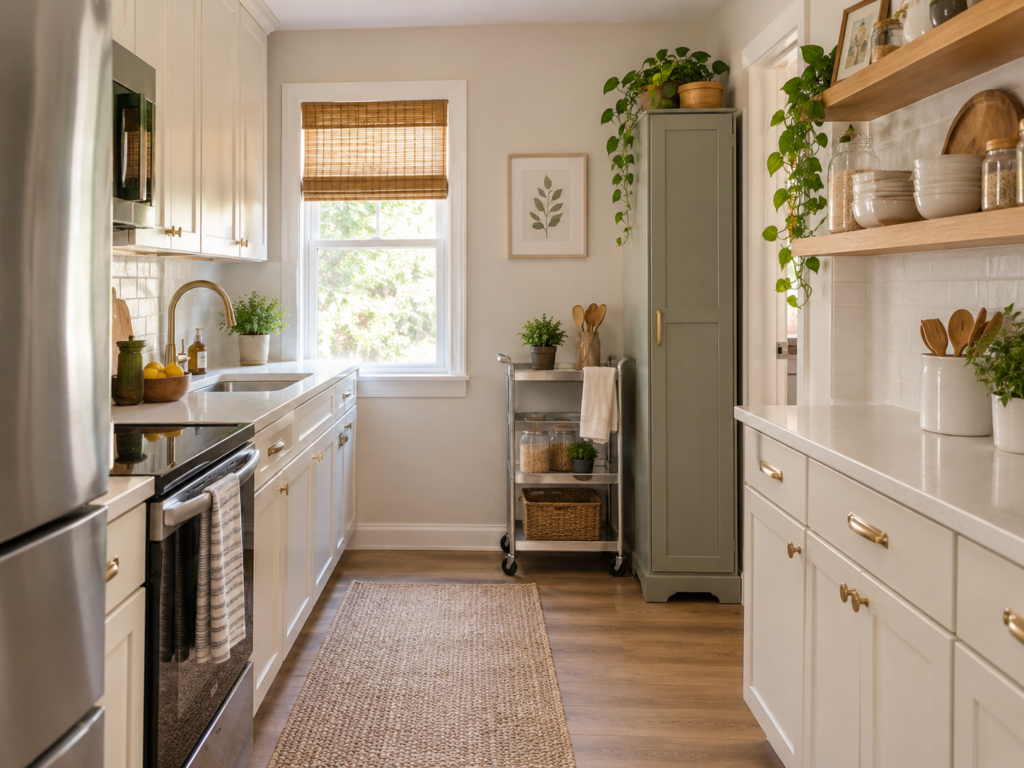
A small kitchen can be perfectly functional right up until the cabinets run out of room.
This is why it’s important to know how to organize a kitchen with too little cabinet space.
Then everything starts migrating.
Mugs live on the counter.
Food gets stacked on top of appliances.
Pans are jammed into one cabinet.
Plastic containers avalanche every time you open another.
And eventually the kitchen feels messy even when you technically have everything “put away.”
If your kitchen has too little cabinet space, the goal is not to force every item into the existing cabinets.
The better approach is to:
- make the cabinets you do have work harder
- move certain categories into better storage
- use vertical and overlooked space
- keep daily-use items accessible
- stop using valuable cabinet space for low-priority items
Here’s how to organize a kitchen when your actual cabinet capacity is limited.
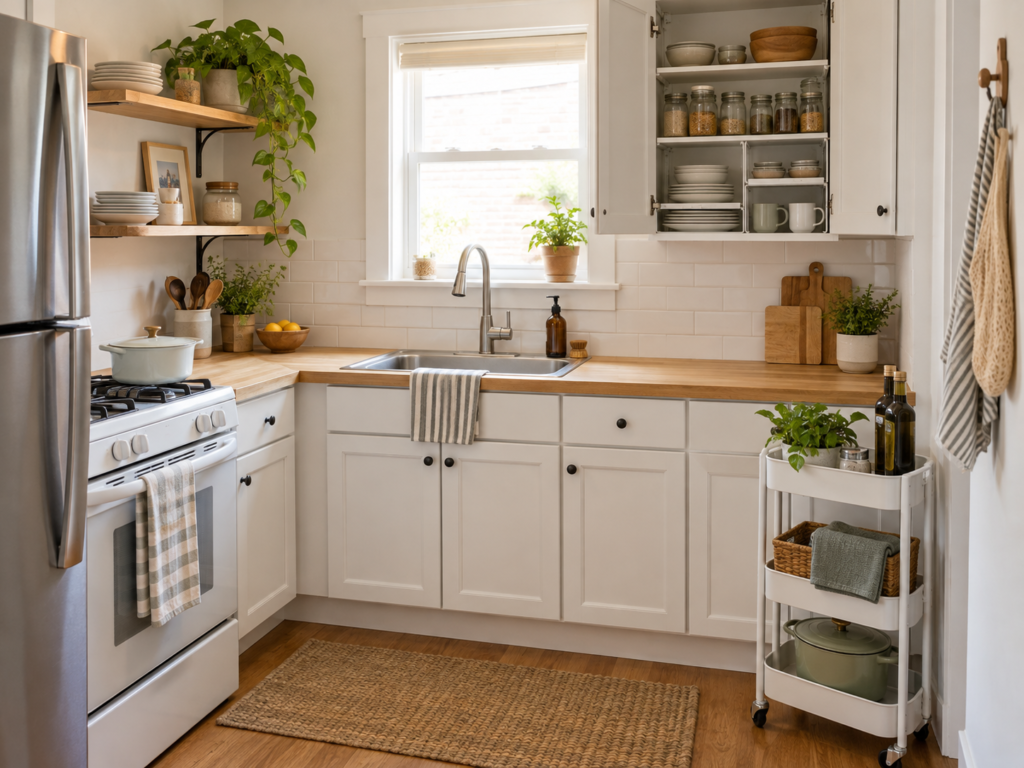
Start by Figuring Out What Is Using Your Cabinet Space – How to Organize a Kitchen with too Little Cabinet Space
Before adding organizers, empty the worst cabinet first.
Not the entire kitchen.
Just the cabinet that makes you angry every time you open it.
Take everything out and sort it into categories:
- cookware
- food
- dishes
- mugs
- storage containers
- baking supplies
- appliances
- cleaning supplies
- rarely used items
Then ask:
Does this item actually need cabinet space?
That question matters because cabinets are some of the most valuable storage in a kitchen.
A cabinet should not automatically become the home for anything that fits inside it.
Some items may work better:
- on a wall
- in a pantry
- on a cart
- in a drawer
- on an open shelf
- on a rack
- somewhere outside the kitchen
If you’re short on cabinet space, you have to be more selective about what gets that prime storage.
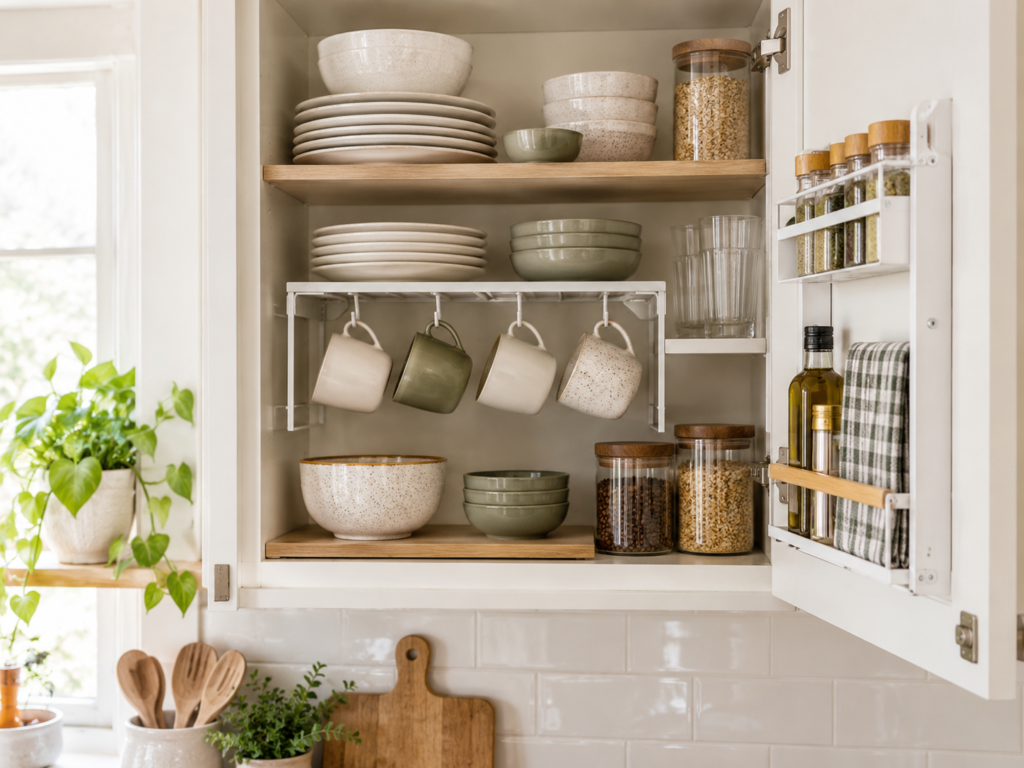
1. Use Shelf Risers Inside Cabinets
One of the most common cabinet problems is wasted vertical space.
You place plates or mugs on the bottom shelf, and several inches of empty air sit above them.
A shelf riser creates another level.
Use them for:
- dishes
- bowls
- mugs
- canned goods
- jars
- pantry staples
The most useful risers are the ones that match the width and height of the cabinet.
Before buying one, measure:
- cabinet width
- shelf depth
- vertical clearance
- height of the items going underneath
- height of the items going on top
You don’t want to create a second shelf that technically fits but leaves too little clearance to remove anything.
Adjustable cabinet shelf riser → Buy on Amazon
2. Add Hooks Under Shelves
Mugs often consume an absurd amount of cabinet space.
If you have open space beneath a cabinet shelf, under-shelf hooks can create hanging storage.
They work well for:
- mugs
- measuring cups
- lightweight utensils
- small kitchen tools
This is useful when shelf space is limited but there is unused vertical room.
Just make sure the hooks do not interfere with whatever is stored below.
The goal is to add another usable layer, not create a cabinet where everything bumps into everything else.
3. Use the Inside of Cabinet Doors
Cabinet doors are another overlooked storage surface.
Depending on the cabinet, you can add:
- adhesive hooks
- slim racks
- cutting board holders
- measuring spoon storage
- lid organizers
- cleaning-supply holders
This works especially well for shallow items.
But measure the interior carefully.
A door-mounted organizer needs enough clearance to close without hitting shelves or the items inside.
If it protrudes too far, the door may never close properly.
For more cabinet-specific ideas, see our 15 Kitchen Cabinet Organization Ideas That Make Every Shelf Work Harder.
4. Move Pantry Foods Out of Prime Cabinet Space
If your kitchen cabinets are packed with food, ask whether all of it needs to stay there.
Dry goods can often be stored elsewhere.
Depending on your home, that might mean:
- a nearby pantry
- a freestanding cabinet
- a rolling cart
- a narrow shelf
- a dining-area storage unit
Reserve the best kitchen cabinets for things that benefit from being close to the cooking area.
If food storage is consuming most of the room, our 21 Small Pantry Organization Ideas That Actually Save Space can help you free up cabinet capacity by using pantry space more efficiently.
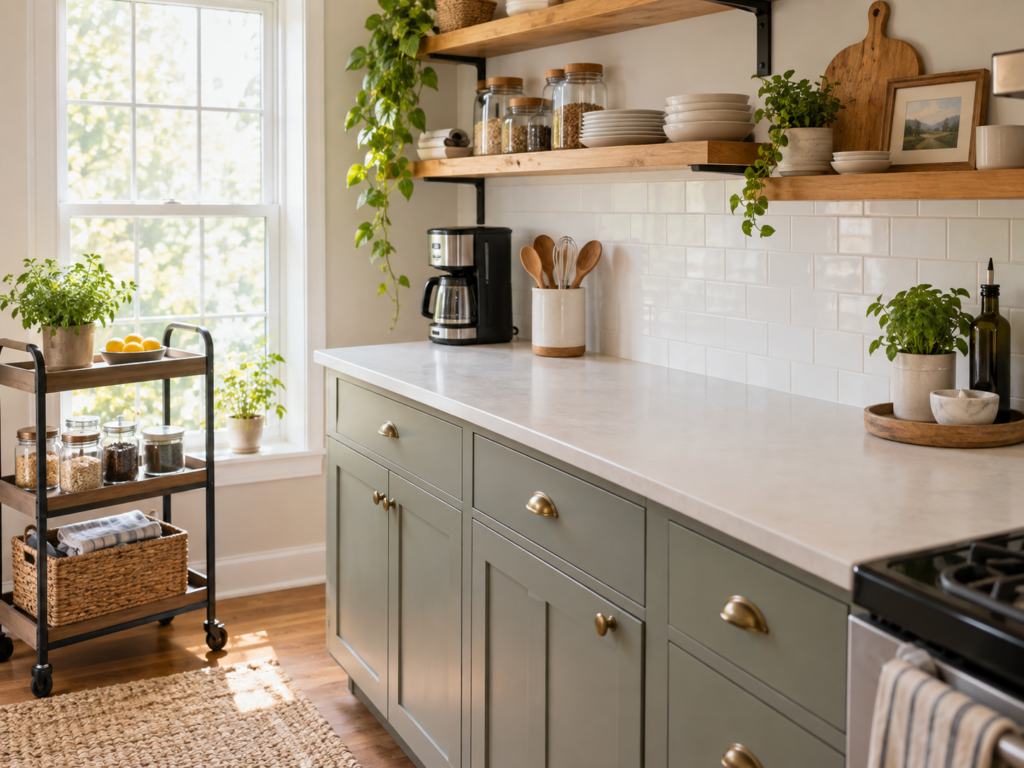
5. Use a Rolling Kitchen Cart
A rolling cart can function like a movable extra cabinet.
Use it for:
- pantry staples
- small appliances
- mixing bowls
- baking supplies
- cookware
- produce
The advantage is flexibility.
You can roll it beside the prep area when needed and move it out of the way afterward.
Measure the cart footprint carefully.
In a narrow kitchen, even a few extra inches of width can interfere with circulation.
Also think about whether the shelves are open or enclosed.
Open carts keep items easy to grab but can look cluttered faster.
Closed carts hide more visual mess but may feel bulkier.
Narrow rolling kitchen cart → Buy on Amazon
6. Put Rarely Used Appliances Somewhere Else
Small kitchens often sacrifice an entire cabinet to appliances used three times a year.
Think about:
- slow cookers
- waffle makers
- specialty blenders
- large serving pieces
- seasonal bakeware
- oversized roasting pans
If an item is rarely used, it does not need premium kitchen storage.
Move it to:
- a pantry
- utility closet
- garage shelf
- basement storage
- high shelf
- other appropriate household storage
Keep the most accessible cabinets for things that support everyday cooking.
This one change can sometimes free an entire shelf or cabinet.
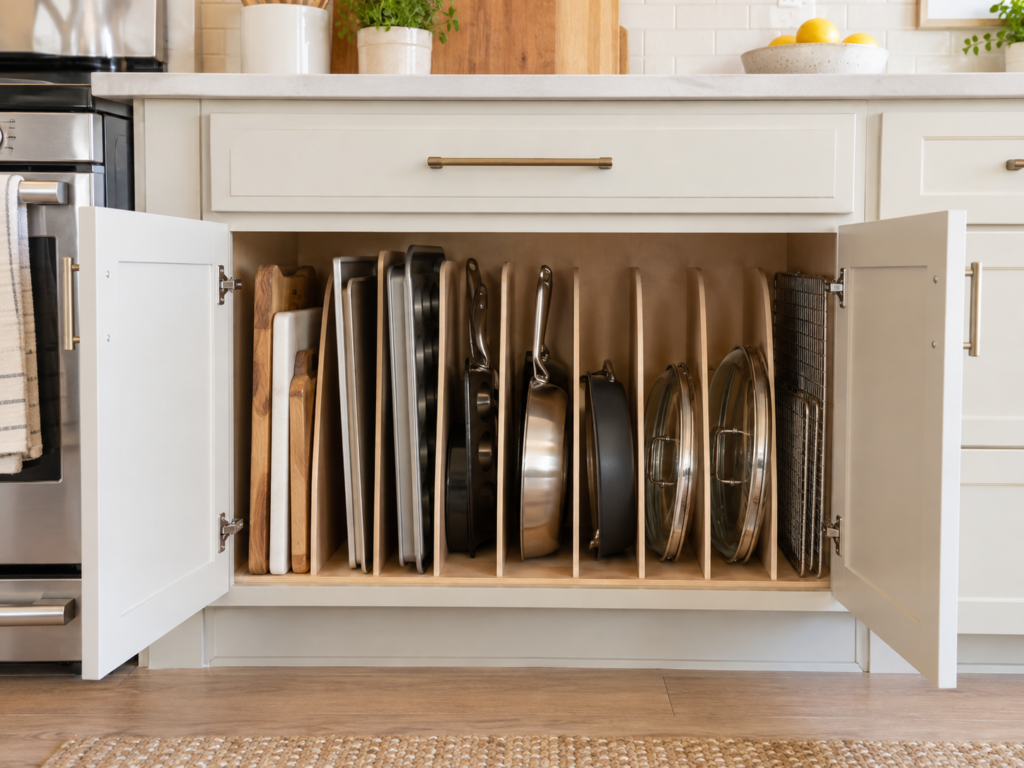
7. Use Vertical Dividers for Pans and Cutting Boards
Pans, baking sheets and cutting boards become difficult to store when they are stacked horizontally.
Vertical dividers let you stand them upright.
This makes it easier to:
- see each item
- remove one without moving the rest
- use narrow cabinet sections
- keep lids from piling up
Before adding dividers, measure the cabinet height.
Large baking sheets need more clearance than cutting boards or pan lids.
Vertical cabinet divider → Buy on Amazon
8. Use Pull-Out Storage in Deep Cabinets
Deep lower cabinets can technically hold a lot.
The problem is that the back becomes hard to reach.
Pull-out baskets or drawers bring that space forward.
They work well for:
- pots
- pans
- food containers
- pantry staples
- cleaning supplies
Measure carefully before buying.
You need to account for:
- cabinet opening width
- hinges
- interior depth
- shelf supports
- door clearance
A pull-out organizer must fit through the opening, not just inside the cabinet box.
This is especially important when the cabinet frame is narrower than the interior.
Cabinet pull-out organizer → Buy on Amazon
9. Use Open Shelves for Everyday Items
If wall space is available, open shelves can move frequently used items out of cabinets.
Good candidates include:
- everyday dishes
- mugs
- glasses
- bowls
- frequently used jars
This can free cabinet space while keeping the kitchen functional.
But open shelves work best when they remain relatively edited.
If every shelf is packed wall-to-wall with mismatched items, the kitchen can feel more cluttered.
Use them for items you actually use often, not as a dumping ground.
10. Use the Space Above Upper Cabinets
If your cabinets do not reach the ceiling, the area above them can hold low-frequency items.
Use it for:
- baskets
- serving pieces
- seasonal items
- large bowls
- lightweight appliances
This is not ideal for daily-use items because it is harder to reach.
That makes it better for backup or occasional storage.
Keep the area visually contained.
A few coordinated baskets usually look better than dozens of loose objects lined across the top.
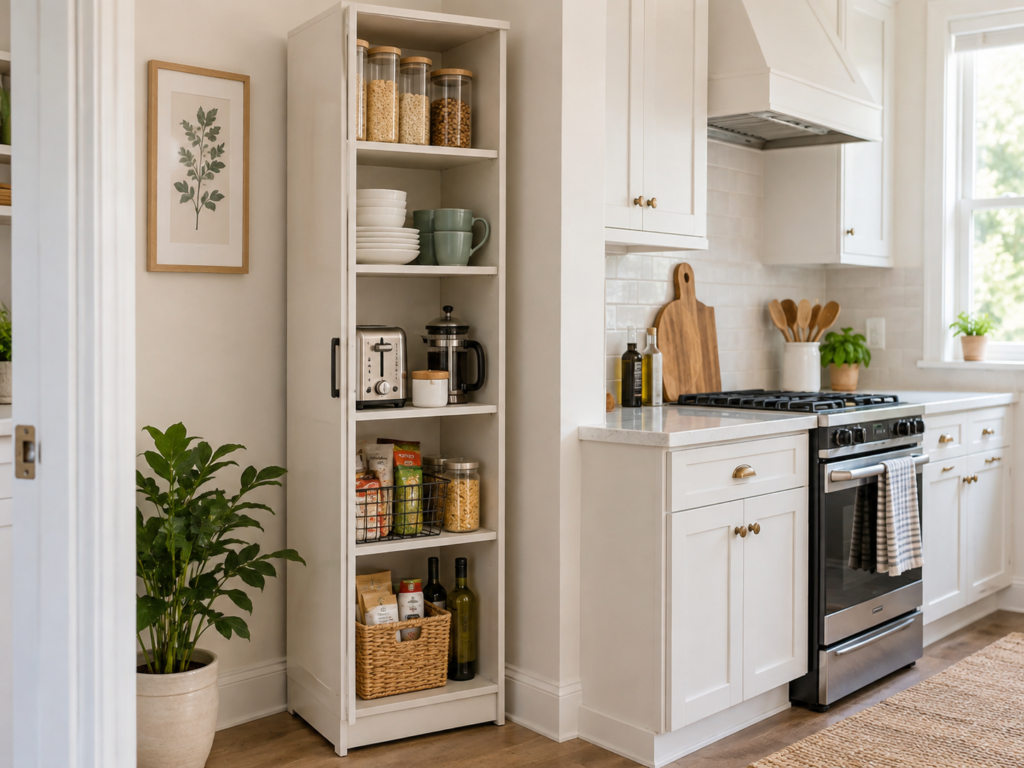
11. Add a Narrow Freestanding Pantry
If you have a slim unused wall or gap, a freestanding pantry cabinet can add a significant amount of storage.
Even a relatively narrow unit can hold:
- canned food
- snacks
- baking supplies
- small appliances
- dishes
- cleaning supplies
Measure the floor footprint carefully.
Also check:
- door swing
- baseboards
- walkway clearance
- nearby outlets
- whether the unit needs anti-tip hardware
A narrow cabinet that blocks traffic is not an improvement.
Tall narrow pantry cabinet → Buy on Amazon
12. Use the Refrigerator Sides Carefully
The refrigerator side can sometimes support magnetic storage.
Possible uses include:
- spice racks
- paper towel holders
- small baskets
- magnetic shelves
Keep the storage shallow.
A deep organizer can interfere with walkways or cabinet doors.
And do not block appliance ventilation.
Check the refrigerator manufacturer’s clearance recommendations before placing storage tightly against the unit.
13. Use Drawer Space for Things Currently in Cabinets
Sometimes the cabinet is crowded because the drawers are underused.
Look at whether drawers can take over storage for:
- utensils
- lids
- wraps
- bags
- small tools
- spices
- food-storage accessories
A well-divided drawer can often hold more than a loose cabinet shelf.
This is especially useful if small items are currently scattered through larger cabinets.
14. Store Food Containers More Efficiently
Food-storage containers can eat up an entire cabinet.
Separate containers from lids.
Nest containers by size.
Store lids vertically.
Discard mismatched pieces.
If a cabinet is filled with 40 containers but you use eight of them, the storage problem may partly be inventory.
This is another place where less can be more useful than another organizer.
15. Keep Counters Mostly Clear
When cabinet space disappears, the counter becomes overflow storage.
That is understandable.
But once the counter fills with appliances, jars and supplies, the kitchen becomes harder to use.
Try to keep only daily-use items on the counter.
That might include:
- coffee maker
- knife block
- utensil crock
- one small appliance
Move everything else into the storage system you are creating.
The goal is not an empty counter.
It is enough clear space to prep food comfortably.
16. Move Cleaning Supplies Out of Kitchen Cabinets
Under-sink cabinets are often packed with cleaning supplies.
If your kitchen is short on cabinet space, some of those products may be better stored elsewhere.
For example:
- laundry room
- utility closet
- garage
- bathroom
- centralized cleaning-supply area
Keep only the products you routinely use in the kitchen.
If plumbing makes your under-sink cabinet especially difficult, see our 15 Under-Sink Organization Ideas That Maximize Every Inch.
17. Stop Storing Duplicates in Prime Space
Backup items add up quickly.
Three bottles of oil.
Four bags of flour.
Eight cans of the same food.
Bulk purchasing can save money, but duplicate supplies do not all need prime kitchen storage.
Keep one active item where you use it.
Store the rest as backstock in:
- pantry storage
- secondary shelving
- utility storage
- another appropriate area
This keeps working cabinets focused on active-use items.
A Simple Priority System for Limited Cabinet Space
When cabinet capacity is tight, assign storage based on frequency.
Best cabinets: daily-use items
Keep these closest to where you use them.
Examples:
- dishes
- glasses
- everyday cookware
- spices
- food-storage basics
Secondary cabinets: weekly-use items
These can be slightly less convenient.
Examples:
- baking supplies
- serving dishes
- specialty cookware
High or distant storage: occasional-use items
Use harder-to-reach space for:
- seasonal items
- large serving pieces
- rare appliances
Outside the kitchen: low-priority items
If an item rarely supports daily cooking, it may not need kitchen storage at all.
This is the basic tradeoff in a kitchen with too little cabinet space.
You cannot make the cabinets infinitely large.
You can make them more selective.
What to Measure Before Buying Cabinet Organizers
Measurements matter even more when every inch is valuable.
For shelf risers, measure:
- cabinet width
- depth
- shelf height
For pull-outs, measure:
- interior width
- cabinet opening width
- hinge clearance
- depth
- required movement space
For door organizers, measure:
- door width
- interior clearance
- shelf position
For carts and freestanding cabinets, measure:
- floor footprint
- walkway clearance
- baseboards
- door swing
- drawer clearance
Do not buy based on the product photo.
A storage organizer can look tiny online and still be too bulky for a small kitchen.
What Not to Do When Cabinet Space Is Limited
Avoid solving a storage problem by creating a movement problem.
Be cautious with:
- oversized carts
- deep freestanding cabinets
- bulky door organizers
- too many open shelves
- countertop racks that consume prep space
- organizers that block cabinet doors
- products that reduce access instead of improving it
Also avoid buying storage products before deciding which category they are supposed to hold.
Start with the problem.
Then choose the organizer.
How to Tell Whether You Need More Storage or Less Stuff
Sometimes the kitchen truly lacks enough cabinetry.
Sometimes the cabinet is full because it contains too many low-value items.
Ask:
- Do I use this?
- How often?
- Do I own duplicates?
- Does it need to live in the kitchen?
- Could this category be stored elsewhere?
- Is the organizer helping or just containing excess inventory?
A kitchen with limited storage needs stricter priorities than a large one.
That is not a disadvantage.
It often leads to a more functional setup because every item has to justify the space it uses.
For a broader look at organizing an entire small kitchen, see our 17 Small Kitchen Organization Ideas for Maximizing Limited Space.
Frequently Asked Questions
How do you organize a kitchen with very little cabinet space?
Start by prioritizing daily-use items inside the cabinets. Add shelf risers, vertical dividers, door storage and pull-outs where useful. Move low-frequency items and bulk backstock elsewhere, and use carts, shelves or narrow freestanding storage only where they do not interfere with movement.
What should I store outside kitchen cabinets?
Rarely used appliances, seasonal bakeware, bulk food, extra paper goods and duplicate supplies are often good candidates for secondary storage.
Are open shelves good for small kitchens?
They can be. Open shelves work well for frequently used items and can free cabinet space. Keep them relatively uncluttered so the kitchen does not feel visually crowded.
How do you create more storage without remodeling?
Use shelf risers, cabinet-door storage, wall shelves, vertical dividers, rolling carts and narrow freestanding cabinets. You can often improve capacity significantly without changing the cabinetry itself.
What should I remove from kitchen cabinets first?
Start with rarely used appliances, duplicates, bulk supplies, expired food, mismatched food containers and items that do not need to live in the kitchen.
Make Every Cabinet Earn Its Space
A kitchen with too little cabinet space requires better decisions more than it requires more stuff.
Use vertical space inside the cabinets.
Bring deep storage forward.
Move rarely used items out.
Add storage only where it solves a specific problem.
And protect your counters from becoming permanent overflow space.
The goal is not to squeeze the maximum number of objects into the kitchen.
It is to make the things you use most easy to see, easy to reach and easy to put away.