Laundry room cabinets can hide a lot of clutter, but they can also waste a surprising amount of space.
Deep shelves become catch-all zones. Tall cabinet openings leave unused vertical gaps. Small supplies disappear behind large detergent bottles. And before long, the cabinet looks organized from the outside while everything inside is stacked, buried, or hard to reach.
Good laundry room cabinet storage is about making the inside of the cabinet work harder.
That means creating smaller zones, using the full height, keeping heavy products low, and making deep storage easier to access.
Here are practical laundry room cabinet storage ideas for small spaces.
Start by Emptying One Cabinet at a Time
Do not organize every laundry cabinet at once.
Start with one.
Take everything out and group it into categories such as:
- Detergent
- Stain treatment
- Dryer supplies
- Cleaning products
- Laundry bags
- Small tools
- Backup products
- Paper goods
- Miscellaneous items
This makes it easier to see which categories deserve cabinet space and which items have simply accumulated there.
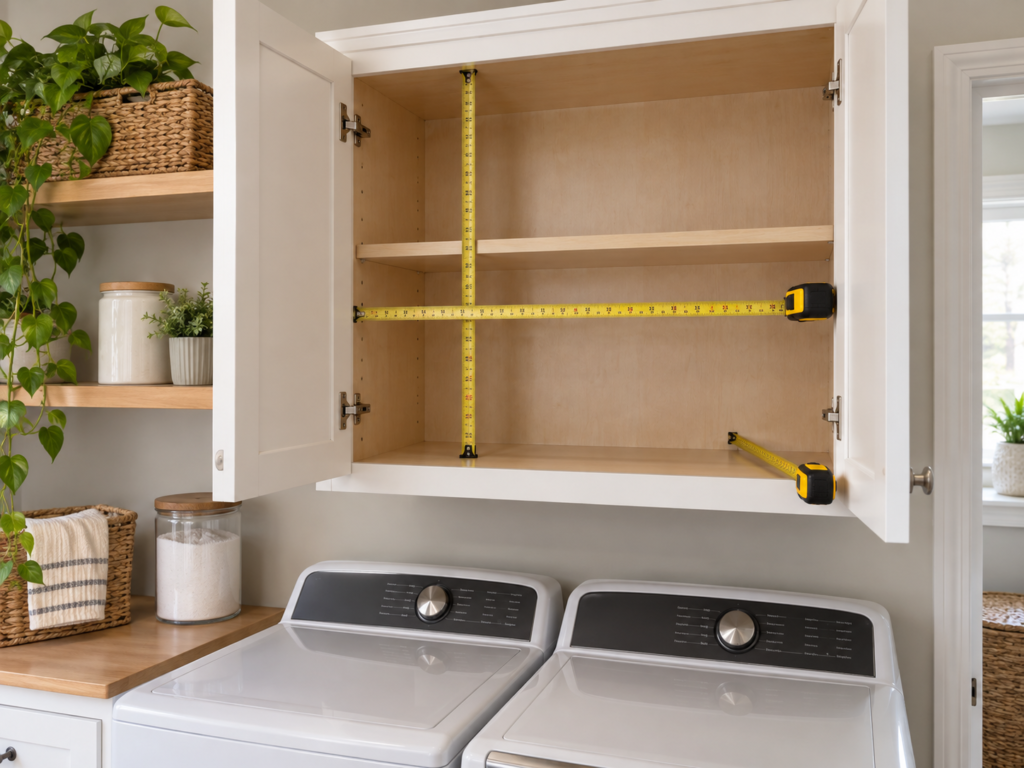
Before buying organizers, measure the cabinet’s:
- Interior width
- Interior depth
- Shelf height
- Door opening width
- Hinges and hardware
- Any fixed shelf supports
Our guide to measuring for storage organizers can help you avoid buying bins or risers that fit the cabinet interior but cannot pass through the door opening.
1. Use Shelf Risers to Create a Second Level
A tall cabinet opening often wastes vertical space.
Shelf risers let you create another storage level without installing a permanent shelf.
They work well for:
- Dryer sheets
- Small detergent containers
- Cleaning cloths
- Stain products
- Laundry accessories
- Small baskets
Put shorter items underneath and taller products beside or above them.
The goal is to avoid stacking unrelated items directly on top of each other.
A riser gives each category its own level.
Cabinet shelf riser → Buy on Amazon
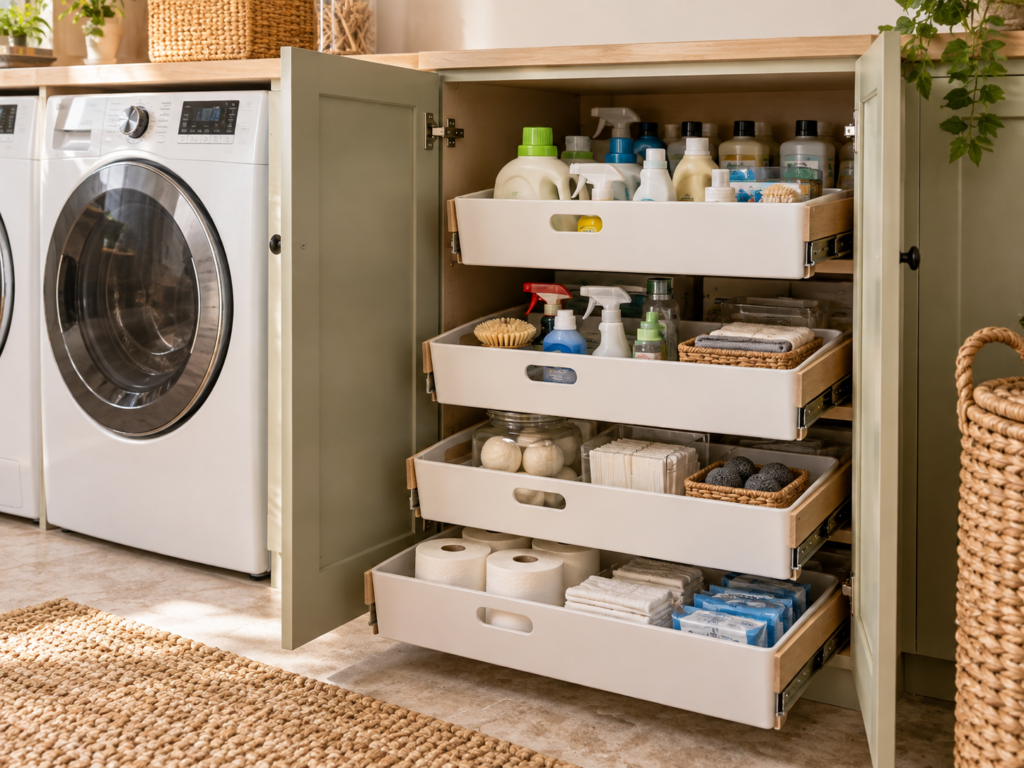
2. Use Pull-Out Bins in Deep Cabinets
Deep laundry cabinets can hold a lot, but the back half is often difficult to reach.
Pull-out bins solve that problem by letting you bring the entire category forward.
They work well for:
- Backup detergent
- Cleaning supplies
- Laundry bags
- Small bottles
- Bulk refills
- Extra dryer products
Use bins with handles whenever possible.
Instead of reaching behind several bottles, you can slide one container out and see everything inside.
Pull-out cabinet bin → Buy on Amazon
3. Separate Everyday Supplies From Backstock
Do not mix today’s detergent with six backup bottles.
Keep everyday products in the easiest-to-reach section.
Put backstock higher, deeper, or farther to the side.
For example:
Everyday zone
- Detergent
- Stain spray
- Dryer sheets
- Dryer balls
Backup zone
- Refill detergent
- Extra cleaning products
- Bulk paper goods
- Seasonal laundry products
This prevents frequently used items from getting buried behind supplies you may not need for months.
4. Create a Dedicated Stain-Treatment Bin
Stain products tend to multiply.
You may have:
- Spray treatments
- Stain sticks
- Small brushes
- Oxygen cleaner
- Enzyme products
- Pre-soak products
Keep them together in one bin or tray.
This makes the cabinet easier to use and helps prevent spills from spreading across the entire shelf.
A shallow handled bin is often enough.
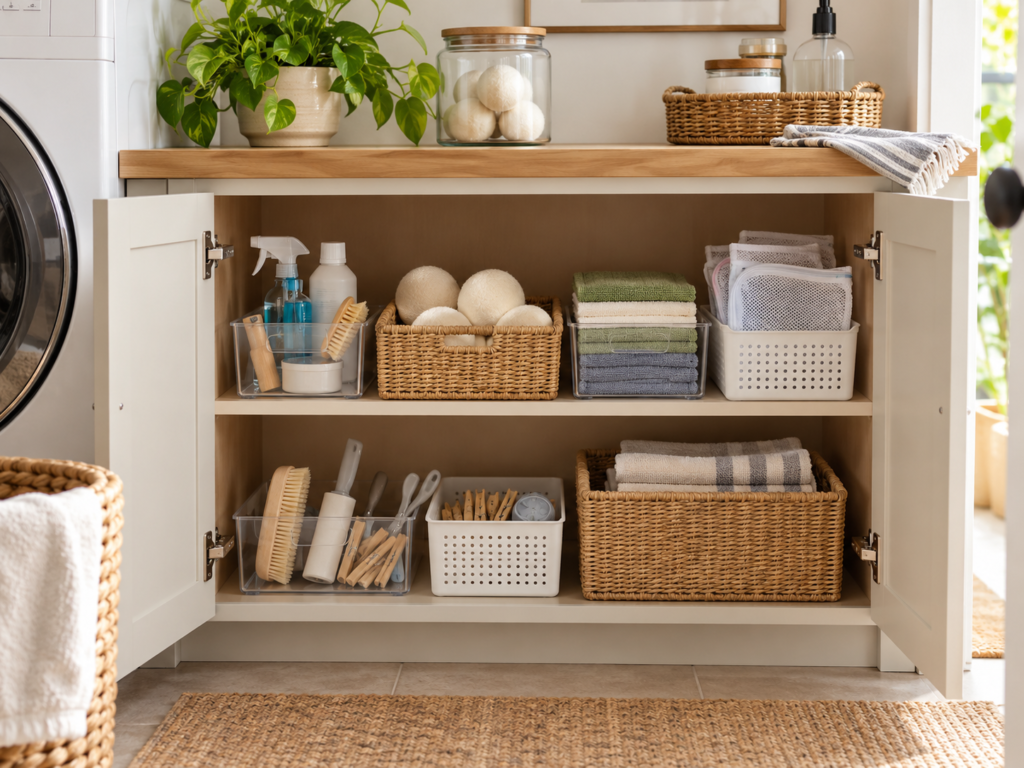
5. Use Clear or Open-Front Bins for Small Items
Small items disappear quickly inside deep cabinets.
Clear bins or open-front containers make it easier to see:
- Dryer balls
- Clothespins
- Mesh wash bags
- Lint tools
- Small brushes
- Laundry repair items
- Replacement parts
Avoid using oversized bins for tiny categories.
A small category should get a small container.
Otherwise, the bin itself wastes more space than the items inside it.
6. Use Stackable Bins Carefully
Stackable bins can increase capacity, but only if you can access the lower container easily.
Use them for items you do not need constantly.
For example:
- Seasonal supplies
- Backup cloths
- Extra laundry bags
- Refill products
If you have to remove three bins every time you need detergent, the system is too complicated.
Stacking works best for low-frequency storage.
Stackable cabinet bins → Buy on Amazon
7. Use Narrow Bins in Shallow Cabinet Zones
Not every cabinet section has the same usable depth.
Hinges, pipes, shelf supports, or door hardware may reduce part of the space.
Use narrow bins for these awkward areas.
They can hold:
- Small bottles
- Brushes
- Laundry accessories
- Cleaning cloths
- Dryer supplies
A bin that fits the actual usable depth is better than one that technically fits but prevents the door from closing.
Narrow cabinet organizer → Buy on Amazon
8. Store Heavy Detergent Low
Large detergent containers can be heavy.
Keep them on lower cabinet shelves when possible.
This makes them easier to lift and reduces the risk of dropping a heavy bottle from overhead.
Higher shelves are better for lighter items such as:
- Paper goods
- Empty baskets
- Mesh laundry bags
- Cleaning cloths
- Lightweight backup products
Storage height should reflect both frequency of use and weight.
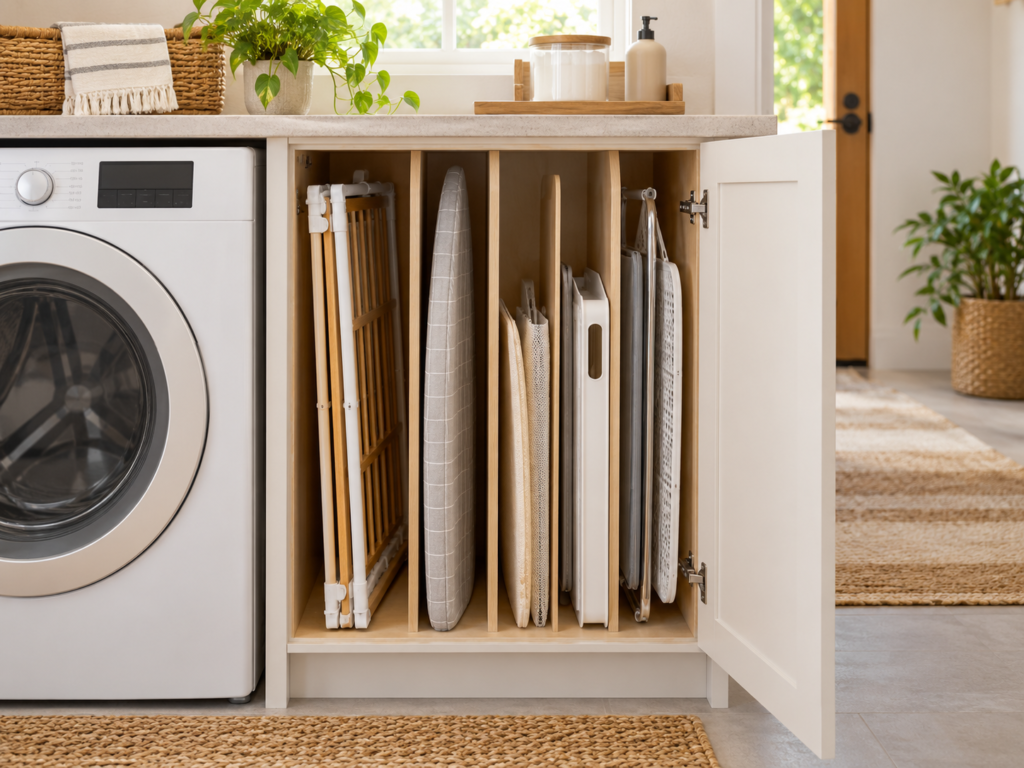
9. Use Vertical Dividers for Flat Laundry Tools
Some laundry supplies store better vertically.
Vertical dividers can hold:
- Ironing mats
- Foldable drying racks
- Laundry boards
- Reusable pressing cloths
- Slim trays
Instead of stacking flat items on top of one another, stand them upright so you can remove one without disturbing the rest.
10. Use the Cabinet Door for Lightweight Storage
The inside of a cabinet door can provide useful storage, but only for lightweight items.
Depending on the door, you might store:
- Small cloths
- Mesh bags
- Dryer sheets
- Stain sticks
- Gloves
- Small brushes
Use shallow organizers so they do not hit the shelf contents when the door closes.
Before installing anything, close the cabinet slowly and check the available clearance.
11. Keep Chemicals Contained
Laundry cabinets often hold liquids that can leak.
Use trays or bins under:
- Detergent
- Bleach products
- Stain removers
- Cleaning sprays
- Fabric treatments
A contained spill is much easier to clean than one that spreads across the cabinet shelf.
Follow the product’s storage instructions, especially when children or pets are present.
12. Do Not Overfill Deep Cabinets
A deep cabinet does not need to be filled from front to back.
Leaving some open space can make it easier to:
- See what is stored
- Pull bins forward
- Return products
- Clean spills
- Reach the back
If you have to remove five items to reach one bottle, the cabinet is storing too much.
Deep storage works best when categories are contained and movable.
13. Use Labels for Similar Containers
Matching bins can make a cabinet look tidy, but they can also make everything look the same.
Labels help distinguish:
- Stain treatment
- Dryer supplies
- Cleaning cloths
- Backstock
- Mesh bags
- Small tools
Keep labels specific.
“Miscellaneous” is not a useful category.
If a bin contains unrelated items, it usually needs to be divided or reconsidered.
Storage label system → Buy on Amazon
14. Create a Cleaning-Supply Zone
Laundry rooms often double as cleaning-supply storage.
If that is true in your home, keep the cleaning products together rather than scattering them through every cabinet.
A dedicated zone might include:
- Spray cleaners
- Gloves
- Brushes
- Cloths
- Sponges
- Small refill bottles
Keep frequently used laundry products separate so the cabinet does not become a general utility closet.
15. Use One Cabinet for Laundry and One for Household Cleaning
If you have more than one cabinet, assign them different jobs.
For example:
Cabinet 1: Laundry
- Detergent
- Stain treatment
- Dryer supplies
- Mesh bags
- Laundry tools
Cabinet 2: Cleaning
- Spray cleaners
- Gloves
- Brushes
- Cleaning cloths
- Refill products
This makes both cabinets easier to maintain.
You are less likely to create random piles when every cabinet has a clear purpose.
16. Use Adjustable Shelves When Possible
Fixed cabinet shelves can create awkward gaps.
Adjustable shelves let you match the spacing to the products you actually own.
A shelf holding short baskets may need far less vertical room than one holding detergent bottles.
Reducing unused vertical gaps can create room for another storage level.
This is especially useful in small laundry rooms where every shelf matters.
17. Keep Rarely Used Items Higher
Use upper cabinet shelves for low-frequency items such as:
- Specialty stain products
- Extra refills
- Seasonal cleaning supplies
- Spare laundry bags
- Backup paper goods
Keep everyday detergent and dryer supplies closer to eye level.
The harder something is to reach, the less often you should need it.
18. Use Small Bins for Loose Laundry Tools
Tiny laundry tools create clutter quickly.
Give them one contained area.
A small bin can hold:
- Safety pins
- Garment bags
- Lint rollers
- Small brushes
- Clothespins
- Fabric shavers
- Repair kits
This prevents them from spreading across the cabinet shelf.
19. Keep Cabinet Storage Near Where Items Are Used
If your cabinets span the room, do not organize them purely by appearance.
Put products near the appliance or task where they are used.
For example:
- Detergent near the washer
- Dryer supplies near the dryer
- Cleaning cloths near the utility sink
- Ironing supplies near the ironing area
This reduces unnecessary movement in a small room.
20. Avoid Turning Cabinets Into a Miscellaneous Dumping Ground
Closed cabinets make clutter easy to ignore.
That is why laundry cabinets often collect unrelated items.
Avoid storing random:
- Tools
- Batteries
- Light bulbs
- Pet supplies
- Household paperwork
- Unsorted hardware
unless the laundry room is intentionally serving as a utility-storage zone.
Every cabinet should have a defined purpose.
If an item does not belong to that purpose, find a better home for it.
21. Leave Room for Products to Change
Detergent bottles, cleaning products, and storage containers change over time.
Do not build a cabinet system so exact that one slightly taller bottle breaks the layout.
Leave some flexibility.
Adjustable shelves, movable bins, and open zones are easier to adapt than tightly packed custom arrangements.
How Do You Organize Deep Laundry Room Cabinets?
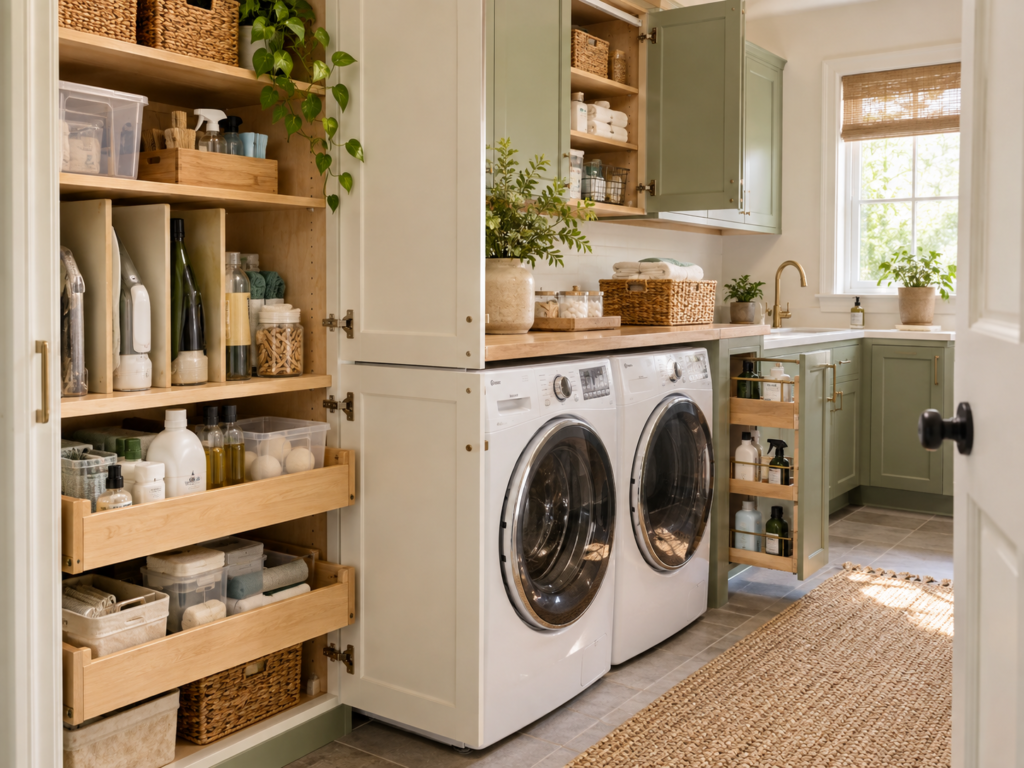
Use containers that move.
Pull-out bins, handled baskets, and trays make deep storage much easier to access.
Keep frequently used items toward the front and backup products farther back.
Avoid loose rows of bottles extending deep into the cabinet.
What Should Go in Laundry Room Cabinets?
Good categories include:
- Detergent
- Stain treatment
- Dryer supplies
- Laundry bags
- Cleaning cloths
- Small laundry tools
- Cleaning supplies
- Backup products
Keep heavy liquids lower and lightweight backstock higher.
Are Clear Bins Better for Laundry Cabinets?
Clear bins can be useful because you can see the contents.
Opaque bins can look cleaner when cabinets are occasionally left open.
Either works.
The more important features are:
- Correct size
- Easy-to-grab handles
- Appropriate depth
- Clear categories
A well-sized opaque bin is more useful than a clear bin that wastes half the cabinet.
How Do You Use Tall Laundry Cabinets Efficiently?
Use the vertical space intentionally.
Add:
- Shelf risers
- Adjustable shelves
- Stackable bins
- Vertical dividers
Keep enough clearance to remove items comfortably.
Do not simply stack loose products upward.
What Is the Difference Between Laundry Shelving and Cabinet Storage?
Open shelving is about using exposed wall space efficiently.
Cabinet storage is about improving the capacity and accessibility inside enclosed storage.
If you need ideas for wall shelves above or beside your machines, see our laundry room shelving ideas for small spaces.
For broader layout ideas, see our small laundry room organization ideas.
Laundry Room Cabinet Storage Works Best When Every Shelf Has a Purpose
The easiest way to lose storage space is to treat a cabinet like one large box.
Instead, break it into smaller zones.
Use risers when there is wasted height.
Use pull-out bins when there is too much depth.
Keep heavy detergent low.
Store backstock separately.
Contain small items.
Label similar bins.
And leave enough empty room to actually use the cabinet.
In a small laundry room, organized cabinet interiors can add meaningful capacity without adding another shelf, cart, or piece of furniture.