
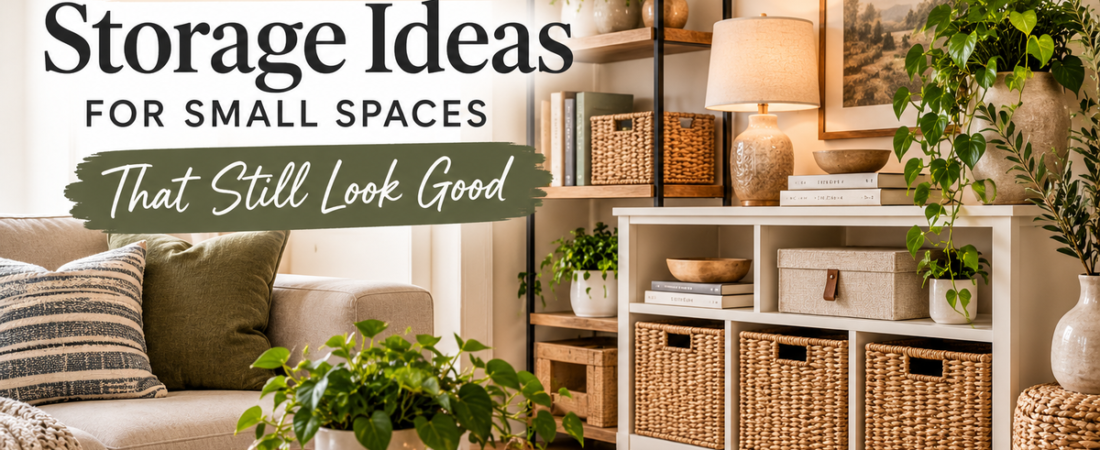
Storage in a small space has to work hard, but that does not mean your home has to look like a storage unit.
The best aesthetic storage solves a real organization problem while also helping the room feel calmer, warmer, and more intentional.
That usually means fewer mismatched containers, less visual clutter, smarter use of concealed storage, and choosing organizers that actually fit the room instead of buying whatever happens to be functional.
You do not need to replace everything with matching beige bins or create a Pinterest-perfect system that takes twenty minutes to maintain every day.
These aesthetic storage ideas are designed for real small spaces where storage needs to look good and remain easy to use.
Start With Function Before Aesthetics
Before buying attractive baskets, boxes, or cabinets, decide what you actually need to store.
Ask:
- What keeps creating clutter?
- Which items need daily access?
- Which items can be concealed?
- What needs to stay visible?
- Where does clutter naturally collect?
- Which storage areas are already working?
A beautiful organizer that does not solve a real problem is still clutter.
The easiest way to create an attractive organization system is to first give everything a practical home, then improve how that storage looks.
If your home needs more storage overall, start with my storage ideas for small homes before focusing on the visual details.
1. Use Woven Baskets for Visible Storage
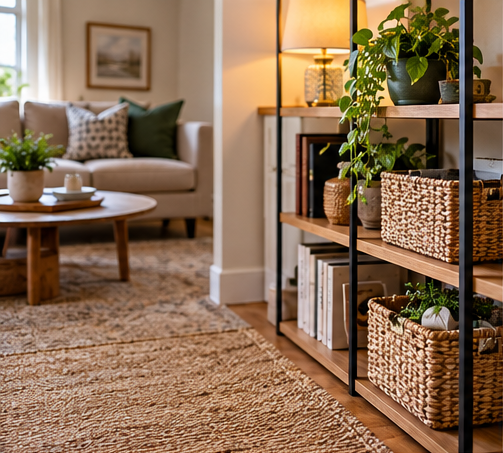
Woven baskets are one of the easiest ways to make open storage look intentional.
They can hide categories such as:
- Electronics
- Chargers
- Toys
- Extra linens
- Cleaning supplies
- Office supplies
- Bathroom products
Natural textures add warmth without creating a lot of visual noise.
The key is using baskets where they actually help.
You do not need a matching basket on every shelf. A few well-placed baskets often look better than covering every visible surface with identical containers.
Woven storage baskets → Buy on Amazon
2. Choose Warm Wood Storage Instead of More Plastic
Plastic bins are useful, especially inside closets and cabinets.
But in areas where storage stays visible, wood can make the space feel more like a room and less like a utility closet.
Consider:
- Wood shelving
- Small wood cabinets
- Storage benches
- Wood trays
- Wooden boxes
- Open cubbies
Warm wood works particularly well with neutral fabrics, woven textures, greenery, and simple metal accents.
3. Hide the Ugliest Categories
Not everything deserves open storage.
Some categories simply create visual clutter no matter how neatly they are arranged.
Good candidates for concealed storage include:
- Cleaning products
- Cables
- Medicine
- Extra toiletries
- Bulk supplies
- Paperwork
- Packaging
- Random household extras
Use cabinets, drawers, lidded boxes, or baskets to hide them.
For more ways to make storage disappear into the room, see my hidden storage ideas for small homes.
4. Keep Attractive Everyday Items Visible
Some items can actually make open storage look better.
Examples include:
- Folded neutral towels
- Books
- Glass jars
- Wood cutting boards
- Ceramic containers
- Woven baskets
- Plants
- Simple dishes
You do not need to hide everything.
The trick is separating things that contribute to the room visually from things that create noise.
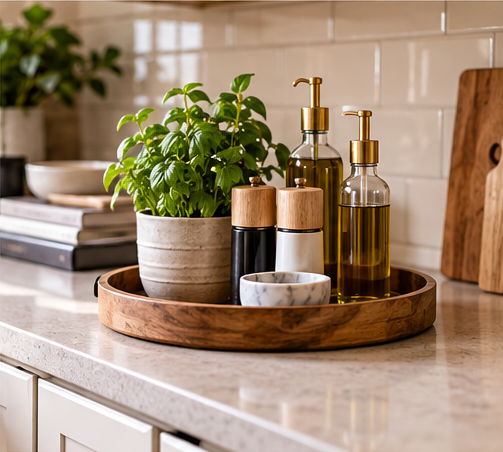
5. Use Trays to Contain Small Visible Categories
Small items scattered across a countertop almost always look cluttered.
Put the same items on a tray, and suddenly they look like a defined group.
Trays work well for:
- Skincare
- Perfume
- Coffee supplies
- Cooking oils
- Keys
- Candles
- Bathroom essentials
This does not technically create more storage, but it creates boundaries.
Once the tray is full, that category has reached its limit.
Decorative countertop tray → Buy on Amazon
6. Mix Open and Closed Storage
All-open storage can feel busy.
All-closed storage can feel heavy.
A mix usually works best.
For example:
- Closed cabinet below
- Open shelves above
- Baskets on one shelf
- Books and decorative objects on another
This lets you hide the unattractive categories while keeping everyday items accessible.
It also gives a small room visual breathing room.
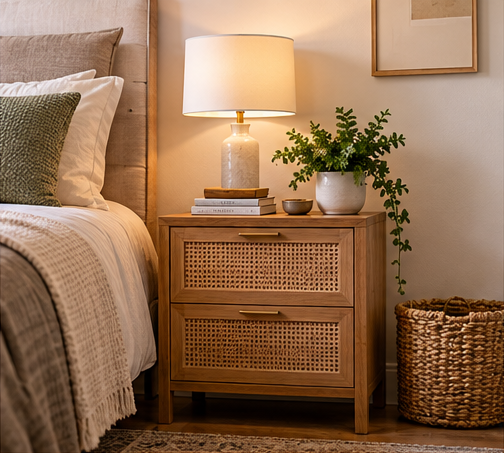
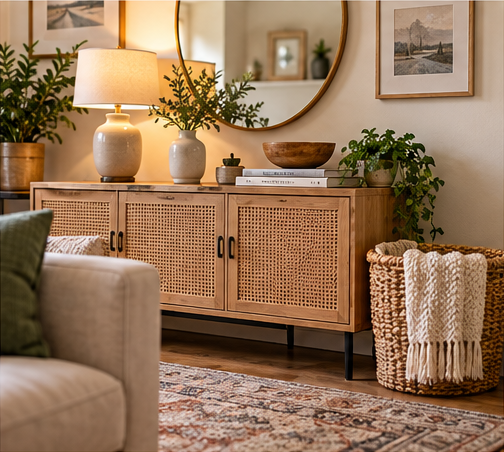
7. Use Furniture That Looks Like Furniture
Storage furniture does not have to look like an organizer.
Look for pieces such as:
- Narrow cabinets
- Storage benches
- Console cabinets
- Cane-front cabinets
- Small sideboards
- Storage ottomans
These pieces can provide useful concealed storage while still feeling like part of the room.
A storage bench or ottoman is especially useful in a small home because it can serve more than one purpose.
Storage ottoman or bench → Buy on Amazon
8. Choose Containers That Match the Room
You do not need every storage container in the house to match.
Instead, choose containers that make sense in the room where they will be visible.
For example:
Bedroom
Soft fabric bins, wood, woven baskets.
Bathroom
Washable containers, glass jars, simple trays.
Kitchen
Wood, metal baskets, glass containers.
Living Room
Furniture-like storage, baskets, decorative boxes.
Matching the material to the room often looks more natural than buying one giant matching set for the entire house.
9. Repeat Materials Instead of Matching Everything
A room can feel cohesive without every organizer being identical.
Try repeating two or three materials.
For example:
- Warm wood
- Natural woven texture
- Black metal
Or:
- White ceramic
- Light wood
- Soft fabric
Repeating materials creates visual consistency while still allowing you to choose the container that works best for each category.
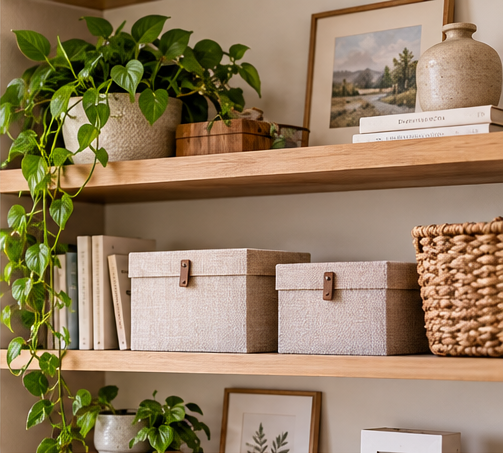
10. Use Decorative Lidded Boxes for Small Clutter
Lidded boxes are especially useful for things you want nearby but do not want visible.
Use them for:
- Charging cables
- Remotes
- Paperwork
- Small electronics
- Craft supplies
- Personal items
- Miscellaneous accessories
Choose boxes that look like part of the room rather than office storage.
A decorative box on a shelf can look intentional while hiding a surprisingly messy category.
Decorative lidded storage boxes → Buy on Amazon
11. Keep Labels Subtle
Labels are useful, but they do not need to dominate the storage system.
Huge labels on every container can make a room feel more like a stockroom.
Use subtle labels when needed:
- Small printed labels
- Simple handwritten tags
- Labels inside cabinet doors
- Discreet basket tags
If everyone in the household already knows what belongs in a basket, it may not need a label at all.
Labels should improve function, not become the main visual feature.
12. Decant Only When It Actually Helps
Decanting can make shelves look attractive, but it is easy to take it too far.
Good candidates include:
- Rice
- Pasta
- Oats
- Baking ingredients
- Cotton swabs
- Laundry powder
Poor candidates are things where the original packaging contains important instructions, expiration information, or is simply easier to use.
Do not create extra chores just to make a shelf photograph better.
Aesthetic organization should make life easier.
13. Use Matching Containers Selectively
There are places where matching containers make sense.
For example:
- One pantry shelf
- One open bathroom shelf
- One closet cubby
- A row of baskets beneath a console
The mistake is assuming every storage container in the room needs to match.
Start with the visible areas where mismatched containers create the most clutter.
Leave hidden storage alone if it already works.
14. Style Open Shelves Around Actual Storage
Open shelving should still earn its space.
Instead of turning every shelf into decoration, combine useful storage with a few visual elements.
For example:
Shelf One
Books + small plant
Shelf Two
Basket of electronics + decorative box
Shelf Three
Folded linens + ceramic container
This keeps the shelf functional without making it look overloaded.
Warm wood shelving unit → Buy on Amazon
For more ways to make vertical storage useful, see my vertical storage ideas for small spaces.
15. Leave Some Empty Space
One of the biggest differences between storage that looks calm and storage that looks cluttered is empty space.
Do not fill every:
- Shelf
- Basket
- Counter
- Cubby
- Wall
just because space is available.
A little breathing room makes the entire storage system easier to see and use.
It also leaves room for future needs without forcing another organization overhaul.
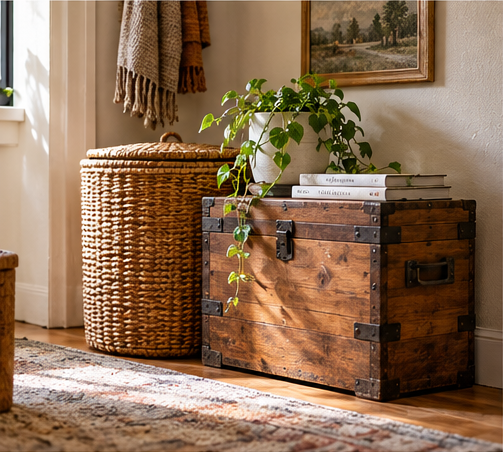
16. Use Vintage Looking Storage Pieces
Storage does not have to come from the organization aisle.
Useful options can include:
- Wood crates
- Vintage-style boxes
- Small trunks
- Old-style metal bins
- Woven hampers
- Lidded baskets
These pieces can add personality while still performing a real storage job.
Just avoid buying decorative containers with awkward shapes that cannot actually hold much.
Function still comes first.
17. Make Daily Storage the Easiest to Reach
The things you use every day should be the easiest to put away.
That means aesthetics should never require extra steps.
If you have to:
- Open a cabinet.
- Remove a basket.
- Open a lid.
- Move another container.
- Put away one everyday item.
the system probably will not last.
Reserve the easiest storage for frequently used items.
Use prettier but less convenient storage for things you access less often.
18. Keep Countertop Storage Low and Intentional
Small spaces can quickly feel crowded when tall organizers cover countertops.
Keep visible countertop storage limited.
A simple arrangement might include:
- One tray
- One small container
- One plant
- One frequently used appliance
Move the rest into cabinets, drawers, or vertical storage.
This is particularly useful in kitchens and bathrooms where usable counter space is already limited.
19. Use Closed Storage Below Eye Level
Lower shelves often become visually messy because they hold larger or less attractive items.
Consider using:
- Cabinets
- Baskets
- Doors
- Lidded bins
on lower levels.
Keep the more attractive categories at eye level.
This can make a storage wall feel much calmer without reducing the amount of storage.
20. Use Attractive Storage in Awkward Spaces
Sometimes the best place to add storage is a very visible awkward gap.
Instead of placing a plastic utility bin there, choose something that looks intentional.
Examples include:
- Narrow wood cabinet
- Woven basket
- Small furniture-style shelf
- Decorative lidded box
- Slim console cabinet
A visible storage solution should feel like it belongs in the room.
21. Let Storage Double as Decor
Some storage can perform both jobs.
Examples include:
- Books on shelves
- Rolled towels
- Baskets
- Glass pantry jars
- Attractive cookware
- Cutting boards
- Ceramic containers
This works especially well in small homes because every surface does not need separate decorative objects.
Useful items can provide the visual interest.
22. Choose Fewer, Larger Containers
A shelf with eight small bins often looks busier than a shelf with two larger baskets.
Whenever practical, consolidate similar categories.
Instead of:
- Charger basket
- Cord basket
- Adapter basket
use:
Electronics
Instead of:
- Hair ties
- Clips
- Headbands
use:
Hair Accessories
Broader categories are often easier to maintain and visually calmer.
23. Use Texture Instead of More Color
If you want storage to feel interesting without making the room busy, use texture.
Try combining:
- Woven baskets
- Wood
- Linen
- Cane
- Ceramic
- Matte metal
These materials add depth without introducing five new colors.
This is particularly effective in small rooms where too many contrasting colors can make the space feel crowded.
24. Keep Your Color Palette Flexible
You do not need a strict neutral palette to have aesthetic storage.
But choosing a few repeating colors helps.
For example:
- Warm white
- Sage green
- Natural wood
- Black accents
Or:
- Cream
- Terracotta
- Medium wood
- Brass
Your storage can still include personality without looking random.
25. Avoid Buying a Full Organization System at Once
One of the easiest ways to waste money is to buy an entire matching set before knowing whether the system works.
Start with one problem area.
Test:
- Basket size
- Shelf spacing
- Container style
- Accessibility
- Cleaning requirements
Then expand what works.
This is especially important in small homes where one inch can determine whether an organizer is useful or frustrating.
26. Make Concealed Storage Easy to Maintain
Hidden storage can look great from the outside and still be chaos inside.
Use simple categories inside cabinets and drawers.
You may need:
- A few bins
- Drawer dividers
- Small baskets
- Shelf risers
But avoid over-organizing.
A cabinet does not need to look like a showroom when you open the door. It just needs to make things easy to find and put away.
27. Create One Calm Storage Zone in Each Room
You do not have to redesign every storage area at once.
Choose one visible area in each room.
For example:
Bedroom
Nightstand or open shelf.
Bathroom
Vanity counter.
Kitchen
One open shelf or counter zone.
Living Room
TV console or bookshelf.
Improving a few high-visibility storage areas can make the whole home feel more organized.
Aesthetic Storage Does Not Mean Perfect Storage
A good storage system should survive normal life.
If the system only looks good when:
- Every towel is folded identically
- Every label faces forward
- Every pantry product is decanted
- Every basket is perfectly arranged
it may be too difficult to maintain.
The goal is not perfection.
The goal is to reduce visual clutter while still making the space easy to live in.
What Makes Storage Look More Aesthetic?
Usually, it comes down to a few simple principles:
- Limit visible clutter
- Repeat a few materials
- Hide unattractive categories
- Use boundaries like trays and baskets
- Leave some empty space
- Choose furniture-like storage for visible areas
- Keep daily items easy to access
- Avoid unnecessary containers
You do not need expensive organizers to do this.
Do Storage Containers Need to Match?
No.
Matching everything can actually make a room feel overly staged.
A better approach is to repeat a few materials or colors while choosing containers based on what each category needs.
That gives you a cohesive look without sacrificing function.
How Do You Make a Small Apartment Look Organized?
Start with the areas that create the most visual clutter.
Clear counters, conceal unattractive categories, use vertical storage, and give frequently used items an easy home.
Then improve the appearance of the storage that stays visible.
If you’re working with a very tight home, my guide to creating more storage in a small apartment can help you find the space first.
Make Storage Part of the Room
The best aesthetic storage does not call attention to itself.
It simply makes the room easier to use while helping everything feel calmer and more intentional.
Use warm materials, conceal messy categories, keep useful items accessible, and choose storage pieces that fit both the space and the way you actually live.
You do not need a perfectly matching organization system.
You need storage that works well enough to stay organized—and looks good enough that you do not feel like hiding it.