
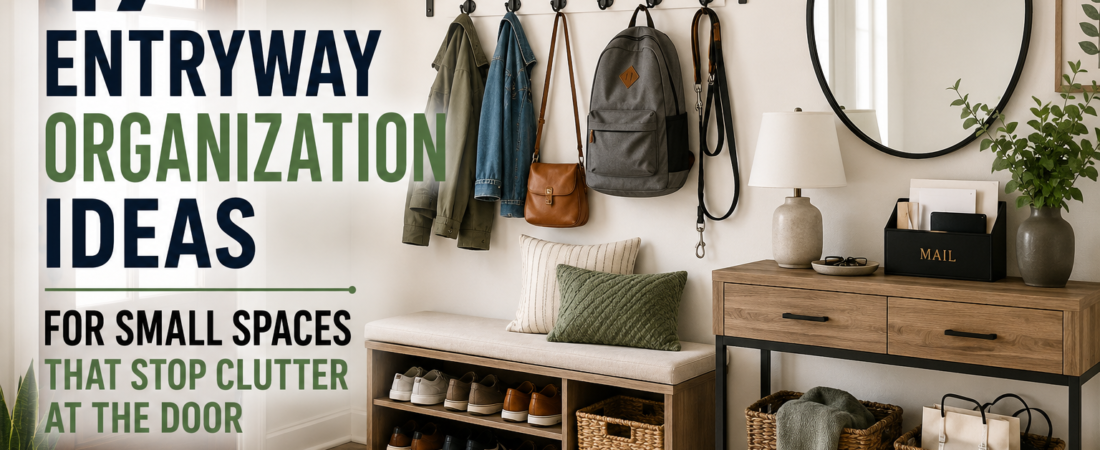
The entryway is one of the smallest areas in many homes.
It also has to handle an unreasonable amount of stuff.
Shoes, coats, backpacks, purses, keys, mail, umbrellas, dog leashes, reusable shopping bags, and whatever somebody was carrying when they walked through the door all tend to land in the same few square feet.
When you have a large mudroom, that’s manageable.
When your “entryway” is basically a narrow strip of wall beside the front door, things get messy fast.
The best entryway organization ideas for small spaces don’t require a dedicated room. They use walls, doors, narrow furniture, baskets, hooks, and clearly defined drop zones to control clutter without blocking the walkway.
Here are 17 practical ways to make a small entryway work harder.
1. Start With What Actually Lands by the Door
Before buying an entryway organizer, pay attention to what regularly gets dropped near the entrance.
That might include:
- Shoes
- Coats
- Backpacks
- Purses
- Keys
- Sunglasses
- Dog leashes
- Hats and gloves
- Reusable bags
Those items tell you what storage the space actually needs.
If shoes are the main problem, prioritize shoe storage.
If backpacks constantly end up on the floor, you need sturdy hooks.
If mail covers the nearest counter, create a small paper drop zone.
Organize around the clutter that’s actually happening rather than creating storage for an imaginary perfectly behaved household.
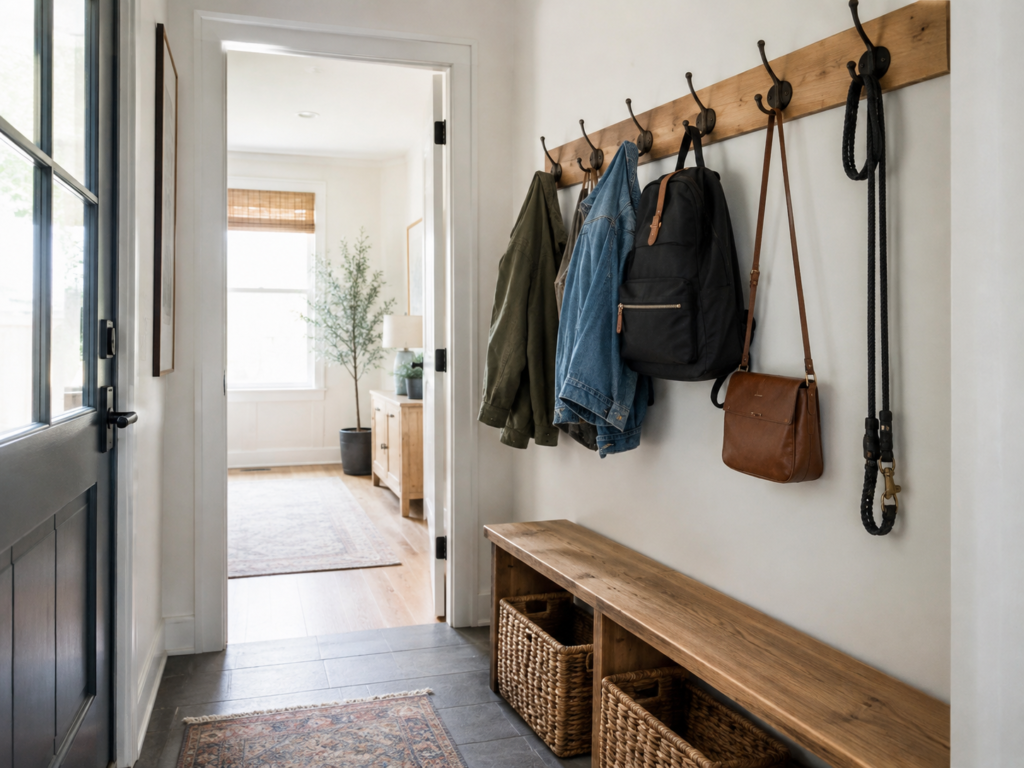
2. Install Wall Hooks Instead of a Coat Rack
A freestanding coat rack takes up valuable floor space.
Wall hooks don’t.
Heavy-duty entryway wall hooks → View on Amazon
Install a row of sturdy hooks for things such as:
- Jackets
- Backpacks
- Purses
- Hats
- Dog leashes
If children use the entryway, consider adding a few hooks at a lower height.
They can’t put their backpack away if the hook is five feet off the ground.
Just avoid turning every hook into permanent storage.
Too many coats hanging in a small entryway can make the area feel crowded even when everything is technically organized.
3. Use a Narrow Shoe Cabinet
Traditional shoe racks can stick surprisingly far into a walkway.
A narrow or tilt-out shoe cabinet provides storage with a much smaller footprint.
Depending on the size, it can hold:
- Everyday sneakers
- Flats
- Children’s shoes
- Sandals
- Slippers
The top can also become a small landing spot for keys or a decorative item.
Measure the available depth carefully.
In a tight entryway, even a few inches can determine whether furniture feels useful or constantly gets bumped into.
Slim tilt-out shoe cabinet → View on Amazon
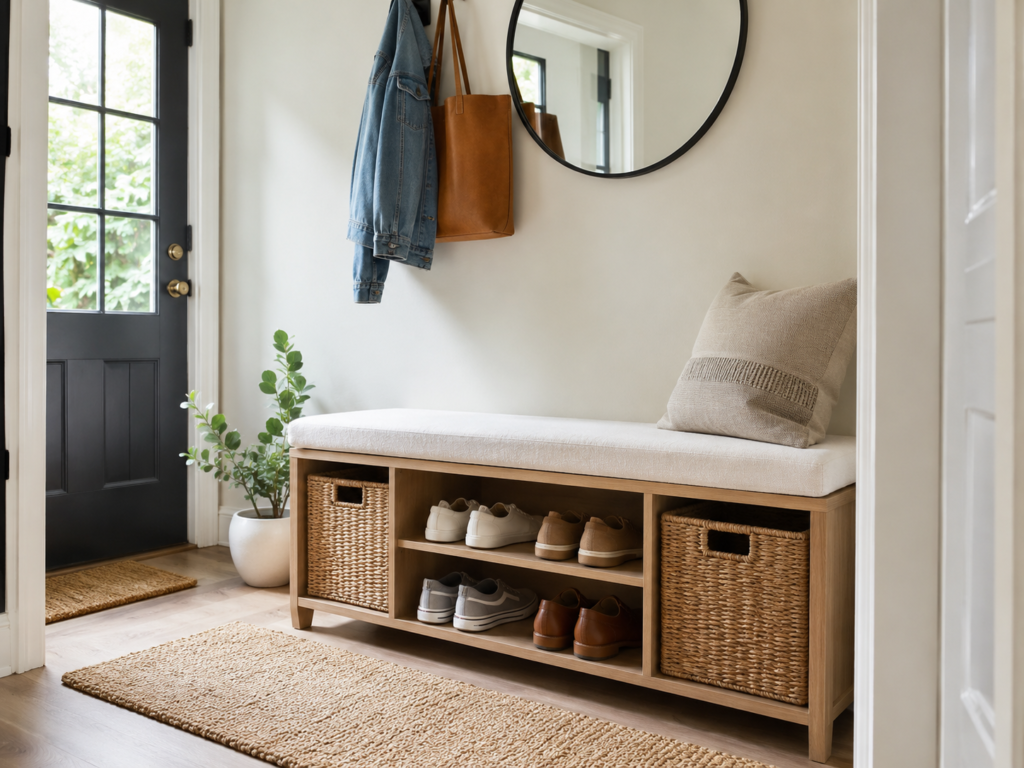
4. Add a Small Bench With Storage
If you have enough room, a compact bench can serve two purposes.
It gives you somewhere to sit while putting on shoes and creates storage underneath.
Look for designs with:
- Open shoe shelves
- Baskets
- Cubbies
- Lift-up storage
Keep the bench proportional to the space.
Compact entryway storage bench → View on Amazon
A giant mudroom bench squeezed into a tiny entrance defeats the purpose.
Even a small bench can make the area considerably more functional.
5. Create a Dedicated Key Drop Zone
Keys need one predictable home.
That could be:
- A small wall hook
- A shallow tray
- A wall-mounted organizer
- A tiny bowl on a console
Put it close to the door you actually use.
Not across the room because that’s where it looked better in a photograph.
The easier the habit is, the more likely everyone is to use it.
This same principle works throughout an organized home: frequently used items should have the easiest storage locations.
If you’re working on another frequently used small space, see 17 Small Kitchen Organization Ideas for Maximizing Limited Space.
6. Use a Slim Console Table
A console doesn’t need to be deep to be useful.
A narrow table can provide a landing area for:
- Keys
- Sunglasses
- Wallets
- Small bags
Choose one with drawers or a lower shelf if you need additional storage.
But be careful.
A console table can quickly become a clutter magnet if everything entering the house gets dumped onto it.
Give the surface a purpose and keep the number of permanent items on top limited.
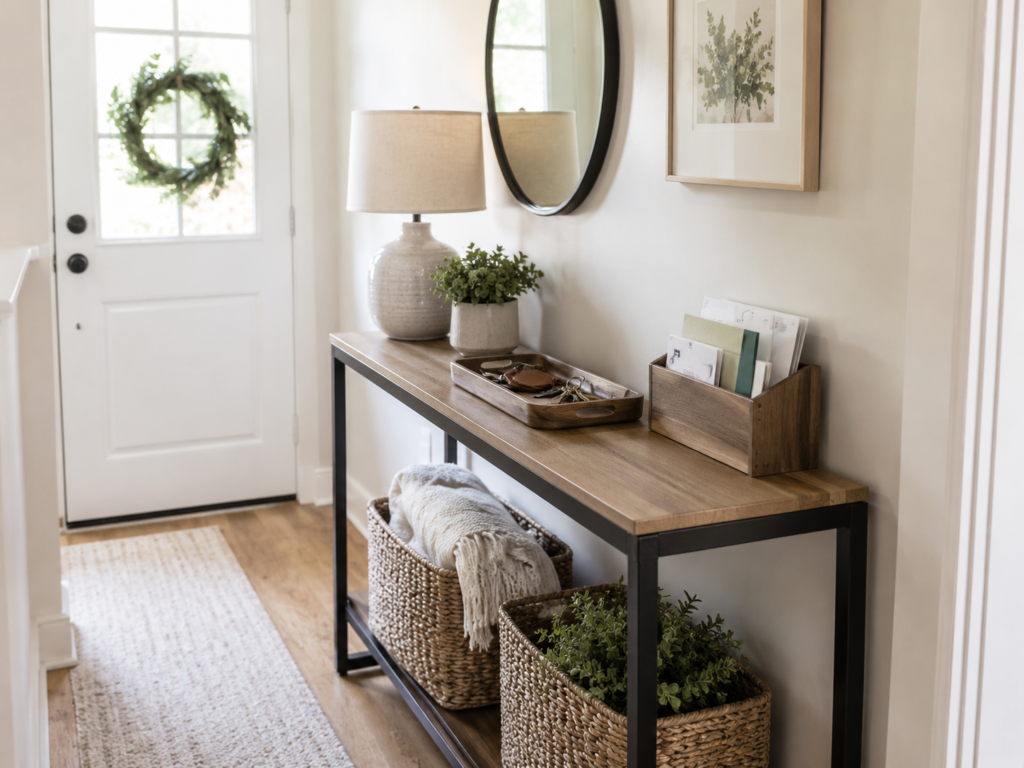
7. Give Mail a Specific Place
Mail tends to travel.
It enters through the front door, lands on a table, moves to the kitchen counter, and eventually becomes a pile nobody wants to deal with.
Create one small mail station near the entrance.
Use:
- A wall pocket
- A tray
- A file holder
- A small basket
Then process it regularly.
Recycle junk mail quickly.
Move bills or documents to wherever they’re actually handled.
The entryway should be a temporary landing point, not a long-term paper archive.
8. Use Baskets for Grab-and-Go Items
Baskets are useful for loose items that don’t need individual compartments.
Depending on your household, you might have a basket for:
- Winter accessories
- Reusable bags
- Dog supplies
- Outdoor toys
- Children’s accessories
Open baskets are often easier to maintain than containers with lids.
If somebody has to perform a five-step ritual to put away a winter hat, the hat is probably ending up on the floor.
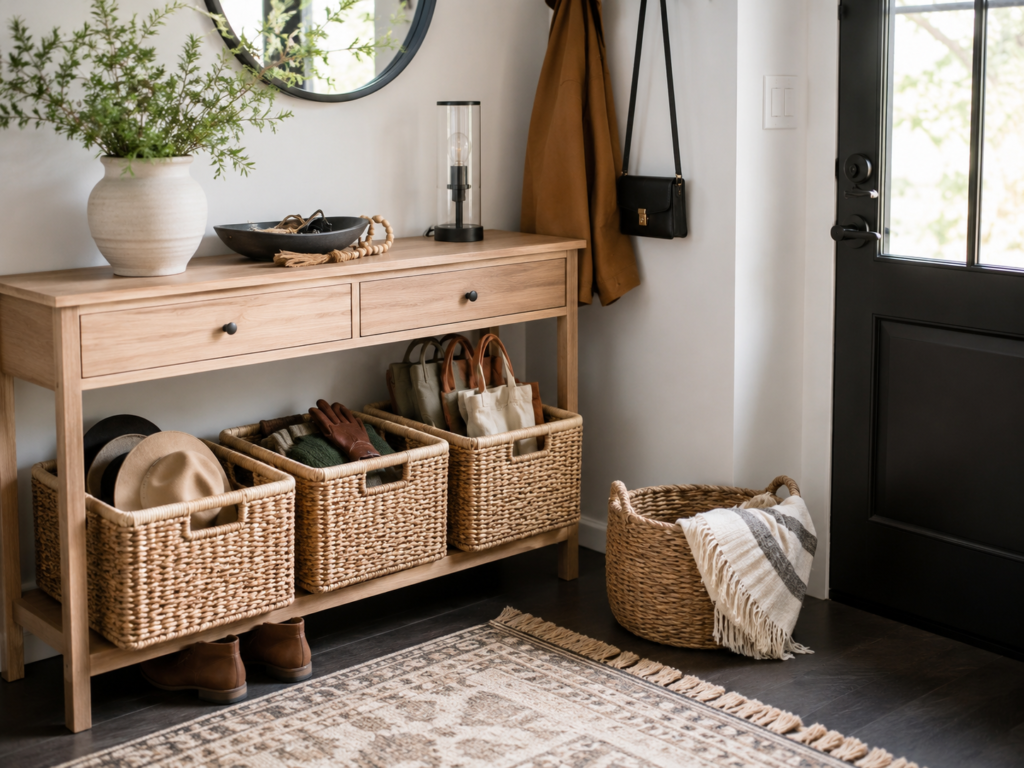
9. Add a Mirror With Storage
A mirror is useful near the door anyway.
If you’re short on space, consider one that also includes:
- Hooks
- A narrow shelf
- A small ledge
- Hidden storage
Even a simple mirror above a narrow console can make a small entryway feel larger by reflecting light.
Just don’t sacrifice function for an oversized decorative mirror if the wall could solve a more important storage problem.
In a tiny entryway, every large object should earn its space.
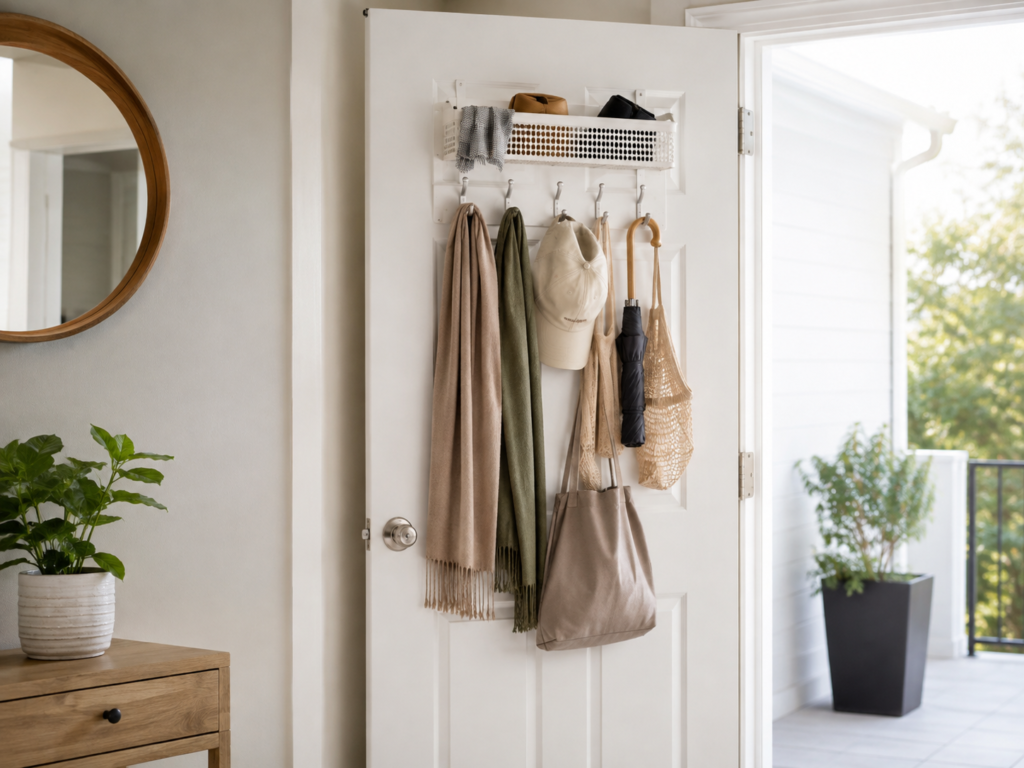
10. Use the Back of the Door
The back of the entry door may provide additional storage without consuming floor space.
Depending on the door and available clearance, you could add:
- Hooks
- A slim hanging organizer
- A small basket
- An accessory rack
Use it for lightweight items such as scarves, hats, umbrellas, or reusable bags.
Make sure anything you install doesn’t interfere with the door closing, hardware, locks, or safe operation.
11. Keep Only Everyday Shoes Near the Door
One of the easiest ways to overwhelm a small entryway is to make it responsible for storing every pair of shoes in the house.
Don’t.
Keep only frequently worn shoes near the door.
Everything else can live in:
- Bedroom closets
- Seasonal storage
- Under-bed containers
- Another shoe cabinet
A household of four can easily turn an entryway into a shoe store if everyone leaves several pairs there.
Set a reasonable limit.
For example, one or two everyday pairs per person may be enough.
If closets elsewhere in the home are struggling too, see 17 Small Closet Organization Ideas That Make the Most of Limited Space.
12. Create Individual Drop Zones for Family Members
If several people use the same entrance, assigning each person a small zone can prevent belongings from blending into one giant pile.
That might mean:
- One hook per person
- Individual baskets
- Separate cubbies
- Labeled bins
Keep it simple.
You don’t need a custom-built mudroom with everyone’s name engraved above a locker.
A row of hooks and a few baskets can accomplish the same basic job.
The important part is that everyone knows where their things belong.
13. Use Vertical Space Above Hooks
Once you’ve installed hooks, look above them.
There may be room for a shelf.
Use high entryway shelving for lightweight or less frequently used items such as:
- Seasonal hats
- Extra bags
- Decorative baskets
- Off-season accessories
Don’t put everyday items so high that retrieving them becomes annoying.
The upper shelf should handle overflow, not things you need every morning.
This is the same vertical-storage strategy that works especially well in utility spaces.
Our guide to 15 Garage Storage Ideas for Small Garages That Maximize Every Inch has more ideas for moving storage off the floor.
14. Add an Umbrella Solution That Doesn’t Take Over
Umbrellas are awkward.
They’re long, occasionally wet, and often needed right by the door.
If you use them frequently, give them a specific home.
Options include:
- A narrow umbrella stand
- Wall hooks
- A tall slim basket
- An appropriate door-mounted holder
Choose something with a small footprint.
And consider where wet umbrellas can dry without damaging flooring or nearby belongings.
15. Create a Small Charging Spot
If phones, earbuds, watches, or other devices tend to land near the entrance, a small charging station may help.
It could be as simple as:
- One drawer in the console
- A small charging tray
- A cable routed behind furniture
The goal is to keep cords and devices from spreading across the surface.
This can also create a convenient place to leave devices you want to remember before heading out.
Don’t force a charging station into the entryway if your household naturally charges everything somewhere else.
Storage should follow your habits, not fight them.
16. Keep the Walkway Clear
A beautifully organized entryway isn’t useful if you have to turn sideways to walk through it.
Preserve enough room to:
- Open the door fully
- Carry groceries inside
- Walk through safely
- Put on shoes
- Move bags or packages
- Get multiple people through the area
This is why narrow furniture and wall-mounted storage work so well in small entryways.
They add function without consuming as much floor space.
When choosing furniture, always measure the remaining walkway, not just whether the furniture technically fits against the wall.
17. Create a Five-Minute Entryway Reset
Entryways accumulate clutter because nearly everything there is temporary.
Mail is supposed to move somewhere else.
Shoes eventually return to closets.
Shopping bags get reused.
Coats change with the weather.
That means even a good system benefits from a quick reset.
Every few days:
- Put extra shoes away
- Move mail
- Return stray items
- Empty unnecessary bags
- Remove out-of-season clothing
- Straighten baskets
This doesn’t need to become another household chore that takes half an hour.
Five minutes can usually restore a small entryway when the underlying storage system is working.
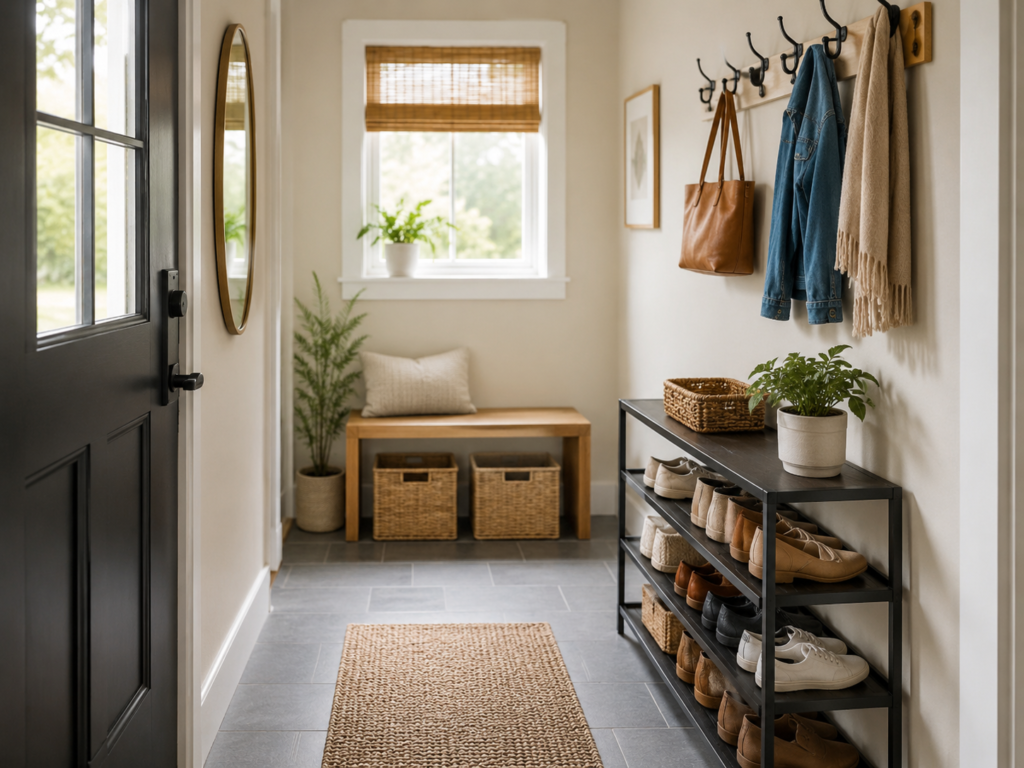
Entryway Organization Ideas for Small Spaces: Stop Clutter Before It Spreads
The entryway is a transition zone.
Things arrive there before moving somewhere else.
That’s why the best entryway organization doesn’t try to permanently store everything.
It controls the flow.
Shoes have somewhere to land.
Keys have one predictable spot.
Mail has a temporary home.
Backpacks and coats get off the floor.
Loose accessories stay contained.
When those basic categories have obvious homes, clutter is less likely to migrate into the kitchen, living room, or hallway.
Quick Small Entryway Problem Solver
Problem: Shoes cover the floor
Try: A narrow shoe cabinet or compact shoe rack
Problem: Coats and backpacks pile up
Try: Wall-mounted hooks
Problem: Keys constantly disappear
Try: One dedicated hook or tray near the door
Problem: Mail covers the counter
Try: A small wall pocket or mail tray
Problem: No place to sit
Try: A compact storage bench
Problem: Hats and gloves scatter everywhere
Try: One open basket
Problem: Multiple family members create chaos
Try: Individual hooks, baskets, or cubbies
Problem: Entryway feels cramped
Try: Wall storage and shallower furniture
Frequently Asked Questions About Small Entryway Organization
How do you organize an entryway with very little space?
Start with the walls.
Hooks, narrow shelves, wall pockets, and slim shoe storage can provide useful organization without consuming much floor space.
Prioritize the items that actually accumulate near your door rather than trying to create storage for everything.
What should every small entryway have?
There isn’t one universal setup, but most entryways benefit from a place for shoes, hooks for outerwear or bags, and a small location for keys.
Everything else depends on your household’s routine.
How do I organize an entryway without a closet?
Use wall-mounted hooks for coats and bags, a narrow shoe cabinet or rack, baskets for accessories, and a small console or wall shelf if space allows.
Vertical storage becomes especially important when there isn’t an entry closet.
How do I keep shoes organized by the front door?
Limit the number of shoes stored there.
Keep only frequently worn pairs near the entrance and move the rest to bedroom closets or other storage.
A narrow shoe cabinet, compact rack, or storage bench can keep everyday pairs contained.
How can I make a small entryway look less cluttered?
Keep the floor as clear as possible, limit the number of visible shoes and coats, use baskets for loose accessories, and choose furniture proportional to the space.
Leaving some empty wall and floor space often makes the entryway feel larger.
Is a bench worth having in a small entryway?
Yes, if there’s enough room to maintain a comfortable walkway.
Choose a compact bench that also provides storage underneath so the footprint serves more than one purpose.
Make the First Few Feet of Your Home Work Better
A small entryway doesn’t need to become a miniature mudroom.
It just needs to handle the things that happen when people come and go.
Give shoes a limit.
Put hooks where bags and coats naturally land.
Create one place for keys.
Contain small accessories.
Use walls before filling the floor.
And leave enough open space to comfortably walk through the door.
When those first few feet of the house work well, a surprising amount of clutter never gets the chance to spread any farther.