
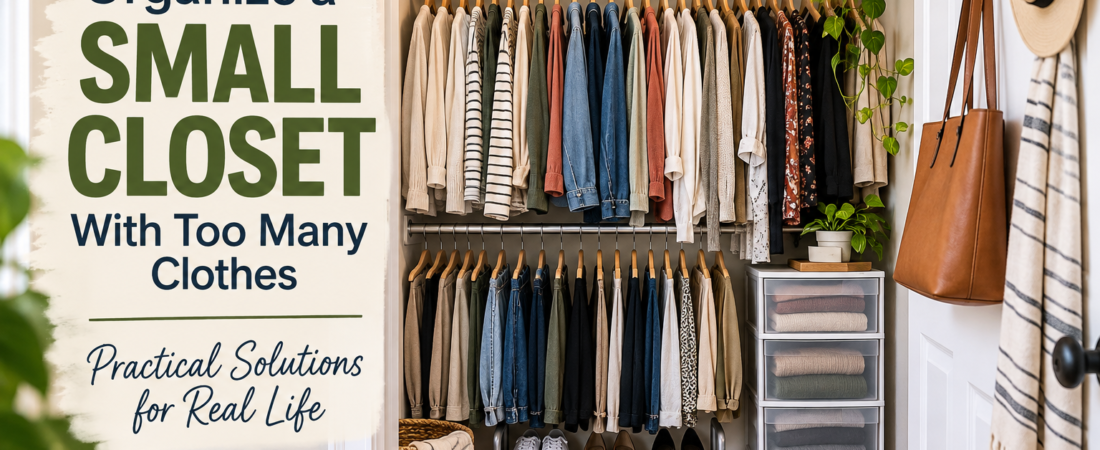
A small closet can get overwhelmed surprisingly fast.
You hang up a few new shirts. Shoes accumulate on the floor. Sweaters get stacked wherever they’ll fit. Before long, hangers are packed so tightly that you can’t see what you own, clothes fall onto the floor, and getting dressed means digging through everything.
At that point, buying another set of matching bins probably isn’t going to solve the problem.
When you have too many clothes for a small closet, you need to tackle two separate issues:
How much clothing the closet can realistically hold—and how efficiently you’re using the space it already has.
Sometimes better organization creates a surprising amount of additional room.
Sometimes the closet is simply over capacity.
Usually, it’s a little of both.
Here’s how to organize a small closet with too many clothes without turning your bedroom into overflow storage.
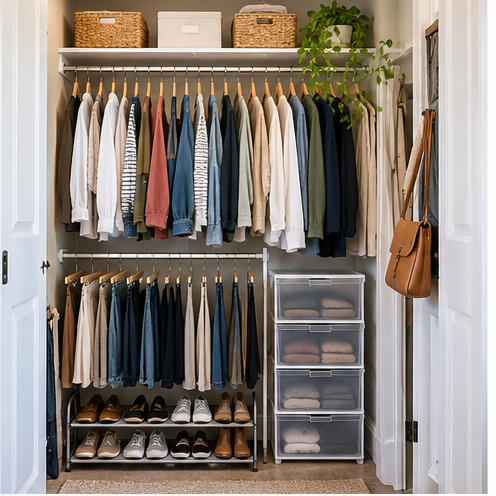
How to Organize a Small Closet Without Wasting Space
Start by Emptying the Closet
This is the annoying part of learning how to organize a small closet, but it’s worth doing.
Take everything out.
Clothing, shoes, bags, boxes, random items on the upper shelf—all of it.
An empty closet lets you see the actual storage space instead of the storage system you’ve gradually created around your belongings.
You may discover:
- Unused wall space
- A very high upper shelf
- Empty space beneath short hanging clothes
- A closet rod positioned inefficiently
- Shoes consuming far more floor space than necessary
- Items that don’t belong in the closet at all
It also forces you to confront how much clothing you’re trying to fit into the space.
That’s important because organization cannot overcome unlimited inventory.
Before buying anything, figure out whether your biggest problem is poor use of space, too many clothes, or both.
1. Separate the Clothes You Actually Wear
Don’t start by asking whether each piece of clothing is good enough to keep.
Start with a simpler question:
Do I actually wear this?
Create a group of clothing you regularly reach for.
These are the items that deserve the easiest-to-access closet space.
Then separate everything else into categories such as:
- Seasonal clothing
- Special-occasion clothing
- Clothes that don’t currently fit
- Duplicates
- Damaged clothing
- Things you haven’t worn in a long time
You don’t necessarily have to get rid of everything outside the first group.
But rarely worn clothing shouldn’t occupy the same premium storage space as the clothes you use every week.
2. Measure the Closet Before Buying Organizers
Once the closet is empty, measure it.
Record:
- Interior width
- Interior depth
- Floor-to-ceiling height
- Rod height
- Rod length
- Upper shelf height and depth
- Distance from the rod to the floor
- Door opening width
Also note anything that interferes with usable space:
- Trim
- Hinges
- Sliding doors
- Electrical panels
- Sloped ceilings
- Baseboards
This matters because closet products frequently fit on paper but fail in practice.
A drawer unit may fit inside the closet but be impossible to open because of a sliding door.
A shoe rack may fit the width but stick too far into hanging clothes.
A second rod may technically fit but leave too little vertical clearance for shirts.
Measure the usable space, not just the dimensions of the empty box.
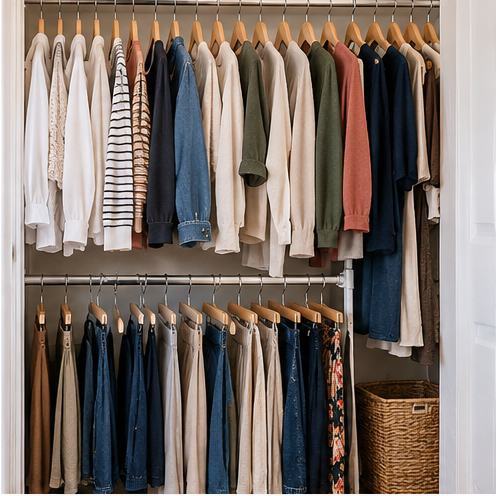
3. Switch to Slim Hangers
Bulky hangers consume rod space surprisingly quickly.
If you’re using a mixture of thick plastic, wood and oversized hangers, switching to uniform slim hangers can help you fit more clothing onto the same rod.
Slim velvet hangers are particularly useful for:
- Shirts
- Blouses
- Dresses
- Lightweight jackets
- Pants
They also help prevent clothing from sliding off.
But don’t interpret the extra capacity as permission to pack the rod until the hangers can barely move.
You should still be able to slide clothing aside enough to see what you own.
Slim velvet hangers → Buy on Amazon
4. Add a Second Hanging Rod
Many closets waste a huge amount of vertical space beneath shirts and folded pants.
If most of your hanging clothes are relatively short, a second rod can effectively create another level of hanging storage.
A common setup is:
Upper rod: shirts, blouses and jackets
Lower rod: pants, skirts and shorter items
You don’t necessarily need to rebuild the closet.
Hanging closet rods are available that suspend from an existing rod and create another hanging level below.
Before buying one, measure your clothing.
Hang one of your longer shirts from the upper rod and determine how much clearance remains beneath it.
If your clothes overlap heavily with the lower level, you’ve gained theoretical capacity without making the closet easier to use.
Adjustable second closet rod → Buy on Amazon
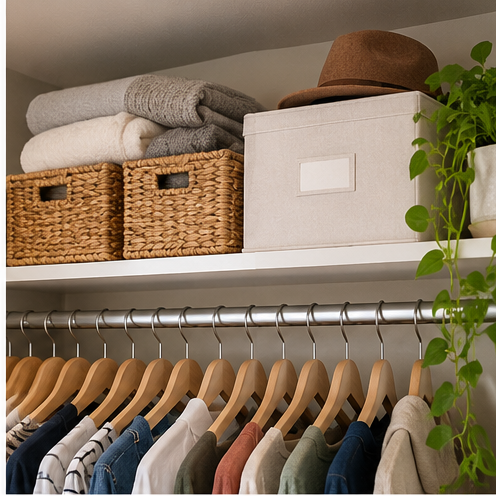
5. Use the Upper Shelf for Seasonal and Low-Frequency Items
The highest closet shelf shouldn’t necessarily hold things you need every morning.
It’s better suited to items such as:
- Seasonal clothing
- Extra bedding
- Handbags
- Hats
- Special-occasion clothing
- Clothing accessories
- Lightweight storage bins
Use labeled bins or baskets so you don’t have to open six containers to find one item.
If the shelf is particularly high, avoid storing very heavy bins there.
You shouldn’t have to wrestle a 30-pound container over your head just to retrieve a sweater.
6. Use Shelf Dividers to Stop Stacks From Collapsing
Open closet shelves often look useful until you stack sweaters on them.
Then one pile leans into another.
You pull out the bottom sweater.
Everything falls over.
Shelf dividers create separate lanes for folded clothing and help keep stacks upright.
They’re useful for:
- Sweaters
- Jeans
- Sweatshirts
- Handbags
- Towels
- Folded pants
Don’t make each stack excessively tall.
A three-foot tower of sweaters is technically organized until you need the sweater at the bottom.
Closet shelf dividers → Buy on Amazon
7. Use the Closet Floor Deliberately
The floor often becomes the default location for everything that doesn’t have a home.
Shoes get tossed there.
Bags get dropped there.
Boxes accumulate.
Eventually, you can’t even reach the back of the closet.
Instead, decide exactly what the floor is for.
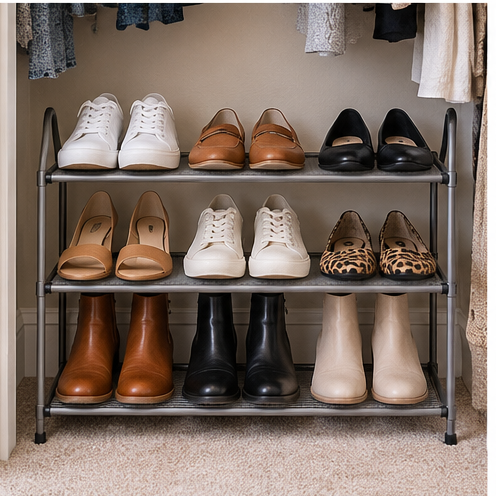
In many small closets, shoes are the best candidate.
A low shoe rack can create two or three levels of storage in roughly the same footprint as one loose row of shoes.
Compact closet shoe rack → Buy on Amazon
If you own many pairs, keep the frequently worn ones in the closet and rotate seasonal or special-occasion shoes elsewhere.
8. Add Drawers Beneath Short Hanging Clothes
If you have several feet of empty space beneath shirts, consider placing a small drawer unit there.
This can provide storage for clothing that doesn’t need to hang:
- Underwear
- Socks
- Workout clothing
- Pajamas
- T-shirts
- Accessories
Measure carefully.
You need enough room for the drawers themselves and enough clearance to pull them completely open.
Closet doors are especially important here.
Sliding or bifold doors can reduce the width of the usable opening even when the closet interior is much wider.
9. Use the Back of the Closet Door
If your closet has a traditional hinged door, the back can provide useful storage without taking up shelf or rod space.
Depending on what you own, use it for:
- Shoes
- Belts
- Scarves
- Jewelry
- Hats
- Small bags
- Accessories
Choose an organizer based on the problem you’re solving rather than simply buying the largest over-door organizer available.
And check door clearance.
An organizer filled with bulky shoes can become thick enough to interfere with clothing inside the closet or prevent the door from opening fully.
10. Move Seasonal Clothes Out of Prime Storage
A small closet doesn’t need to hold your entire wardrobe equally all year.
If it’s July, heavy winter sweaters don’t need prime hanging space.
If it’s January, summer clothing doesn’t need to occupy your easiest shelves.
Seasonal rotation lets you dedicate limited closet capacity to the clothes you’re actually using.
Off-season clothing can go:
- Under the bed
- In another closet
- In labeled upper-shelf bins
- In storage containers elsewhere in the home
When the season changes, swap the categories.
This isn’t creating more storage.
It’s reducing the amount of inventory competing for your best storage.
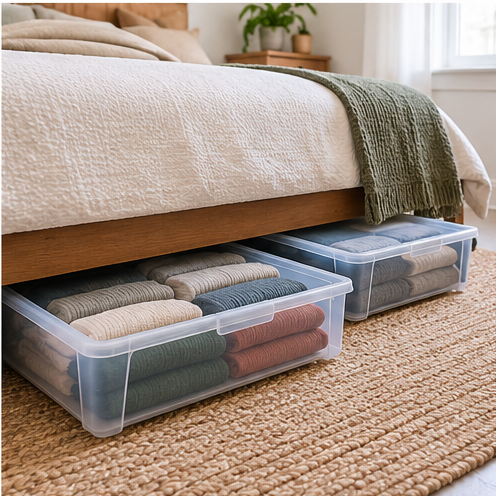
11. Use Under-Bed Storage for Overflow
If the bedroom has limited closet space, the area beneath the bed can become valuable secondary clothing storage.
It’s especially useful for:
- Off-season clothing
- Extra shoes
- Sweaters
- Spare bedding
- Special-occasion items
Measure the clearance beneath your bed before buying containers.
Don’t rely on the advertised height of the bed frame alone—support rails or other hardware may reduce usable clearance.
Containers with handles or wheels are easier to retrieve than boxes you have to drag awkwardly across the floor.
Under-bed clothing storage bins → Buy on Amazon
For more ways to use overlooked storage areas throughout a small home, see 25 Storage Ideas for Small Homes That Make Every Inch Count.
12. Don’t Waste Narrow Wall Space
Look at the side walls inside the closet.
There may be narrow areas where a shelf wouldn’t fit but hooks would.
These spaces can hold:
- Belts
- Scarves
- Bags
- Hats
- Jewelry
- Ties
Even a few inches of unused wall can remove several awkward accessories from the rod or shelves.
The same principle applies outside the closet.
If the bedroom has a narrow strip of wall near the closet, hooks or shallow wall storage may work there without consuming meaningful floor space.
13. Fold Bulky Items That Don’t Need to Hang
Not every piece of clothing benefits from a hanger.
Bulky sweaters and sweatshirts can consume a large amount of rod width.
Some knitwear can also stretch when hung.
If shelf or drawer space is available, folding these items may make better use of the closet.
Reserve hanging space for clothing that benefits most from it:
- Button-down shirts
- Blouses
- Dresses
- Jackets
- Dress pants
- Wrinkle-prone clothing
Then use shelves and drawers for items that stack efficiently.
14. Stop Storing Empty Luggage in the Closet
Suitcases are enormous empty boxes.
If they’re taking up a large section of your closet, make the space inside them work.
Store infrequently used items inside your luggage, such as:
- Travel accessories
- Off-season clothing
- Extra bags
- Spare bedding
Or move luggage somewhere less valuable if another storage location exists.
The worst option is allowing an empty suitcase to consume a quarter of a small closet while you’re struggling to find room for clothing.
15. Create a One-In, One-Out Rule
Once you’ve gotten the closet under control, prevent it from immediately filling again.
A simple rule can help:
When a new clothing item enters the closet, an old one leaves.
You don’t have to follow this with mathematical precision forever.
The point is to recognize that your closet has a fixed capacity.
If it comfortably holds 80 hanging items, adding another 40 doesn’t magically create more rod space.
Eventually, something has to give.
16. Keep a Donation Bag Nearby
One of the easiest ways to prevent another massive closet cleanout is to declutter gradually.
Keep a donation bag or box somewhere convenient.
When you put on a shirt and immediately decide you hate how it fits, don’t hang it back up.
Put it in the donation bag.
When you notice jeans you haven’t worn in two years, make a decision then.
Small decisions throughout the year are much easier than repeatedly emptying an overflowing closet.
17. Know When Organization Isn’t the Problem
This is the part storage content sometimes avoids.
There is a limit to what organizers can do.
If your closet is packed from floor to ceiling, every rod is full, every shelf is stacked, under-bed storage is full and you’re still trying to squeeze more clothing inside, the problem probably isn’t organization anymore.
It’s inventory.
No shelf divider, hanger or storage bin changes the physical dimensions of the closet.
At some point, you have three choices:
Own less clothing.
Store some clothing somewhere else.
Create additional clothing storage outside the closet.
That’s not a failure of organization.
It’s simply recognizing the capacity of the space you’re working with.
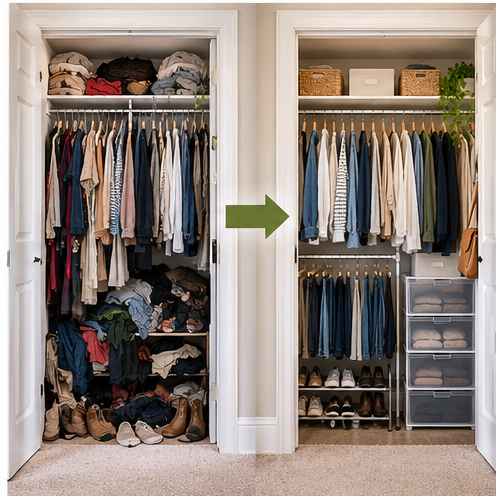
What Should Stay in a Small Closet?
When closet capacity is extremely limited, prioritize items in roughly this order:
1. Clothing you wear frequently
These deserve the easiest rod, shelf and drawer space.
2. Current-season clothing
Keep what matches the weather accessible.
3. Work or regularly used special-purpose clothing
Uniforms, workwear or frequently worn formal pieces should remain reasonably convenient.
4. Frequently worn shoes and accessories
Don’t devote half the closet to shoes you wear twice a year.
5. Occasional and off-season items
These can move higher, lower or outside the closet entirely.
This creates a hierarchy based on use, not just category.
How Much Space Should You Leave on the Closet Rod?
If your hangers are compressed so tightly that you have to force clothing apart, the closet is too full.
There isn’t a magic number of inches that works for every wardrobe because clothing thickness varies enormously.
Twenty T-shirts require very different space from twenty winter coats.
A better test is functional:
Can you move the hangers sideways?
Can you see individual garments?
Can you remove one piece without dragging several others with it?
Can you put clean clothes away easily?
If not, either reduce the number of hanging items or move some clothing to shelves, drawers or secondary storage.
Don’t Buy Every Closet Organizer at Once
A freshly emptied closet can make you want to redesign the entire thing immediately.
Don’t.
Solve the biggest constraint first.
If hanging space is the problem, consider slim hangers or a second rod.
If shoes dominate the floor, solve shoe storage.
If folded clothes collapse everywhere, add shelf dividers.
If off-season clothes consume half the closet, relocate them.
Then live with the new setup before adding more.
This prevents you from spending money on organizers that simply create better-organized clutter.
If you want a broader set of ideas for maximizing rods, shelves, shoes and vertical space, our 17 Small Closet Organization Ideas That Make the Most of Limited Space goes deeper into general small-closet organization.
A Simple Small-Closet Reset
If your closet currently feels impossible, don’t try to perfect everything at once.
Start here:
- Empty the closet.
- Remove clothing you don’t wear.
- Move off-season items elsewhere.
- Measure the available space.
- Put frequently worn clothes back first.
- Identify the biggest remaining storage problem.
- Add an organizer only if it solves that problem.
That sequence matters.
If you buy organizers before reducing and prioritizing your clothes, you’re designing the closet around an inventory that may not belong there in the first place. That’s a very important part of how to organize a small closet.
Frequently Asked Questions
How do you organize a small closet when you have a lot of clothes?
Start by prioritizing frequently worn and current-season clothing. Then maximize existing capacity with slim hangers, double hanging rods, upper-shelf storage, shoe racks and drawers beneath short hanging clothes. Move low-frequency and off-season clothing to secondary storage when necessary.
Do slim hangers really save closet space?
They can. Replacing bulky hangers with thinner ones reduces the amount of rod width consumed by the hangers themselves. The benefit is greatest when you’re currently using thick wood, plastic or mixed hangers.
How can I double the hanging space in a small closet?
If most of your clothing is short enough, add a second hanging rod beneath the existing one. Measure the length of your hanging clothes first to make sure the upper and lower levels won’t overlap excessively.
Where should I put clothes that don’t fit in my closet?
Off-season and infrequently worn clothing can go under the bed, in another closet, in upper-shelf bins or in another appropriate storage area. If frequently worn clothing still doesn’t fit after organizing, reducing the wardrobe may be more effective than adding additional containers.
Should I fold clothes or hang them to save space?
It depends on the garment and your available storage. Bulky sweaters, T-shirts, workout clothing and similar items often use space efficiently when folded, while dresses, jackets and wrinkle-prone clothing generally benefit from hanging.
Make the Closet Fit the Wardrobe—or the Wardrobe Fit the Closet
A small closet can hold more than it initially appears to.
Slim hangers can recover rod space.
A second rod can use wasted vertical space.
Shelves, drawers and shoe racks can turn empty areas into functional storage.
Seasonal rotation can keep rarely used clothes from consuming prime space.
But the most important part of organizing a small closet with too many clothes is recognizing that storage has a physical limit.
Don’t judge success by how many things you can cram inside.
Judge it by whether you can see your clothes, reach them easily, put them away without a fight and actually use what you own.