
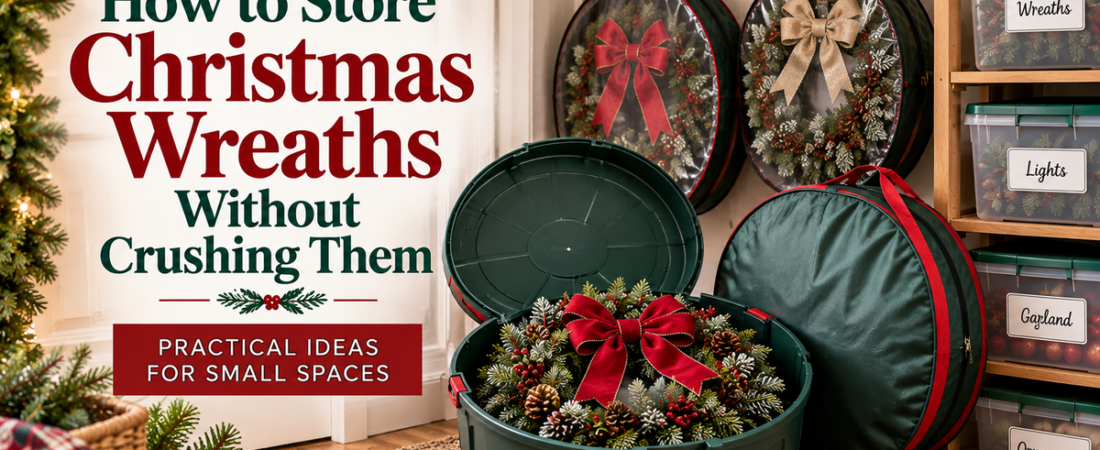
Good wreath storage has to solve an awkward problem: wreaths are wide, relatively shallow, and often covered with decorations that stick out farther than the wreath itself, hence, how to store christmas wreaths.
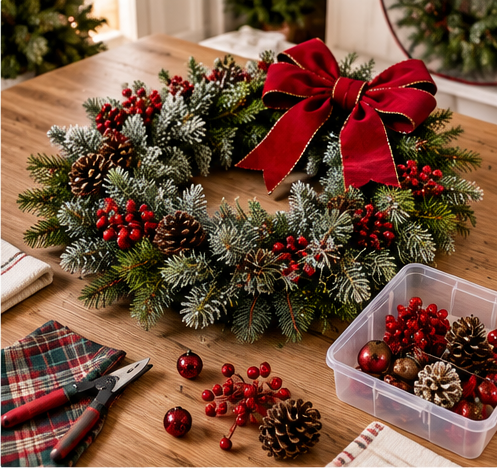
A wreath that measures 24 inches across might also have a six-inch bow, pinecones, ornaments, berries, or decorative picks extending from the front. Push it into a container that is too shallow and those details can come out flattened, bent, or broken next Christmas.
The best way to store Christmas wreaths is to protect both their diameter and depth while using as little valuable storage space as possible.
That might mean a hard-shell container, a soft wreath bag, hanging storage, or even a dedicated section of a closet.
1. Measure the Wreath Before Buying Storage
Wreaths are usually sold by diameter.
That is only half the measurement you need for storage.
Measure:
- the widest point across the wreath
- the deepest point from front to back
- any bow that extends beyond the greenery
- decorative picks or branches that stick out
- oversized ornaments or pinecones
For example, a wreath may have a 24-inch base but measure closer to 28 inches across once the greenery and decorations are included.
Depth matters just as much.
A heavily decorated wreath might be eight or ten inches deep even though the frame itself is relatively flat.
If you are choosing a wreath case or trying to fit one onto shelving, use the same approach as our guide to measuring for storage organizers: measure the object at its true widest and deepest points, then compare those numbers with the usable interior dimensions of the storage container.
2. Do Not Compress the Wreath Just to Make It Fit
A wreath should fit its storage container without needing to be flattened.
Forcing the lid closed can:
- bend artificial greenery
- crush bows
- break ornaments
- flatten berries
- bend decorative picks
- deform the wreath frame
If the wreath only fits after you press firmly on the lid, the container is too shallow.
A little contact with soft greenery is generally unavoidable.
Actual compression is different.
The goal is to keep the wreath contained—not turn it into a pancake for eleven months.
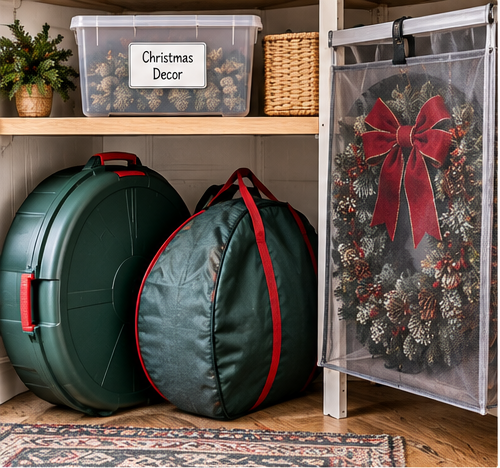
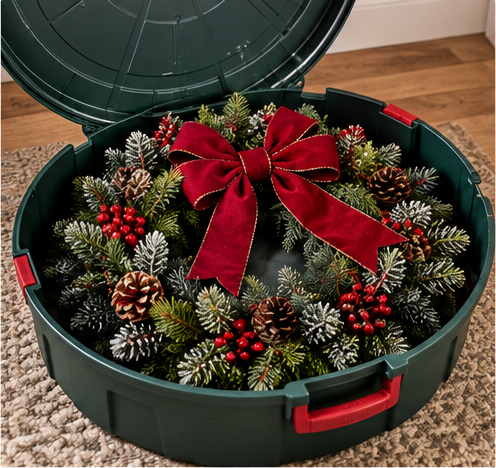
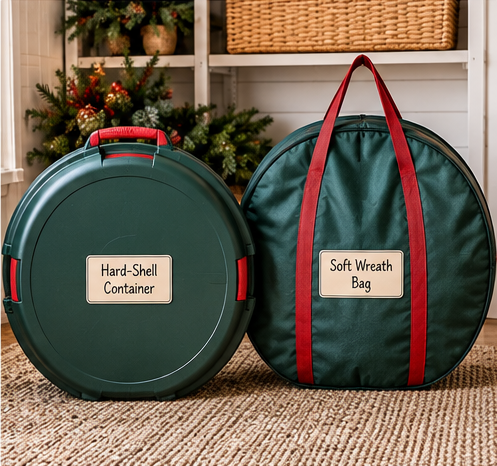
3. Use a Hard-Shell Wreath Container for Fragile Decorations
Rigid wreath containers provide the best protection against crushing.
They make the most sense for wreaths with:
- glass ornaments
- fragile decorative pieces
- large bows
- brittle artificial berries
- delicate picks
- sentimental decorations
- expensive artificial greenery
A hard case prevents another storage bin from accidentally being stacked directly on the wreath.
It can also make wreaths easier to stack when horizontal storage is your best option.
Small-space advantage
A rigid case creates a predictable footprint.
If the case is 30 inches across and 8 inches deep, you know exactly how much shelf space it requires.
Tradeoff
Hard wreath containers are bulky even when empty.
They also need to be sized carefully. Buying a giant case for a small wreath wastes valuable storage volume.
Hard-shell wreath storage container → Buy on Amazon
4. Use a Soft Wreath Bag When Crush Protection Is Less Important
Soft wreath bags are lighter and easier to store than rigid cases.
They work well for relatively durable artificial wreaths without extremely fragile decorations.
Look for:
- a wide zipper opening
- reinforced carrying handles
- enough diameter for the entire wreath
- enough depth for decorations
- a clear label window if useful
A soft bag keeps dust off the wreath and prevents greenery from catching on other stored items.
Small-space advantage
Unlike a rigid container, a fabric bag has a little flexibility.
It can also fold nearly flat when not in use.
Tradeoff
A soft bag does not protect the wreath from heavy objects.
Do not put a fabric wreath bag at the bottom of a stack of Christmas bins.
Soft Christmas wreath storage bag → Buy on Amazon
5. Protect the Bow Before Putting the Wreath Away
Large decorative bows are often the first part of a wreath to get crushed.
Before storage, gently reshape the bow.
Then make sure it has enough open space around it.
If the bow contains wired ribbon, you can lightly shape the loops so they hold their form rather than folding them completely flat.
Avoid wrapping the entire wreath tightly in plastic.
That may press the bow and greenery against the wreath for months.
For particularly elaborate wreaths, the storage container may need to be significantly deeper than the wreath frame itself.
6. Remove Loose Decorations Before Storage
Inspect the wreath before putting it away.
Look for:
- loose ornaments
- unsecured pinecones
- damaged berries
- hanging ribbon
- detached floral picks
- loose wire
- battery packs
Repair loose pieces now rather than discovering them at the bottom of the storage container next year.
If something is designed to be removable, taking it off may make storage easier.
For example, a detachable oversized bow might be stored separately so the wreath itself requires less depth.
7. Remove Batteries From Battery-Powered Wreaths
If your wreath uses battery-powered lights, remove the batteries before long-term storage unless the manufacturer specifically says otherwise.
Old batteries can leak and damage:
- battery compartments
- wires
- lighting controls
- surrounding decorations
Keep the battery box accessible inside the storage container rather than buried beneath the wreath.
If the lights are removable, you may prefer storing them separately with the rest of your Christmas lighting supplies.
8. Hanging Storage Can Save Valuable Shelf Space
Wreaths do not always need to sit on shelves.
Hanging them can turn unused vertical space into seasonal storage.
Possible locations include:
- a closet wall
- the back of a storage-room door
- a sturdy closet rod
- wall hooks in a basement storage room
- garage wall storage where conditions are appropriate
This is particularly useful in small homes because wreaths consume a surprising amount of horizontal shelf area.
The same principle is used throughout our guide to vertical storage for small spaces: items that are awkward to stack can sometimes be stored much more efficiently by moving them upward.
Hanging wreath storage bag → Buy on Amazon
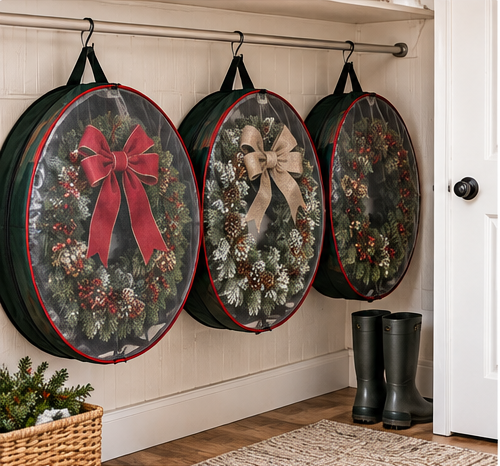
9. Make Sure the Hook Can Handle the Weight
Some wreaths are heavier than they look.
Large artificial wreaths with:
- dense greenery
- wood decorations
- metal frames
- large ornaments
- battery packs
can put substantial weight on a hook.
Check the hook’s weight rating and the surface it is attached to.
A strong hook attached properly to a wall stud is very different from a lightweight adhesive hook attached to painted drywall.
If you are hanging several wreaths, distribute the weight instead of putting the entire collection on one small hook.
Heavy-duty closet or wall hooks → Buy on Amazon
10. Do Not Hang a Wreath From a Fragile Decorative Loop
Some wreaths come with ribbon loops intended mainly for display.
Those loops may not be designed to support the wreath for a full year in storage.
When possible, support the wreath from:
- the actual wreath frame
- a durable built-in hanger
- a storage-bag handle designed for hanging
This reduces the chance that a decorative ribbon stretches or tears while the wreath is stored.
11. Horizontal Storage Works Well on Deep Shelves
If you have wide basement or garage shelving, laying wreath containers flat can work extremely well.
A rigid wreath case can sit:
- on a deep shelf
- on top of other lightweight seasonal storage
- beneath another rigid wreath case
The main limitation is shelf depth.
A 30-inch wreath container needs a lot more depth than a typical closet shelf.
Measure before buying the case.
If the container hangs six inches off the front of the shelf, you have not really solved the storage problem.
12. Store Multiple Wreaths Carefully
If you own several wreaths, resist the temptation to pile them directly on top of each other.
That creates pressure on the lower wreaths.
Better options include:
Separate soft bags
Best when wreaths are decorated differently and need individual protection.
Stackable rigid containers
Useful when you have enough shelf or floor space.
Hanging side by side
Excellent when wall or closet-rod space is available.
One oversized container with separators
Potentially workable for flatter, durable wreaths, but only if the wreaths are kept from pressing directly against one another.
13. Use Closet Walls and Doors That Are Normally Wasted
A wreath is awkward on a shelf but naturally suited to a vertical surface.
Look at:
- unused closet sidewalls
- the back of a utility-room door
- deep closet doors
- wall space above lower storage bins
Those overlooked areas can be valuable.
Our guide to hidden storage ideas for small homes covers the same idea more broadly: seasonal items are good candidates for spaces that are inconvenient for everyday belongings.
Just make sure the wreath does not interfere with the door closing or rub against clothing every time the closet is used.
14. Think About Door Clearance
Behind-the-door wreath storage sounds perfect until the wreath prevents the door from opening fully.
Measure:
- wreath depth
- hook depth
- available wall clearance
- distance between the door and nearby shelving
A heavily decorated wreath can stick surprisingly far into the room.
If the door swings into a wall, the wreath may also get crushed between them.
Test the full door movement before committing to that storage location.
15. Keep Wreaths Off Damp Basement and Garage Floors
If wreaths are stored in a basement or garage, keep them elevated.
Do not place fabric wreath bags directly on concrete floors where they could be exposed to:
- condensation
- minor flooding
- snowmelt
- spilled liquids
- pests
Use shelving or another raised storage surface.
A rigid plastic wreath case provides more protection than fabric but should still be kept away from areas where water regularly collects.
16. Be Careful With Extreme Heat
Attics and garages can become extremely hot.
That may affect:
- hot-glued decorations
- artificial berries
- plastic ornaments
- foam pieces
- battery-powered lights
- some artificial greenery
A basic wreath bag protects against dust.
It does not control temperature.
If the wreath is valuable, sentimental, or covered with delicate materials, climate-controlled indoor storage is the safer choice.
17. Keep Natural Wreaths Out of Long-Term Storage
Fresh evergreen wreaths are not intended to be stored for next Christmas.
Once the season is over, compost or dispose of them appropriately.
The storage methods in this guide are intended for:
- artificial greenery wreaths
- grapevine wreaths
- reusable decorative wreaths
- fabric wreaths
- other durable seasonal wreaths
Trying to seal natural greenery inside a storage container can trap moisture and create mold or odors.
18. Label Wreath Storage Clearly
A round green bag makes the contents fairly obvious.
But labels become useful when you own several wreaths.
Examples:
- Front Door Christmas Wreath
- Kitchen Wreath
- Living Room Wreath
- Red Berry Wreath
- Upstairs Wreath
Labeling by location is especially useful if you decorate the same way every year.
You can carry each wreath directly to the room where it belongs.
Reusable storage labels → Buy on Amazon
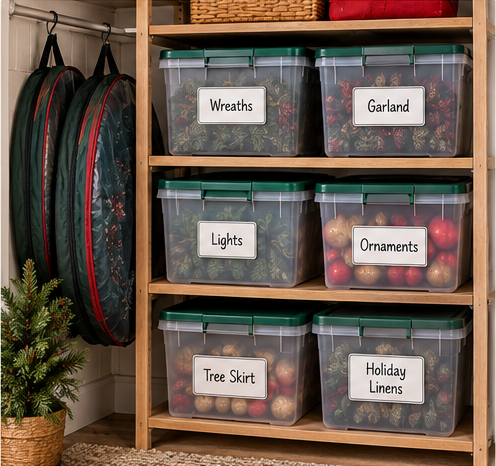
19. Store Wreaths With Other Once-a-Year Decorations
Wreaths do not need prime everyday storage.
Whenever possible, group them with the rest of your Christmas collection.
That might mean:
- upper closet areas
- dedicated basement shelving
- a holiday-storage wall
- remote utility-room storage
20. Do Not Let Wreath Storage Become Bigger Than the Wreath
There is a balance between protection and wasted space.
A 22-inch simple greenery wreath does not necessarily need a giant 36-inch hard-shell container.
Before buying storage, ask:
- Is the wreath actually fragile?
- Does it have decorations that need crush protection?
- Could it safely hang instead?
- Could a soft bag use less space?
- Is the container dramatically larger than the wreath?
The best wreath-storage solution protects the decoration without creating an unnecessarily large seasonal-storage footprint.
Hard-Shell vs. Soft Wreath Storage: Which Is Better?
Neither is automatically better.
Choose a hard-shell wreath container when:
- the wreath has fragile decorations
- other bins will be stacked around it
- crush protection matters
- you have sufficient shelf space
- the container’s fixed footprint fits your storage area
Choose a soft wreath bag when:
- the wreath is relatively durable
- you want hanging storage
- you need a lighter container
- storage space is tight
- the bag will not have heavy objects stacked on it
For many small homes, soft hanging storage is more space-efficient.
For expensive or highly decorated wreaths, rigid protection may be worth the extra footprint.
A Simple Wreath Storage Routine
When the holidays are over:
- Remove the wreath carefully.
- Remove batteries from lighted wreaths.
- Inspect for loose decorations.
- Repair anything that needs attention.
- Reshape bows and greenery.
- Measure the wreath if you are buying new storage.
- Place it in a properly sized bag or case.
- Avoid compression.
- Label it by room or location.
- Store it hanging or flat in a dry, protected area.
That is enough to keep most reusable wreaths looking good year after year.
Looking for more ways to keep holiday decor organized? We rounded up our favorite Christmas storage solutions on Amazon, including practical options for ornaments, lights, wrapping supplies, wreaths, artificial trees, and more—all with small spaces in mind.
Frequently Asked Questions – How to Store Christmas Wreaths
What is the best way to store Christmas wreaths?
Place the wreath in a properly sized protective bag or rigid container without compressing the bow, greenery, or decorations. Store it flat or hanging in a dry location where heavy items cannot crush it.
Is it better to hang or lay wreaths flat for storage?
Both methods can work. Hanging saves shelf space and works well for durable wreaths in soft bags. Flat storage in rigid containers provides better crush protection for fragile decorated wreaths.
Can you store multiple wreaths together?
Yes, but avoid stacking bare wreaths directly on one another. Use individual bags, separators, or rigid containers so the weight of one wreath does not crush another.
How do you store a wreath with a large bow?
Measure the wreath at the deepest point of the bow and choose a container that provides enough front-to-back clearance. Do not flatten the bow simply to make the wreath fit.
Can Christmas wreaths be stored in the garage?
Artificial wreaths can be stored in a dry garage, but heat, humidity, pests, and water exposure can damage some materials. Keep wreaths elevated and use more climate-controlled storage for valuable or delicate decorations.
Should wreaths be stored in plastic bags?
A purpose-made wreath bag can protect against dust, but avoid tightly wrapping the wreath in thin plastic that compresses decorations or traps moisture.
What size wreath storage container do I need?
Measure the wreath’s true outside diameter and its maximum depth, including bows and decorations. Choose a container with enough usable interior space for both dimensions without compressing the wreath.