
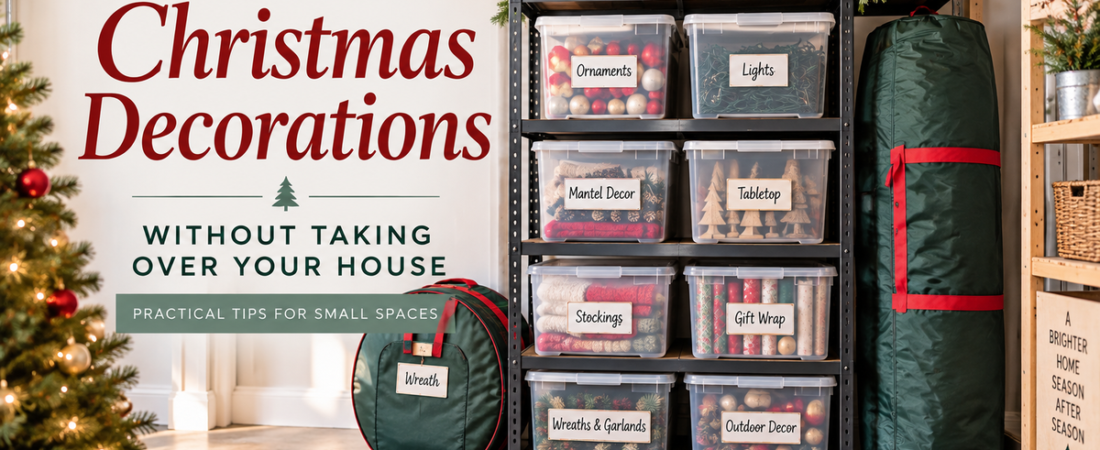
Figuring out how to store Christmas decorations gets harder when you live in a small home. A few bins of ornaments can quickly turn into a collection of bulky tubs, wreaths, light strands, wrapping supplies, and an artificial tree competing for the same closets and shelves you need all year.
The solution is not necessarily buying more storage containers.
A better system starts by deciding what you own, where each type of decoration can safely be stored, and how much space you can realistically dedicate to things you use once a year.
With a little planning, Christmas decoration storage can take up far less room while also making decorating easier next year.
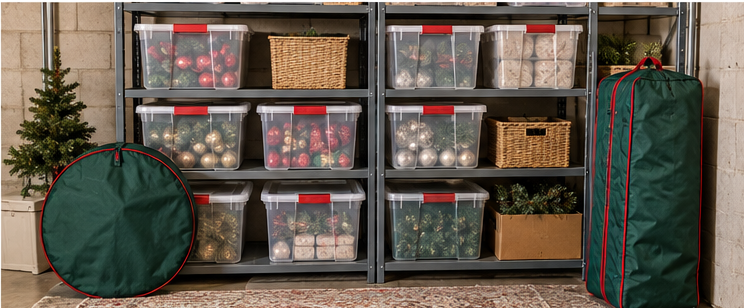
1. Take Inventory Before You Buy More Christmas Storage Bins
It is tempting to start by buying a matching set of holiday bins.
Start with the decorations instead.
Bring your Christmas storage together and sort everything into categories such as:
- tree ornaments
- Christmas lights
- wreaths and garlands
- tabletop decorations
- stockings
- outdoor decorations
- artificial greenery
- wrapping paper and gift supplies
- artificial tree pieces
This does two things.
First, it shows you how much Christmas stuff you actually have.
Second, it prevents the common problem of buying containers first and then trying to force completely different objects into them.
A collection of lightweight fabric decorations does not need the same container as fragile glass ornaments. Wrapping-paper rolls need long, narrow storage. A wreath needs enough depth to prevent its decorations from being crushed.
If you already own a pile of storage containers, emptying and reorganizing them may reveal that you have enough storage without buying anything else.
2. Stop Using One Giant “Miscellaneous Christmas” Bin
Large miscellaneous bins feel convenient when you are putting decorations away.
They are usually frustrating when you need something again.
Instead of digging through one oversized container full of unrelated items, group decorations either by type or by decorating zone.
For example, a category system might include:
- ornaments
- lights
- mantel decor
- outdoor decor
- wrapping supplies
A zone-based system might include:
- living room
- front porch
- kitchen
- bedroom
- dining room
Either can work.
Choose the method that matches how you decorate.
If you tend to decorate one room at a time, storing decorations by room can be surprisingly efficient. If you frequently reuse decorations in different areas, storing them by category may make more sense.
The important part is avoiding huge bins containing unrelated items just because there was space left inside. For more on this, check out my Christmas bin buyer guide.
3. Measure the Storage Space Before Choosing Containers
In a small home, the dimensions of the storage space matter just as much as the capacity of the container.
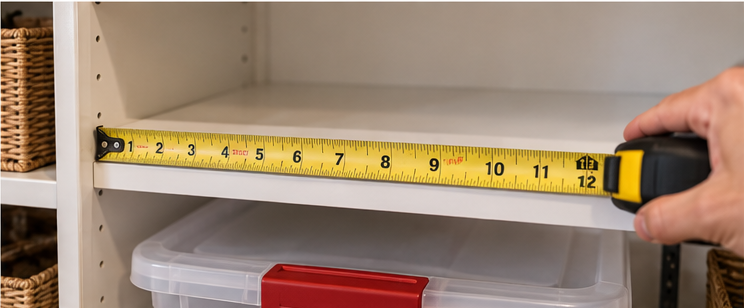
Before buying bins, measure:
- available shelf width
- usable shelf depth
- vertical clearance
- closet-door clearance
- space required for handles or latches
- room needed to lift a bin off a shelf
A 70-quart bin may technically fit on a shelf but still be impractical if you cannot tilt or lift it out.
Likewise, two slightly smaller containers may use the shelf more efficiently than one oversized tub.
If you are unsure how to measure around shelves, doors, trim, and other obstructions, use the SWU guide on how to measure for storage organizers before you buy.
You can also use the storage bin size guide to think through container dimensions rather than relying only on advertised capacity.
4. Standardize Bin Footprints When You Can
Matching containers are not necessary for good organization.
Matching footprints, however, can make stacking much easier.
If one Christmas bin is 18 inches deep, another is 23 inches deep, and another is 30 inches deep, you may end up wasting shelf space even though each container is individually useful.
When replacing old bins, consider gradually standardizing around one or two sizes that fit your actual shelving.
This can make it easier to:
- stack containers safely
- use the full depth of shelves
- avoid unstable towers
- predict how much space future decorations will require
You do not have to replace perfectly usable bins just for appearance.
Treat standardization as a long-term improvement rather than another excuse to buy storage containers.
5. Use Clear and Opaque Bins for Different Jobs
Clear Christmas storage bins make it easier to see what is inside without opening them.
That can be useful for mixed decorations or items that are difficult to describe on a label.
Opaque containers have advantages too. They hide visual clutter and can reduce light exposure for certain items.
There is no rule that every Christmas container needs to match.
A practical combination might be:
- clear bins for general decorations
- divided organizers for ornaments
- dedicated bags or cases for wreaths
- reels or cord organizers for lights
- long organizers for wrapping supplies
Choose the container around the object rather than trying to make every object fit the same container.
6. Label More Specifically Than “Christmas”
A label that says CHRISTMAS is not especially helpful when you have eight Christmas bins.
Use labels that tell you what you will actually find inside.
Examples:
- Living Room Decorations
- Glass Ornaments
- Outdoor Lights
- Mantel + Stockings
- Gift Wrap + Ribbon
- Kitchen Christmas Decor
If a bin contains decorations for one specific location, include that location on the label.
You can also number containers when you routinely unpack them in a certain order.
Labels are particularly useful when opaque bins are stored high on shelves where you cannot see the contents.
Reusable storage labels → Buy on Amazon
7. Put Once-a-Year Decorations in Your Least Convenient Storage
Prime storage should go to things you use regularly.
Christmas decorations do not need the easiest shelf in the house for eleven months of the year.
Look for storage areas that are inconvenient for everyday items but reasonable for seasonal storage, including:
- high closet shelves
- upper garage shelving
- basement shelving
- under-bed areas
- deep closet zones
- high utility-room shelving
- difficult-to-reach cabinet tops
The idea is to move rarely used items away from valuable everyday storage.
Our guide to vertical storage for small spaces has more ways to use height instead of sacrificing additional floor area.
For particularly difficult spots, these storage ideas for awkward spaces may help identify areas you are currently wasting.
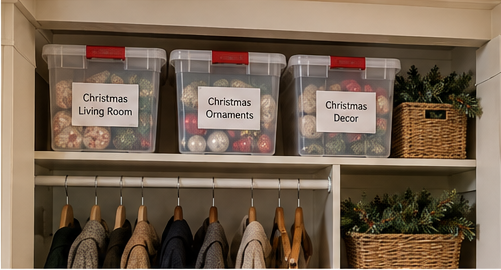
8. Be Careful About What Goes in the Garage, Attic, or Basement
The biggest available storage space is not automatically the best place for every Christmas decoration.
Garages, attics, and unfinished basements may experience bigger temperature and humidity swings than the interior of your home.
Fragile or sensitive decorations may be better stored indoors.
Think carefully before placing items such as:
- delicate heirloom ornaments
- paper decorations
- photographs
- candles
- fabric that could absorb moisture
- electronics
- decorations with adhesives
- valuable collectibles
An artificial tree, durable plastic decorations, or rugged outdoor decor may tolerate remote storage better, depending on the conditions in the space.
If you use a basement or garage, keep containers off damp floors when possible and use containers that close securely.
Do not assume that a sealed plastic tub makes every location safe. The environment still matters.
9. Protect Fragile Ornaments Instead of Filling Them Into Empty Gaps
Small ornaments can make a storage bin look half empty, which creates the temptation to pile other decorations on top.
That can turn into broken ornaments by next Christmas.
Fragile ornaments are usually better stored in divided compartments or individual protective wrapping.
Adjustable dividers are especially useful if your collection includes ornaments of different sizes.
Avoid packing delicate pieces so tightly that pressure is transferred between compartments.
Keep particularly valuable or sentimental ornaments in an area where they will not spend the year underneath heavy bins.
We will cover Christmas ornament storage in much more detail separately because ornaments have very different storage needs from general holiday decor.
Adjustable-divider ornament storage case → Buy on Amazon
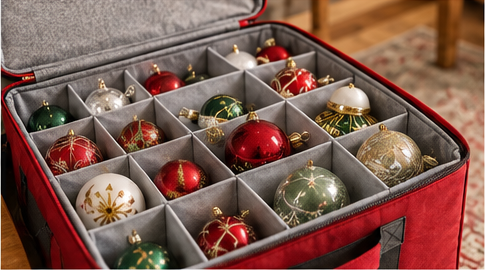
10. Store Christmas Lights So You Never Have to Untangle Them Again
Christmas lights take up surprisingly little physical space.
The problem is usually how they are stored.
Throwing several loose strands into a bin creates a tangled pile that can also put unnecessary stress on wires and bulbs.
Instead, wrap each strand around:
- a dedicated light reel
- a cord spool
- a flat light-storage board
- a simple sturdy wrap
Do not pull strands excessively tight.
Label the organizer by location if you use the same lights in the same place every year.
Examples:
Front Porch
Living Room Tree
Outdoor Railing
Test the strands before putting them away so you are not carefully storing lights that already need to be replaced.
A full guide to storing Christmas lights without tangling them will be part of this holiday-storage series.
Christmas light storage reels → Buy on Amazon
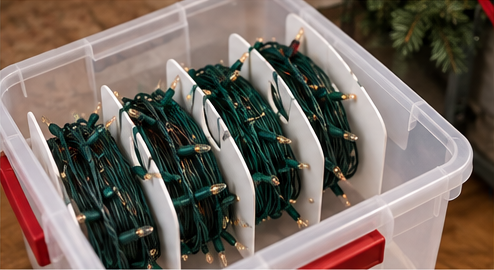
11. Give Wreaths Their Own Storage Space
Wreaths create a different problem.
They are wide, relatively shallow, and often covered with decorations that do not tolerate pressure well.
Trying to wedge a decorated wreath into a standard tote can flatten greenery, crush bows, and bend decorative picks.
Before choosing a wreath container, measure both:
- wreath diameter
- wreath depth at its thickest point
A 24-inch wreath is not necessarily only 24 inches of storage space once a large bow or deep decorative elements are attached.
Depending on your available space, wreaths can be stored:
- hanging
- flat in a protective container
- in a soft wreath bag
- in a rigid wreath case
We will cover these options in the dedicated wreath-storage article later in this series.
Protective wreath storage bag → Buy on Amazon
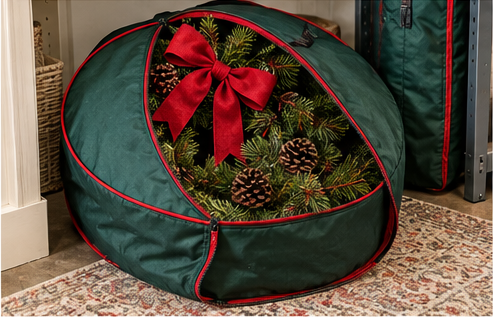
12. Treat the Artificial Christmas Tree as Its Own Storage Project
For many households, the tree is the largest single Christmas item that needs to be stored.
Do not choose a tree-storage bag based only on the advertised tree height.
Two 7.5-foot trees can have very different amounts of branch volume once disassembled.
Before buying a bag, look at:
- number of tree sections
- section length
- compressed branch diameter
- total weight
- bag dimensions
- available shelf or floor space
- whether you need to carry the tree up or down stairs
Pre-lit trees also deserve extra care so wires and connectors are not repeatedly crushed or sharply bent.
Some trees work well in horizontal bags. Others may be easier to store vertically or in rolling bags.
The next tree-specific guides in this holiday cluster will cover both how to store an artificial Christmas tree and how to choose a Christmas tree storage bag that actually fits. Along with that check out my picks for the 7 Best Christmas Tree Storage Bags.
Artificial Christmas tree storage bag → Buy on Amazon
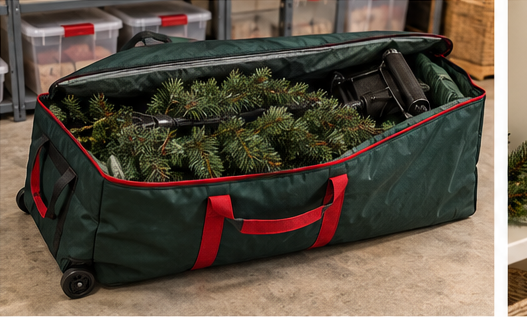
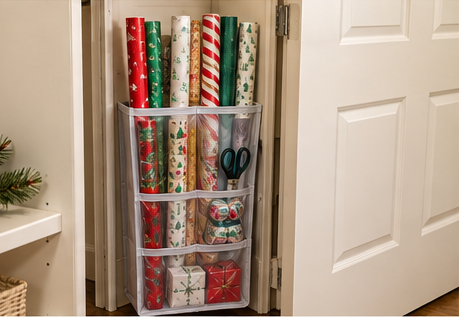
13. Keep Wrapping Supplies Together Instead of Scattered Around the House
Wrapping supplies have an annoying way of spreading into multiple closets and drawers.
One closet has the wrapping paper.
Another drawer has the tape.
Gift bags are somewhere else.
Ribbon is wherever ribbon disappears to.
Create one gift-wrap zone containing:
- wrapping-paper rolls
- gift bags
- tissue paper
- ribbon
- bows
- tags
- tape
- scissors
In small homes, this does not necessarily require a dedicated gift-wrapping station.
A slim organizer can live:
- under a bed
- behind a door
- on a closet wall
- in a tall narrow bin
- on a compact rolling cart
For other ways to hide bulky seasonal supplies inside space you already have, see 15 hidden storage ideas for small homes.
Wrapping paper storage has enough different options that it will also get its own guide in this holiday-storage series.
Slim wrapping-paper or gift-wrap organizer → Buy on Amazon
14. Separate Christmas-Only Items From Year-Round Items
Not everything used at Christmas needs to disappear into deep seasonal storage.
You may use some items throughout the year:
- scissors
- clear tape
- neutral gift bags
- basic tissue paper
- extension cords
- batteries
- reusable hooks
Keep those everyday supplies accessible.
Move only Christmas-specific versions into long-term seasonal storage.
This prevents the annoying February experience of realizing your only roll of tape is buried behind six Christmas tubs.
15. Avoid Letting Holiday Storage Expand Every Year
Storage containers can disguise how much you own.
If another decoration fits inside another bin, it can feel as though storage has solved the problem.
Eventually, however, the bins become the problem.
Give your Christmas decorations a defined storage boundary.
For example:
Christmas decorations must fit on these two shelving units plus one tree bag and two wreath containers.
When the collection exceeds that space, decide whether something should leave before automatically adding another storage location.
This is especially important in a small home where every seasonal storage expansion takes space away from something else.
The broader 25 storage ideas for small homes can help if seasonal items are competing with everyday household storage.
A Simple Christmas Decoration Storage System
If your holiday storage currently feels chaotic, you do not need to reorganize everything perfectly in one day.
Start with this sequence:
- Gather the decorations.
- Remove anything you no longer use.
- Group what remains by category or decorating zone.
- Measure the storage area.
- Match containers to both the objects and the available space.
- Protect fragile and unusually shaped items separately.
- Label everything clearly.
- Move the collection into low-priority seasonal storage.
- Give the entire collection a defined space limit.
That system matters more than whether every bin matches.
For a complete list of my Amazon picks for Christmas storage solutions go here!
The goal is simple:
Your Christmas decorations should fit your home—not take it over.
Frequently Asked Questions – How to Store Christmas Decorations
What is the best way to store Christmas decorations in a small house?
Consolidate decorations by category or decorating zone, then use high shelves, deep closet areas, under-bed storage, or other low-priority spaces for once-a-year items. Measure those spaces before purchasing containers so you use the available volume efficiently.
Should Christmas decorations be stored in cardboard boxes or plastic bins?
Both can work indoors, but latching plastic bins provide better protection from dust, minor moisture exposure, and crushing. Fragile ornaments and specialty items may still need dividers or dedicated containers inside the larger storage system.
Is it okay to store Christmas decorations in the garage?
Some durable decorations may work well in garage storage, but garages can experience large temperature and humidity changes. Fragile, paper-based, heat-sensitive, moisture-sensitive, or valuable decorations are generally better kept in a more controlled indoor area.
How many Christmas storage bins do I need?
There is no universal number. Start with the amount and type of decor you own, then measure your available storage area. Several appropriately sized bins that fit your shelving can be more space-efficient than a few oversized containers.
Should I use clear Christmas storage bins? – 7 Best Christmas Storage Bins for Holiday Decorations
Clear bins make contents easy to identify, while opaque bins hide visual clutter. Either works. Fit, lid security, stackability, and how well the container protects its contents are usually more important than color.
How do I keep Christmas decorations from taking up too much space?
Set a physical storage boundary for the collection. Use vertical and remote storage for seasonal items, choose containers that fit the available space efficiently, and periodically remove decorations you no longer use instead of continually adding more bins.