
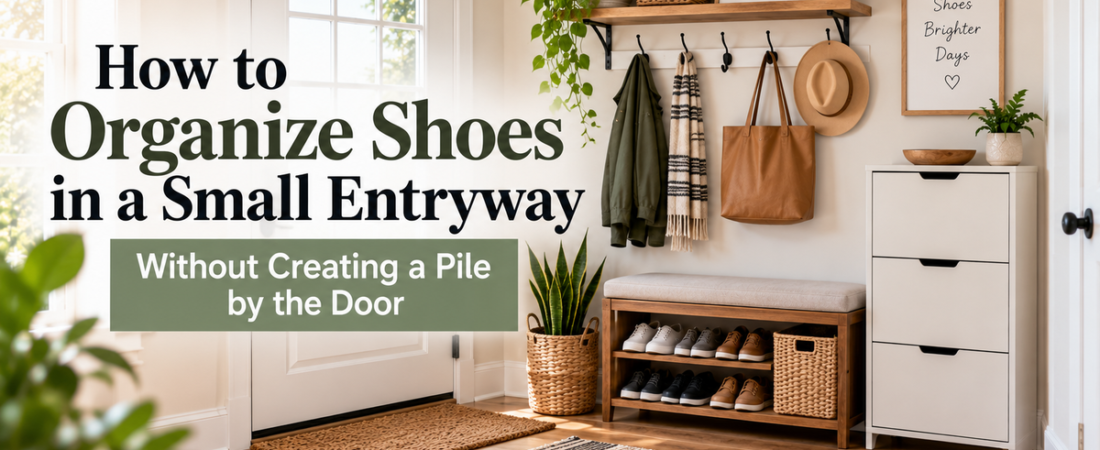
Shoes can take over a small entryway faster than almost anything else.
A few everyday pairs become a pile by the door, wet shoes end up mixed with clean ones, kids kick theirs off wherever they land, and a narrow walkway starts feeling even tighter.
The best small entryway shoe storage system isn’t necessarily the one that holds the most pairs.
It’s the one that keeps the right shoes accessible, limits how many stay by the door, fits the actual walkway, and gives wet or muddy footwear somewhere sensible to go.
Here’s how to organize shoes in a small entryway without creating another bulky storage problem.
Start by Limiting How Many Shoes Live in the Entryway
The first step is deciding how many pairs actually need to stay near the door.
Your entryway should hold current-use shoes, not your entire shoe collection.
A practical starting point is:
- 1–2 everyday pairs per person
- one seasonal pair if needed
- one designated spot for wet or muddy shoes
Everything else should move to a bedroom closet, under-bed storage, another closet, or seasonal storage.
This matters because even a very good shoe rack will look cluttered if you’re trying to store 30 pairs in a space designed for eight.
If you need ideas for storing the rest of your footwear, see our 17 Best Shoe Storage Ideas for Small Spaces.
1. Use a Narrow Shoe Cabinet Instead of a Deep Rack
A narrow shoe cabinet is one of the best choices for a tight entryway because it can store several pairs while keeping the footprint relatively shallow.
Tilt-out cabinets are especially useful where hallway depth is limited.
Before buying one, measure:
- total wall width
- cabinet depth
- door or drawer opening space
- nearby baseboards
- the remaining walkway
A cabinet that is only a few inches too deep can make a narrow entrance annoying to use.
The most important number isn’t the cabinet depth by itself.
It’s how much walkway remains once the cabinet is in place.
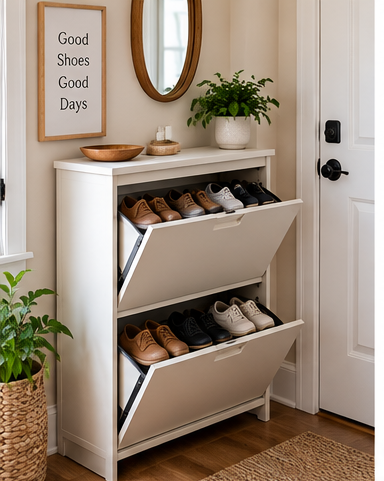
Narrow tilt-out shoe cabinet → Buy on Amazon
2. Choose Vertical Shoe Storage When Floor Width Is Tight
If you don’t have much room to spread storage across the wall, go upward.
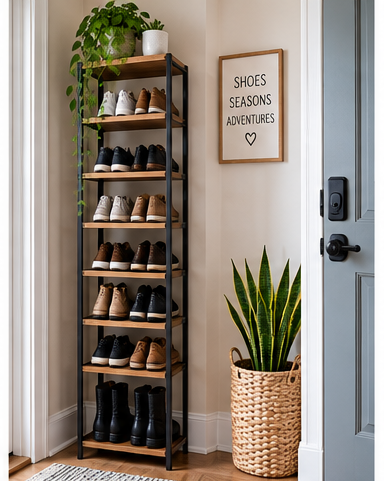
A tall narrow shoe rack can hold more pairs than a low wide rack while using less floor width.
This works especially well:
- beside a coat closet
- near the front door
- in a narrow entry alcove
- against a short wall
Put heavier shoes and boots lower.
Keep lighter shoes higher up.
If the organizer is tall and narrow, follow the manufacturer’s stability and anchoring instructions where applicable.
Tall vertical shoe rack → Buy on Amazon
3. Measure Shoe Depth Before Choosing a Rack
Many people measure the wall and forget to measure the shoes.
That matters.
A narrow rack may fit the entryway perfectly but fail if your largest shoes stick several inches beyond the shelf.
Measure your bulkiest everyday footwear, especially:
- men’s sneakers
- work shoes
- boots
- high-top shoes
Compare those measurements with the usable shelf depth.
If shoes overhang slightly, that may be fine.
If they protrude far enough to narrow the walkway, the rack isn’t really solving the problem.
Our How to Measure for Storage Organizers Before You Buy covers this kind of fit problem in more detail.
4. Use a Small Shoe Bench Only If You Need the Seat
A shoe bench can work well in an entryway because it combines seating and storage.
But in a very small space, it only makes sense if you actually need somewhere to sit.
If you never sit down to put shoes on, a bench may consume more floor depth than a narrow cabinet or vertical rack.
Choose one with:
- open lower shelves
- shallow overall depth
- enough room for everyday pairs
- a seat height that feels practical
Don’t let the bench become a surface for mail, bags, jackets, and everything else.
If you want a bench, give it one job: sit here and store shoes here.
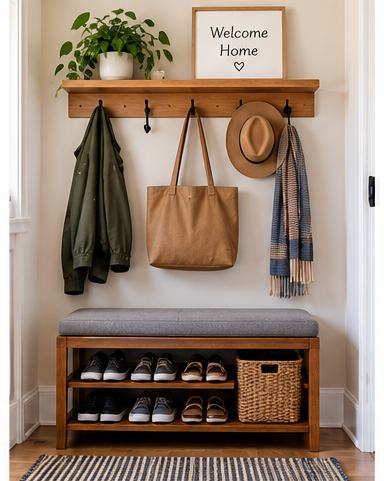
Compact shoe storage bench → Buy on Amazon
5. Give Each Person a Shoe Limit
A shared entryway gets messy quickly when everyone treats it as unlimited storage.
Assign each person a fixed amount of space.
That could mean:
- one shelf
- one cubby
- two pairs
- one small basket
Once that space is full, something has to move elsewhere.
This is especially useful with kids because the rule becomes visual and easy to follow.
You don’t have to ask whether the entryway is too crowded.
If someone’s section is overflowing, the answer is obvious.
6. Create a Separate Spot for Wet or Muddy Shoes
Wet shoes need different storage than clean everyday footwear.
Don’t shove muddy boots directly into a closed cabinet.
Use a designated:
- boot tray
- washable mat
- ventilated lower shelf
- waterproof shoe zone
Place it near the entrance so water, salt, mud, or snow doesn’t travel farther into the home.
A boot tray is especially useful during wet seasons because it keeps moisture contained.
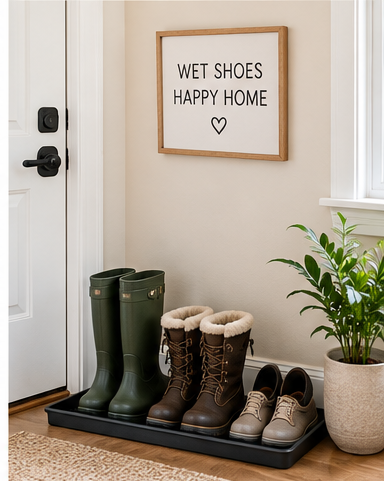
Waterproof boot tray → Buy on Amazon
7. Keep the Most-Worn Shoes at the Easiest Height
Daily shoes should be the easiest pairs to grab.
Don’t put frequently worn sneakers on the top shelf just because they fit there.
Use the most convenient levels for:
- work shoes
- school shoes
- everyday sneakers
- current-season footwear
Put occasional footwear higher, lower, or somewhere else entirely.
Good storage reduces friction.
If retrieving shoes is annoying, people will start leaving them on the floor.
8. Use Stackable Shoe Storage When Your Needs Change
Stackable organizers are useful when you don’t want to commit to one large rack.
You can start with a few levels and add more later if needed.
They work well in:
- small entry closets
- alcoves
- narrow walls
- under hanging coats
Measure the completed height if you plan to stack several units.
Also check whether the system is designed to lock or secure together.
Loose stacking can become unstable.
Stackable shoe organizer → Buy on Amazon
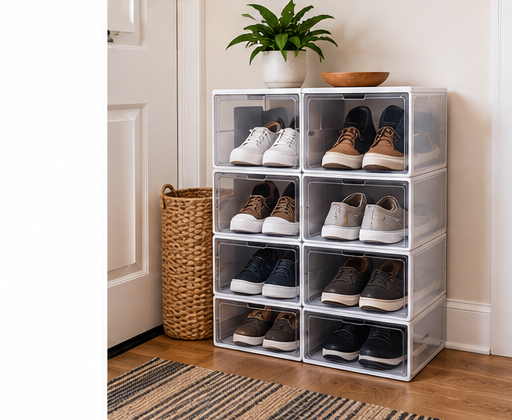
9. Use an Over-the-Door Organizer When the Floor Is Already Full
If your entryway has a nearby closet, the back of its door can provide shoe storage without using more floor space.
This works best for:
- flats
- sandals
- lightweight sneakers
- kids’ shoes
Bulky footwear may not fit well in pocket-style organizers.
Check both door clearance and interior closet clearance before buying.
The organizer shouldn’t prevent the door from closing or collide with clothing and shelves inside.
10. Don’t Store Every Season by the Door
Seasonal rotation matters more in a small entryway than in a large mudroom.
In winter, your entryway may need space for:
- boots
- heavier shoes
- snow gear
In warmer months, those items shouldn’t keep occupying prime storage.
Move off-season footwear to:
- closets
- under-bed bins
- upper shelves
- secondary storage
That frees the entryway for what you’re actually wearing now.
11. Store Shoes Heel-to-Toe When Shelf Width Is Limited
Alternating shoes heel-to-toe can sometimes reduce the width needed for a row.
It works because the widest parts of neighboring shoes don’t sit directly beside each other.
This is an easy trick to test before buying a larger organizer.
It works especially well on:
- narrow shelves
- closet floors
- benches
- compact racks
The amount of space saved depends on shoe shape, but it costs nothing to try.
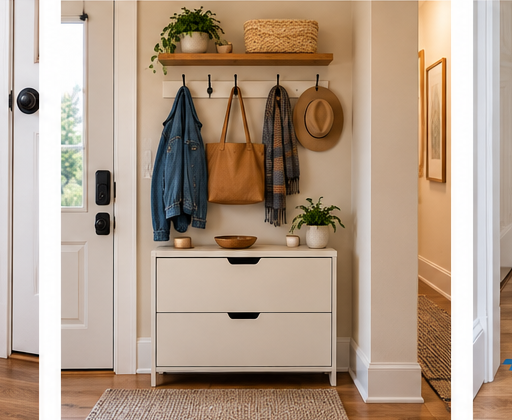
12. Keep Bags and Coats Above the Shoe Zone
A small entryway works better when storage is layered vertically.
Shoes stay low.
Coats, bags, hats, and accessories go higher.
You might combine:
- shoe cabinet below
- wall hooks above
- small shelf at the top
This creates a complete entryway zone without adding several separate pieces of furniture.
For more ideas beyond shoes, see our 17 Entryway Organization Ideas for Small Spaces That Stop Clutter at the Door.
13. Avoid Open Racks If Visual Clutter Bothers You
Open shoe racks are convenient.
You can see every pair and grab them quickly.
But they also put the entire shoe collection on display.
If your entryway is visible from the living room, a closed cabinet may make the space feel calmer.
Choose open storage if you value speed and ventilation.
Choose concealed storage if reducing visual clutter matters more.
Neither is automatically better.
The right choice depends on how the room feels and how your household behaves.
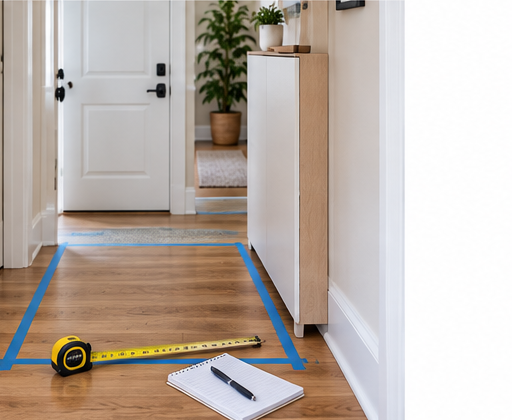
14. Leave Enough Clearance to Walk Through Comfortably
This is one of the most important measurements in a small entryway.
Don’t judge a storage piece only by whether it fits against the wall.
Put painter’s tape on the floor to mark the proposed footprint before buying.
Then walk through the entryway.
Open the front door.
Carry groceries through.
Imagine two people trying to pass each other.
If the storage feels intrusive before it’s even there, choose something shallower.
15. Keep Shoe Storage Close to Where Shoes Come Off
Storage needs to be convenient enough that people actually use it.
If everyone removes their shoes beside the door but the rack is across the room, the floor will probably win.
Place storage near the natural drop point.
This could mean:
- directly beside the door
- inside the nearest closet
- beneath wall hooks
- beside a small entry bench
Organization works better when the system follows behavior instead of expecting behavior to completely change.
16. Give Small Items Their Own Entryway Storage
Shoe clutter often isn’t only shoe clutter.
Keys, sunglasses, dog leashes, hats, gloves, and bags may all be competing for the same tiny area.
Give smaller items their own storage above or beside the shoe zone.
Use:
- hooks
- trays
- small baskets
- wall pockets
- shallow shelves
Keeping those items separate prevents your shoe cabinet or bench from becoming a catch-all.
17. Remove Shoes That Never Get Worn
If the shoe pile keeps returning even after you’ve added storage, the problem may be quantity.
Go through the pairs near the entrance and ask:
- Is this currently in season?
- Has anyone worn it recently?
- Does it fit?
- Does it belong somewhere else?
- Is another pair serving the same purpose?
Small entryways don’t have enough room for shoes that aren’t earning their space.
The easiest shoe organizer to maintain is one that isn’t overloaded.
How Much Shoe Storage Does a Small Entryway Need?
Don’t start with the number of pairs your household owns.
Start with the number of pairs your household regularly uses at the door.
For example, a family of four may own 40 pairs of shoes but only need entryway storage for 8–12 current-use pairs.
The rest can live elsewhere.
That keeps the entryway functioning as a transition zone instead of becoming the household shoe warehouse.
What Type of Shoe Storage Works Best?
Very narrow hallway
Use a shallow tilt-out shoe cabinet.
Little wall width
Use a tall vertical rack.
Need seating
Use a compact shoe bench.
Wet climate
Add a boot tray or waterproof shoe zone.
Rental
Use freestanding racks, benches, or over-door storage.
Large family
Use assigned shelves or pair limits.
Entryway visible from living space
Consider concealed shoe storage to reduce visual clutter.
Measure Before You Buy
Before ordering any shoe-storage product, record:
- available wall width
- usable depth
- total height
- door swing
- baseboard depth
- nearby vent locations
- closet-door clearance
- largest shoe dimensions
- remaining walkway width
For cabinets with tilt-out doors or drawers, measure the space they require when open too.
An organizer that fits perfectly when closed may still block the entryway every time you use it.
Frequently Asked Questions – Organize Shoes in a Small Entryway
How do you organize shoes in a very small entryway?
Limit the number of shoes stored there, then use shallow or vertical storage. Narrow shoe cabinets, tall racks, over-door organizers, and compact benches can all work depending on the layout.
How do you stop shoes from piling up by the door?
Give each person a fixed shoe allowance, place storage exactly where shoes naturally come off, and move occasional or seasonal footwear elsewhere.
What is the best shoe storage for a narrow hallway?
A shallow tilt-out shoe cabinet is often a strong option because it can hold several pairs without projecting as far into the hallway as traditional shelving.
How should wet shoes be stored?
Keep wet or muddy shoes on a boot tray, washable mat, or ventilated lower shelf until they’re dry. Avoid putting damp footwear directly into enclosed storage.
Should shoes be stored open or closed?
Open racks offer easy access and ventilation. Closed cabinets reduce visual clutter. The better choice depends on whether convenience or appearance matters more in your particular entryway.
Where should extra shoes go?
Move occasional and seasonal footwear to bedroom closets, under-bed storage, upper shelves, or other secondary storage areas.
Keep the Entryway for Everyday Shoes
A small entryway doesn’t need to hold every shoe your household owns.
It needs to make the shoes you’re using now easy to put away.
Limit the number of pairs by the door. Give wet footwear its own place. Use vertical or shallow storage when the walkway is tight, and measure the full working footprint before buying anything.
Most importantly, put the storage where people already take their shoes off.
When the easiest option is putting the shoes away, the pile by the door becomes much easier to control.