
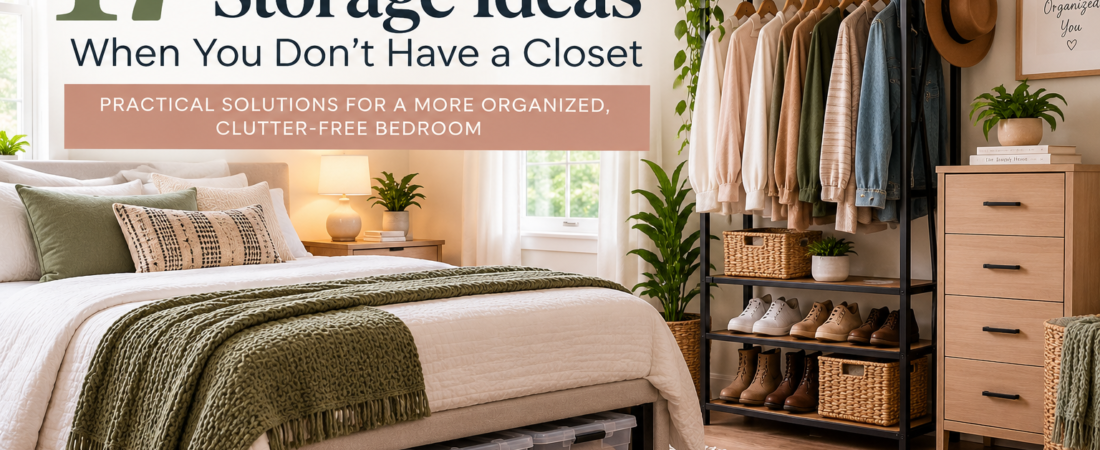
A bedroom without a closet can feel like it was designed under the assumption that you simply don’t own clothes, that’s why we came up with some small bedroom storage ideas.
Suddenly, shirts need somewhere to hang. Shoes migrate toward the wall. Extra bedding gets piled into a corner. Bags end up on chairs. And a perfectly usable bedroom starts feeling cluttered because there is nowhere obvious for everyday belongings to go.
The solution isn’t necessarily to recreate a full walk-in closet inside the room.
In a small bedroom, that can make things worse.
Instead, the goal is to build a compact storage system around the things you actually need to store while protecting as much floor space as possible.
That usually means combining several smaller solutions:
- hanging storage
- drawers
- under-bed storage
- wall storage
- concealed storage
- selective open storage
Here are practical small bedroom storage ideas for when you don’t have a closet at all.
Start by Deciding What the Bedroom Actually Needs to Store
Before buying a wardrobe or clothing rack, take inventory.
A bedroom without a closet can become overcrowded quickly if you’re trying to store:
- every piece of clothing you own
- all your shoes
- luggage
- extra bedding
- seasonal clothes
- laundry supplies
- bags
- accessories
- household overflow
Separate your belongings into categories first.
Daily-use clothing
These need the easiest access.
Think:
- work clothes
- everyday shirts
- pants
- pajamas
- underwear
- frequently worn shoes
Current-season clothing
These should also stay reasonably accessible.
Occasional clothing
Formal wear, specialty clothing and rarely used pieces can live farther away.
Seasonal clothing
Heavy winter items in July don’t need prime bedroom storage.
Things that don’t need to be in the bedroom
Luggage, bulk linens and household backstock may belong somewhere else entirely.
This matters because your storage system should be designed around what actually needs to live in the room, not everything you happen to own.
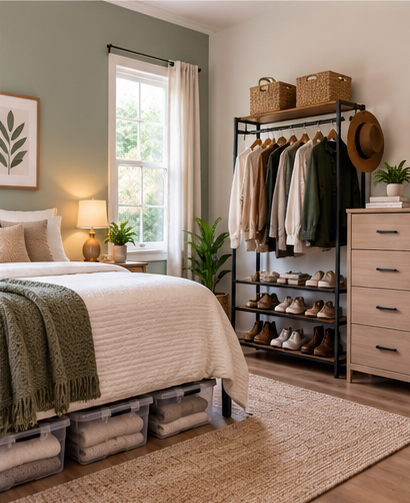
1. Use a Freestanding Clothing Rack
A clothing rack is one of the simplest closet replacements.
It gives you hanging storage without requiring construction or a large piece of furniture.
Use it for:
- shirts
- dresses
- jackets
- pants
- frequently worn outfits
But don’t automatically buy the largest rack you can fit.
Open clothing storage has one major downside:
everything remains visible.
If the rack is packed shoulder-to-shoulder with clothing, it can make a small bedroom feel cluttered even when everything is technically organized.
Measure the available wall before buying.
Check:
- rack width
- rack depth
- overall height
- base footprint
- nearby door swing
- walking clearance
A rack that extends 20 inches into a narrow walkway may solve the clothing problem while creating a movement problem.
Compact garment rack → Buy on Amazon
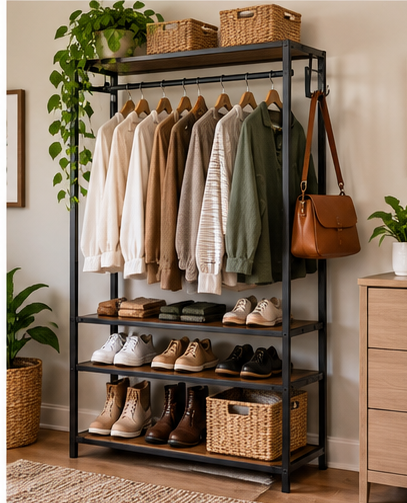
2. Use a Clothing Rack With Built-In Shelves
If floor space is extremely limited, make the clothing rack do more than one job.
Some garment racks include:
- shoe shelves
- upper shelves
- side hooks
- baskets
- lower storage
That lets one footprint handle hanging clothes plus accessories and shoes.
Use the top shelf for lightweight or low-frequency items.
Use the lower level for shoes, baskets or folded clothing.
Just pay attention to weight capacity.
A lightweight rack filled with winter coats, shoes and storage bins can become unstable.
If possible, choose one with a wide stable base or anti-tip capability.
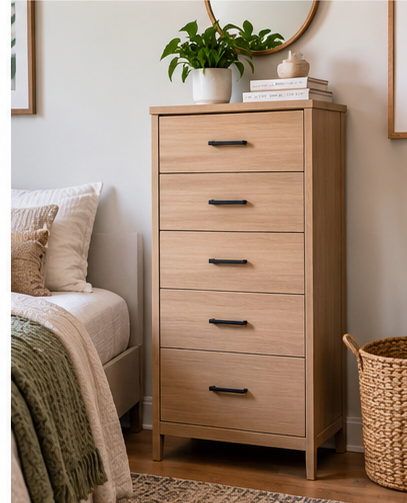
3. Add a Narrow Dresser
Not everything needs to hang.
A dresser is usually better for:
- underwear
- socks
- T-shirts
- workout clothes
- pajamas
- folded sweaters
In a small bedroom, favor height over width when possible.
A tall narrow dresser uses less floor space than a wide low dresser while still providing several drawers.
Measure:
- dresser width
- dresser depth
- drawer extension
- nearby doors
- space between the dresser and bed
This is where people often make a mistake.
A dresser may fit perfectly against the wall but become unusable once you realize the drawers hit the bed when opened.
Measure the furniture while it’s functioning, not only while it’s closed.
Tall narrow bedroom dresser → Buy on Amazon
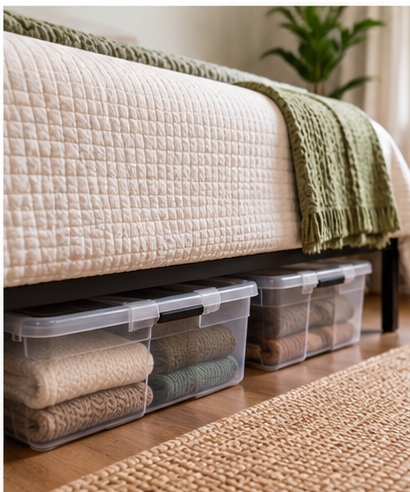
4. Use the Space Under the Bed
The area beneath the bed can replace a surprising amount of missing closet storage.
Use it for:
- seasonal clothes
- extra bedding
- shoes
- sweaters
- rarely used bags
- off-season accessories
Low-profile bins work well when the bed has modest clearance.
If the bed sits very low, bed risers may create additional usable height—but only if they’re appropriate for the bed frame and remain stable.
Before buying bins, measure from the floor to the lowest obstruction beneath the bed.
Under-bed clothing storage bins → Buy on Amazon
Support rails and center braces may sit lower than the outer frame.
Also think about retrieval.
Containers with:
- wheels
- handles
- clear tops
are easier to use than heavy boxes you have to drag out.
For more ways to use overlooked space beneath furniture and in other strange areas, see our 25 Storage Ideas for Small Homes That Make Every Inch Count.
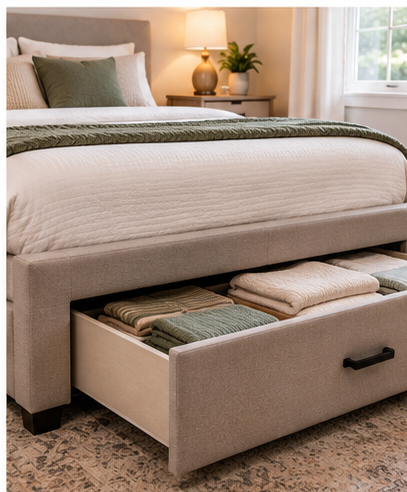
5. Use a Storage Bed
If you’re replacing the bed anyway, storage built into the frame can solve a major capacity problem.
Storage beds may include:
- drawers
- lift-up platforms
- cubbies
- shelving
They can be particularly useful in bedrooms where there isn’t enough room for both a bed and a large dresser.
Storage bed with built-in drawers → Buy on Amazon
But check how the storage opens.
Side drawers
Need enough clearance between the bed and wall.
Foot-end drawers
Need open space beyond the foot of the bed.
Lift-up storage
Requires enough room to raise the platform safely.
A storage bed that technically fits the room but can’t open is just an expensive normal bed.
6. Add Wall Hooks for Frequently Used Items
Hooks are one of the cheapest ways to create storage without occupying floor space.
Use them for:
- jackets
- hats
- handbags
- belts
- scarves
- robes
- tomorrow’s outfit
Install them on:
- an empty wall
- behind the bedroom door
- beside a dresser
- near the clothing rack
Avoid covering an entire wall with belongings.
A few useful hooks can look intentional.
Twenty bags and jackets hanging everywhere can make the room feel like a coatroom.
Use hooks for the things you genuinely reach for often.
7. Use the Back of the Bedroom Door
If the bedroom door swings freely, the back can become another storage zone.
Options include:
- hooks
- hanging shoe organizers
- accessory organizers
- shallow baskets
This works especially well for smaller items that otherwise end up scattered through the room.
Before adding an organizer, check how much clearance exists between the open door and the wall.
A bulky hanging organizer can prevent the door from opening fully.
Also check the top of the door if you’re using over-door hooks.
Some door frames have very little clearance.
8. Add Floating Shelves Above a Dresser
The wall above a dresser is often used for artwork or left empty.
If you’re short on storage, shallow floating shelves can add room for:
- baskets
- folded accessories
- jewelry boxes
- hats
- lightweight storage containers
- books
This works particularly well because you’re adding capacity above furniture that already occupies floor space.
Keep the shelves shallow enough that they don’t feel heavy over the dresser.
And don’t place extremely heavy items overhead.
Use higher shelves for lighter, less frequently used belongings.
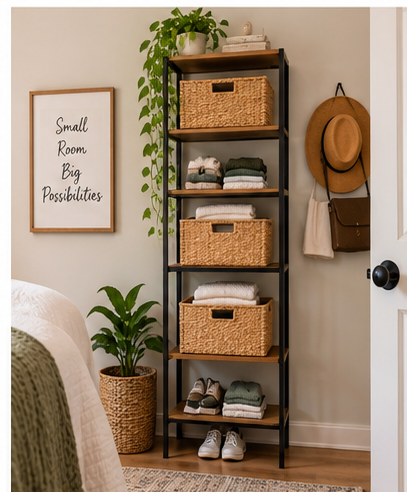
9. Use Tall Shelving Instead of Wide Shelving
When floor space is limited, vertical storage generally makes more sense.
A tall narrow shelving unit can hold:
- folded clothing
- baskets
- shoes
- accessories
- extra bedding
Use baskets or fabric bins to contain smaller items.
This gives you some of the functionality of closet shelves without installing an actual closet.
Just be careful with open shelving.
Too many exposed categories can make the bedroom feel visually busy.
A mix of open shelves and closed baskets usually looks calmer.
10. Use Curtains to Conceal Open Clothing Storage
One of the biggest drawbacks of clothing racks and open shelving is visual clutter.
A simple curtain can solve much of that.
You can install a curtain:
- across a recessed wall
- around a clothing rack
- in front of open shelves
- across a small storage alcove
When closed, the curtain gives the room a cleaner visual surface.
This creates something close to a soft-sided closet without building permanent cabinetry.
Keep the curtain relatively lightweight.
A heavy drape can visually dominate a small room.
11. Use a Freestanding Wardrobe
If you need true enclosed clothing storage, a wardrobe may be the closest replacement for a traditional closet.
Wardrobes can include:
- hanging rods
- shelves
- drawers
- shoe storage
They’re especially useful when you want clothing hidden from view.
But wardrobes are large pieces of furniture.
Measure very carefully.
Check:
- width
- depth
- height
- door swing
- ceiling height
- baseboards
- nearby windows
- nearby outlets
- walking clearance
Also measure the path into the bedroom.
A wardrobe may fit the final wall perfectly and still be impossible to get through the doorway or up the stairs.
Whenever possible, choose a unit that can be assembled in the room.
Compact freestanding wardrobe → Buy on Amazon
12. Put a Dresser Inside an Alcove
Odd wall recesses can become useful clothing storage.
If the bedroom has an alcove, nook or recessed wall, see whether a dresser or drawer unit fits there.
This can make the furniture feel more integrated into the room rather than protruding into the floor plan.
Measure the opening in several places.
Older homes especially may have walls that aren’t perfectly square.
Leave enough clearance for drawers to open comfortably.
13. Use a Bench With Storage
If you have room at the foot of the bed or beneath a window, a storage bench can serve two purposes.
It provides:
Seating + concealed storage
Use it for:
- bedding
- blankets
- shoes
- bags
- seasonal clothing
A hinged-top bench generally works well when the area in front stays clear.
A bench with drawers may be easier to access if you frequently store smaller items.
Don’t add one just because storage benches are useful, though.
If the room is already difficult to walk through, preserving open floor space matters more.
14. Use Nightstands With Real Storage
Tiny decorative nightstands may look nice but provide very little capacity.
If your bedroom has no closet, even the nightstand should work harder.
Look for:
- drawers
- enclosed cabinets
- shelves
- taller designs with small footprints
Use them for smaller clothing categories, accessories or personal items that would otherwise consume dresser space.
Furniture already required by the room is one of the best places to gain extra storage.
15. Store Shoes Vertically
Shoes can consume a surprising amount of floor space.
Instead of lining them along the wall, use:
- narrow shoe racks
- vertical shoe towers
- over-door storage
- under-bed bins
Keep everyday shoes easiest to reach.
Seasonal and special-occasion shoes can move to secondary storage.
If you’re also struggling with a small conventional closet elsewhere in the home, our 17 Small Closet Organization Ideas That Make the Most of Limited Space includes additional ideas for shoes, rods, shelves and vertical closet storage.
16. Create a Clothing Zone Instead of Scattering Storage Everywhere
This is one of the easiest mistakes to make in a closetless bedroom.
You add:
A rack on one wall.
A dresser on another.
Shoes beside the door.
Baskets next to the bed.
Hooks on another wall.
Soon, the entire bedroom feels like storage.
When possible, group clothing storage into a single zone.
For example:
Wall A
- clothing rack
- narrow dresser
- shoe shelf
Now the opposite side of the room can remain visually calmer.
Creating a storage zone helps the room feel like a bedroom that happens to contain clothing storage—not a closet with a bed dropped into the middle.
17. Rotate Seasonal Clothing
A bedroom without a closet does not need to store every piece of clothing equally all year.
Keep current-season clothing accessible.
Move off-season items to:
- under-bed storage
- high shelves
- another closet
- another suitable household storage area
When the season changes, rotate the categories.
If clothing volume is overwhelming even after using secondary storage, the issue may no longer be the lack of a closet.
It may simply be too much clothing for the storage capacity available.
The same principle applies to conventional small closets: better organization helps, but physical capacity still has limits.
Open Storage vs. Closed Storage
A closetless bedroom usually needs both.
Open storage
Examples:
- garment racks
- wall hooks
- open shelves
- shoe racks
Advantages:
- easy access
- usually inexpensive
- visually lightweight
- simple to install
Disadvantages:
- clothing remains visible
- can look cluttered
- requires more maintenance
Closed storage
Examples:
- wardrobes
- dressers
- storage benches
- fabric bins
- storage beds
Advantages:
- hides visual clutter
- keeps the bedroom calmer
- protects items from dust
Disadvantages:
- usually costs more
- often takes more floor space
- can feel bulky in a tiny room
The best setup is usually a combination.
Keep frequently used items accessible.
Hide the categories that create the most visual noise.
What to Measure Before Buying Bedroom Storage
A closetless bedroom makes measurement especially important because you’re adding furniture to the living area itself.
For clothing racks, measure:
- width
- depth
- height
- hanging garment length
For dressers and wardrobes, measure:
- closed depth
- drawer or door opening depth
- walkway clearance
- ceiling height
For under-bed storage, measure:
- lowest clearance
- internal dimensions between frame supports
For shelves, measure:
- wall width
- depth
- mounting height
- furniture beneath them
And don’t forget:
Measure the doorway.
A large wardrobe isn’t useful if you can’t get it into the bedroom.
What Not to Do in a Bedroom Without a Closet
Avoid trying to recreate a huge closet by filling every wall with storage.
Be cautious with:
- oversized wardrobes
- several clothing racks
- very deep dressers
- bulky storage benches
- floor baskets everywhere
- too much exposed clothing
- furniture that blocks windows
- storage that reduces walking space
Also avoid buying organizers before deciding what they’ll store.
A new rack doesn’t help if the real problem is 40 pairs of shoes.
A wardrobe doesn’t help if half its shelves end up storing things that could live elsewhere.
Start with the inventory.
Then build the storage.
A Simple Closetless Bedroom Setup for Small Bedroom Storage Ideas
For many small bedrooms, a practical setup could be:
One compact clothing rack
For frequently worn hanging clothes.
One narrow dresser
For folded clothes and smaller items.
Under-bed storage
For seasonal clothing and extra bedding.
A few wall hooks
For jackets, bags and accessories.
One high shelf or small shelving unit
For lightweight backup storage.
That’s enough to recreate most of the essential functions of a closet without turning the entire room into one.
Frequently Asked Questions
How do you store clothes in a bedroom without a closet?
Combine a freestanding garment rack for hanging clothes with a dresser for folded clothing. Use under-bed storage, wall hooks, shelves and secondary storage for seasonal and low-frequency items.
Is a clothing rack better than a wardrobe?
A clothing rack takes up less visual and physical space and usually costs less, but everything remains visible. A wardrobe provides concealed storage and often more capacity but takes up significantly more floor space.
How do you make an open clothing rack look less cluttered?
Keep only frequently worn clothing on the rack, use consistent hangers, avoid overcrowding it and organize garments by type or color. A curtain can also conceal the rack when desired.
Where should seasonal clothing go without a closet?
Under-bed bins, upper shelves, storage beds and another appropriate household storage area are good options. Current-season clothing should receive the easiest bedroom storage.
How can I add clothing storage without taking up much floor space?
Use vertical solutions such as tall narrow dressers, wall hooks, high shelves, over-door organizers and narrow garment racks. Under-bed storage also adds significant capacity without using additional floor area.
Build the Storage Around the Room You Actually Have
A bedroom without a closet is inconvenient.
But it doesn’t automatically require a giant wardrobe or expensive built-in system.
Start with the clothes you actually use.
Give hanging items a compact rack.
Use drawers for clothing that folds well.
Move seasonal pieces under the bed or into secondary storage.
Use walls where they genuinely help.
And conceal enough of the storage that the room still feels calm.
The goal isn’t to build a closet everywhere.
It’s to create enough organized, accessible storage that the bedroom can still function as a bedroom.