
Good wrapping paper storage gets surprisingly difficult when you live in a small home.
Wrapping-paper rolls are long and awkward. Gift bags collapse into messy piles. Tissue paper wrinkles. Ribbon unravels. Tape and scissors somehow migrate into three different drawers.
And because most gift-wrap supplies are used only occasionally, they should not consume the best everyday storage in your home.
The best system keeps wrapping paper, gift bags, tissue, ribbon, tags, tape, and scissors together while fitting the type of space you actually have—under a bed, behind a door, inside a closet, on a wall, or in a narrow unused gap.
Here are the most practical wrapping paper storage ideas for small spaces, plus how to decide which setup actually makes sense for your home.
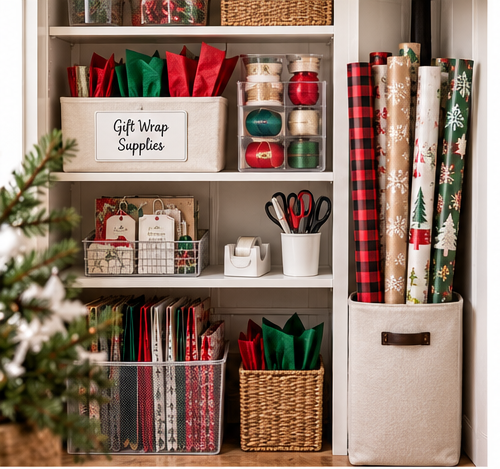
1. Measure Your Longest Wrapping Paper Rolls First
Before buying a wrapping paper organizer, measure the rolls you already own.
Do not assume every roll is the same length.
Common wrapping-paper rolls can vary substantially, especially if you buy:
- oversized holiday rolls
- craft paper
- specialty paper
- commercial-length rolls
- extra-wide wrapping paper
Measure:
- longest roll length
- widest roll diameter
- total number of rolls
- space where the organizer will go
If your longest roll is 40 inches, a 36-inch storage case is not going to work no matter how many rolls the listing says it holds.
If you are fitting an organizer into a closet, cabinet, or tight gap, use our guide on how to measure for storage organizers before you buy.
2. Use Under-Bed Storage When Floor Space Is Tight
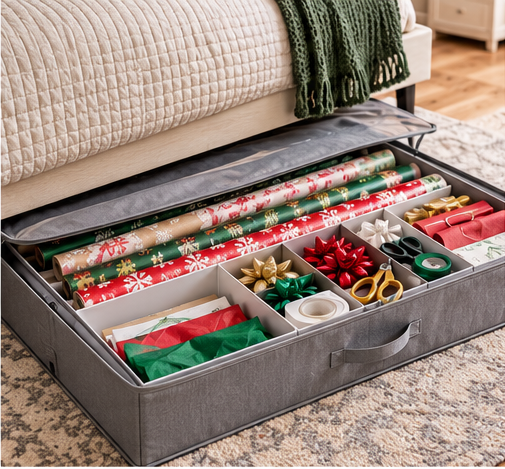
Under-bed gift-wrap storage is one of the best options when closet space is limited.
Long wrapping-paper rolls naturally fit the shape of many under-bed containers.
A dedicated under-bed gift-wrap case can hold:
- wrapping-paper rolls
- tissue paper
- flat gift bags
- bows
- tags
- ribbon
- tape
Why it works in a small space
You are using horizontal space that often sits empty.
It also keeps seasonal Christmas wrap out of the closets you use every day.
What to measure
The critical dimension is height.
Measure from the floor to the lowest obstruction under the bed—not simply to the bottom of the visible bed frame.
Bed supports, center rails, and slats can reduce usable clearance.
If you are considering this setup, our guide to the best under-bed storage for small bedrooms can help you compare low-clearance options.
Under-bed gift-wrap storage case → Buy on Amazon
3. Use an Over-the-Door Organizer When You Have No Floor Space
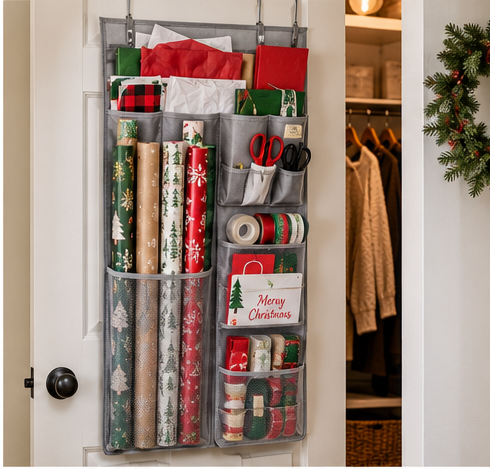
A door gives you a large vertical surface without taking up additional floor area.
Over-the-door gift-wrap organizers can hold:
- wrapping-paper rolls
- gift bags
- ribbon
- tissue
- scissors
- tape
- tags
They work especially well on:
- closet doors
- utility-room doors
- craft-room doors
- spare-bedroom closets
Check the door before buying
Measure the door width and make sure the organizer will not interfere with:
- the door handle
- shelves behind the door
- clothing inside the closet
- the wall when the door opens
- door trim
Also check the thickness of the over-door hooks.
Some doors have very little clearance between the door and frame.
Over-the-door wrapping paper organizer → Buy on Amazon
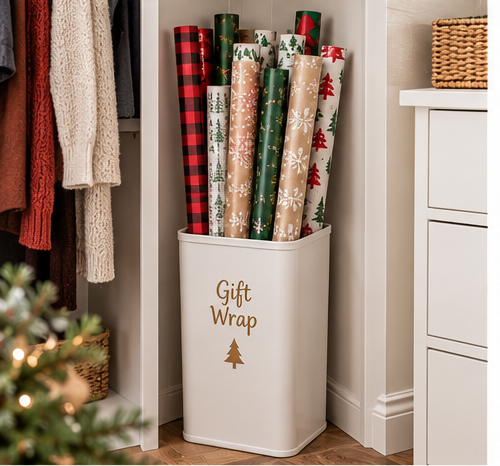
4. Store Wrapping Paper Vertically in a Tall Narrow Bin
If you have unused floor space in a closet corner, vertical wrapping-paper storage can be extremely efficient.
A tall narrow container keeps rolls upright instead of spreading them across a shelf.
This works particularly well for:
- everyday wrapping paper
- smaller collections
- craft paper
- Christmas wrap stored together
Look for a container that is tall enough to support the rolls without hiding them completely.
Small-space advantage
The footprint can be very small.
A container only 10–12 inches wide may hold a surprisingly large number of rolls.
That is a better use of a narrow closet corner than laying the same rolls horizontally across a full shelf.
Our vertical storage ideas for small spaces cover the same strategy throughout the home.
Vertical wrapping-paper storage bin → Buy on Amazon
5. Use a Narrow Rolling Cart for a Complete Gift-Wrap Station
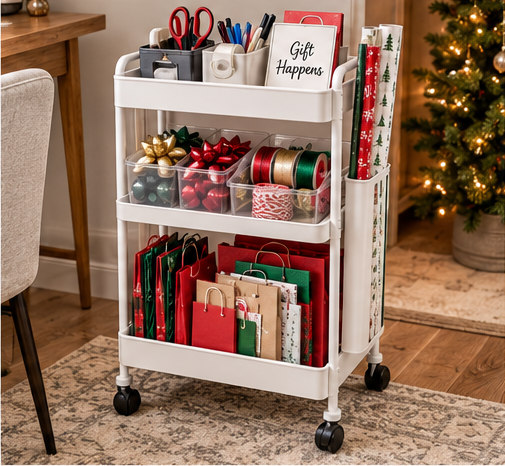
A narrow rolling cart works well if you wrap gifts frequently and want everything accessible.
Use separate levels for:
Top shelf
- tape
- scissors
- tags
- pens
Middle shelf
- ribbon
- bows
- tissue paper
Bottom shelf
- gift bags
- folded boxes
- small wrapping-paper rolls
You can add a side-mounted holder for longer paper rolls.
Small-space advantage
The cart can live in a narrow gap and roll out only when needed.
Possible storage locations include:
- beside a desk
- inside a closet
- between shelving and a wall
- in a laundry room
- beside a craft cabinet
The main downside is that a cart uses permanent floor space.
Choose this setup only if you actually wrap gifts often enough to justify it.
Narrow rolling gift-wrap cart → Buy on Amazon
6. Use Wall-Mounted Storage When Floor Space Is Already Spoken For
An empty wall can hold wrapping supplies surprisingly well.
Wall-mounted options include:
- horizontal paper-roll racks
- dowel systems
- baskets
- pegboards
- wall pockets
- mounted ribbon rods
This works best in:
- craft areas
- utility rooms
- closets
- laundry rooms
The advantage is obvious:
nothing touches the floor.
The drawback is that visible gift-wrap storage can become visually busy.
If the storage is in a living area, use a simple system rather than covering the entire wall with supplies.
7. Use Closet Hanging Organizers for Gift Bags and Tissue
Wrapping paper gets most of the attention, but gift bags and tissue can create just as much clutter.
A hanging closet organizer can use a small section of clothing rod for:
- folded gift bags
- tissue paper
- reusable gift boxes
- ribbon
- tags
Some hanging gift-wrap organizers also include long vertical pockets for paper rolls.
Best for
This setup works well if you have:
- closet rod space
- very little floor space
- a moderate supply collection
Tradeoff
Every inch of hanging storage used for gift wrap is an inch you cannot use for clothing.
In a tiny bedroom closet, that may not be a good trade.
8. Store Gift Bags Flat Instead of Stuffing Them Into a Bin
Gift bags become bulky when they are stored randomly.
Flatten them and group them by size:
- small
- medium
- large
- bottle bags
- holiday-specific bags
Then store them upright like files or flat inside a shallow container.
This prevents handles from tangling and makes it easier to see what you already own.
It also keeps you from buying another $6 gift bag because you forgot you already had twelve.
9. Give Tissue Paper Its Own Flat Zone
Tissue paper wrinkles when it is crushed into whatever space is left.
Store it flat in:
- a shallow drawer
- folder-style organizer
- under-bed case
- flat bin
- hanging organizer
You can separate tissue by color if you have a large collection.
For most households, one simple stack is enough.
The important part is keeping heavier items off it.
10. Keep Ribbon From Becoming a Tangled Pile
Loose ribbon rolls are surprisingly annoying to store.
A simple ribbon organizer allows the roll to rotate while keeping it contained.
Options include:
- dowel rods
- ribbon dispensers
- small baskets
- drawer dividers
- wall-mounted rods
If you use ribbon frequently, storing it where you can pull the ribbon directly from the roll is convenient.
If you rarely use ribbon, a small lidded container may be enough.
Ribbon organizer → Buy on Amazon
11. Create One Small Tool Zone
Tape and scissors should not migrate around the house.
Create one gift-wrap tool area containing:
- scissors
- clear tape
- double-sided tape
- pens
- markers
- gift tags
- ribbon cutters
- spare tape rolls
A small divided box or drawer works well.
The goal is simple:
when you pull out the wrapping supplies, everything you need should come with them.
12. Separate Christmas Wrap From Year-Round Gift Wrap
This is one of the easiest ways to reduce clutter.
Year-round supplies might include:
- neutral wrapping paper
- birthday paper
- plain gift bags
- tissue
- basic ribbon
Christmas-specific supplies can include:
- holiday paper
- Christmas gift bags
- seasonal tags
- holiday ribbon
- decorative boxes
Christmas wrap only needs convenient access for part of the year.
That makes it a good candidate for more remote seasonal storage.
Our holiday-storage hub, How to Store Christmas Decorations Without Taking Over Your House, explains why once-a-year items should generally stay out of your prime everyday storage.
13. Use the Back of a Closet Door for Small Supplies
Even if you do not want a full-length wrapping-paper organizer, the inside of a closet door can hold smaller gift-wrap supplies.
Try:
- clear pockets
- small baskets
- hanging pouches
- ribbon holders
- tag organizers
This is a useful way to separate the small supplies from bulky paper rolls.
Just make sure the door can still close normally.
14. Use Awkward Narrow Gaps for Paper Rolls
Wrapping-paper rolls are long but relatively narrow.
That makes them ideal for some of the strange spaces that are useless for normal storage.
Possible spots include:
- beside shelving
- between a dresser and wall
- beside a closet organizer
- narrow cabinet gaps
- unused closet corners
A tall slim bin can convert a 10-inch gap into useful seasonal storage.
For more ideas like this, see our guide to storage ideas for awkward spaces.
15. Keep Rolls From Unrolling in Storage
Loose paper edges get crushed and torn.
Secure each roll gently with:
- reusable paper bands
- soft elastic bands
- hook-and-loop straps
- purpose-made wrapping-paper clips
Avoid tight rubber bands.
They can leave deep creases or damage the paper over long storage periods.
Reusable wrapping-paper storage bands → Buy on Amazon
16. Do Not Let Rolls Lean at an Extreme Angle
Vertical storage works best when the rolls are reasonably supported.
If a tall roll constantly leans sideways, the paper can develop bends or crushed edges.
Use a container tall enough to support a substantial portion of the roll.
For a large collection, dividers can help keep rolls upright.
17. Store Specialty Paper More Carefully
Some wrapping materials need more protection than basic paper.
Be more careful with:
- foil wrapping paper
- handmade paper
- textured paper
- kraft paper with decorative finishes
- expensive specialty sheets
These can crease or scratch more easily.
Flat specialty sheets should be stored horizontally rather than rolled if that is how they were purchased.
18. Do Not Store Wrapping Paper in Damp Areas
Paper and moisture do not get along.
Avoid long-term storage directly on:
- damp basement floors
- garage floors
- areas near plumbing leaks
- humid exterior walls
A plastic organizer can protect against dust and minor contact, but it will not fix a consistently humid environment.
If you use basement storage, keep paper elevated and away from potential water sources.
19. Use Hidden Storage for Seasonal Gift Wrap
Christmas wrapping supplies are excellent candidates for hidden storage because you only need them for part of the year.
Possible locations include:
- under a bed
- high closet shelves
- behind a door
- inside a storage bench
- deep closet zones
The goal is to save easily accessible storage for things you use every week.
Our guide to hidden storage ideas for small homes has more ways to use overlooked areas without adding more furniture.
20. Avoid Creating a Giant Gift-Wrap Collection
Storage systems can make it easy to justify keeping too much.
Before buying another organizer, go through what you already have.
Remove:
- badly crushed paper
- tiny unusable scraps
- torn gift bags
- dried-out tape
- damaged bows
- tags you never use
Then define a storage boundary.
For example:
All gift-wrap supplies must fit inside this organizer and one small accessory box.
That keeps the collection from quietly expanding across several closets.
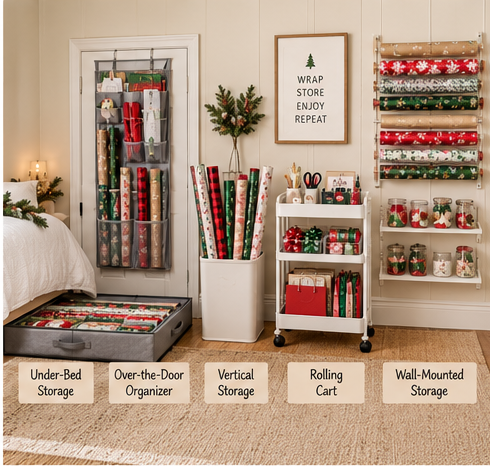
21. Choose the Storage Method Based on Your Space
There is no universally best wrapping-paper organizer.
The best option depends on what your home gives you.
Choose under-bed storage if:
- closet space is limited
- you have enough bed clearance
- you own several long rolls
- you want seasonal supplies hidden
Choose over-the-door storage if:
- floor space is extremely limited
- you have an unused closet door
- you want everything visible and accessible
Choose vertical-bin storage if:
- you have a narrow closet corner
- your collection is mostly paper rolls
- you want a tiny footprint
Choose a rolling cart if:
- you wrap gifts frequently
- you want a mobile work station
- you can spare some floor area
Choose wall-mounted storage if:
- floor and closet space are already full
- you have an available utility or craft wall
- you do not mind visible supplies
The Best Wrapping Paper Storage Setup for Most Small Homes
For many small homes, I would keep the system simple:
One long organizer for paper rolls
Use an under-bed case, over-door organizer, or vertical container depending on your available space.
One flat area for bags and tissue
Keep these from getting crushed underneath the rolls.
One small accessory box
Store scissors, tape, tags, ribbon, and bows together.
That gives you a complete gift-wrap system without creating a dedicated wrapping room—or sacrificing an entire closet.
Looking for more ways to keep holiday decor organized? We rounded up our favorite Christmas storage solutions on Amazon, including practical options for ornaments, lights, wrapping supplies, wreaths, artificial trees, and more—all with small spaces in mind.
Frequently Asked Questions
What is the best way to store wrapping paper in a small space?
Use unused vertical or hidden space. Under-bed cases, over-the-door organizers, tall narrow bins, and closet hanging organizers can all store wrapping paper without consuming much everyday floor space.
Is it better to store wrapping paper vertically or horizontally?
Either works. Vertical storage uses a smaller floor footprint, while horizontal cases work especially well under beds. The best option depends on roll length and your available dimensions.
How do you keep wrapping paper from getting crushed?
Store rolls in a container that supports them properly, keep heavy objects off them, and use gentle paper bands or clips to prevent loose edges from unrolling.
How do you store gift bags in a small space?
Flatten gift bags and store them upright like files or flat inside a shallow container. Grouping them by size makes them easier to find and keeps handles from tangling.
Can wrapping paper be stored in a garage?
It can be stored in a dry, controlled garage, but paper is vulnerable to humidity, water, dirt, insects, and temperature changes. Indoor storage is safer if the garage is damp.
How do you organize wrapping paper, ribbon, and gift bags together?
Give each type of supply a defined zone: long storage for paper rolls, flat storage for bags and tissue, a ribbon holder or small bin, and one accessory box for tape, scissors, and tags.
How many rolls of wrapping paper should you keep?
There is no ideal number. Give the collection a defined storage boundary and keep only the rolls you are likely to use. If the paper no longer fits the organizer, reassess the collection before adding more storage.