Small closet shelving can dramatically increase storage without making a closet bigger—but only when the shelves actually fit the space and the things you need to store.
The problem with many small closets isn’t that they have no shelves. It’s that they have one shelf placed too high, too much empty vertical space, shelves that are too deep to use comfortably, or a layout that sacrifices more hanging space than it creates in storage.
Good closet shelving is less about adding as many shelves as possible and more about using the closet’s height, depth, and narrow gaps efficiently.
Here are practical small closet shelving ideas that make better use of limited space without turning your closet into a cramped wall of storage.
Start by Measuring the Closet You Actually Have
Before buying shelving, measure the usable space—not just the overall closet dimensions.
Record:
- Interior width
- Floor-to-ceiling height
- Usable depth from the back wall to the inside of the closed door
- Door opening width
- Existing shelf and rod height
- Baseboard depth
- Any trim, outlets, vents, sloped ceilings, or other obstructions
Also measure the clothing, bins, shoes, and other items you expect the shelves to hold.
A shelf can technically fit inside a closet and still be a bad choice if it blocks the door, crowds hanging clothes, or leaves bins sticking several inches over the edge.
If you’re adding an organizer or shelving system, use this guide to measuring for storage organizers before buying anything.
1. Replace One Large Top Shelf With Multiple Storage Levels
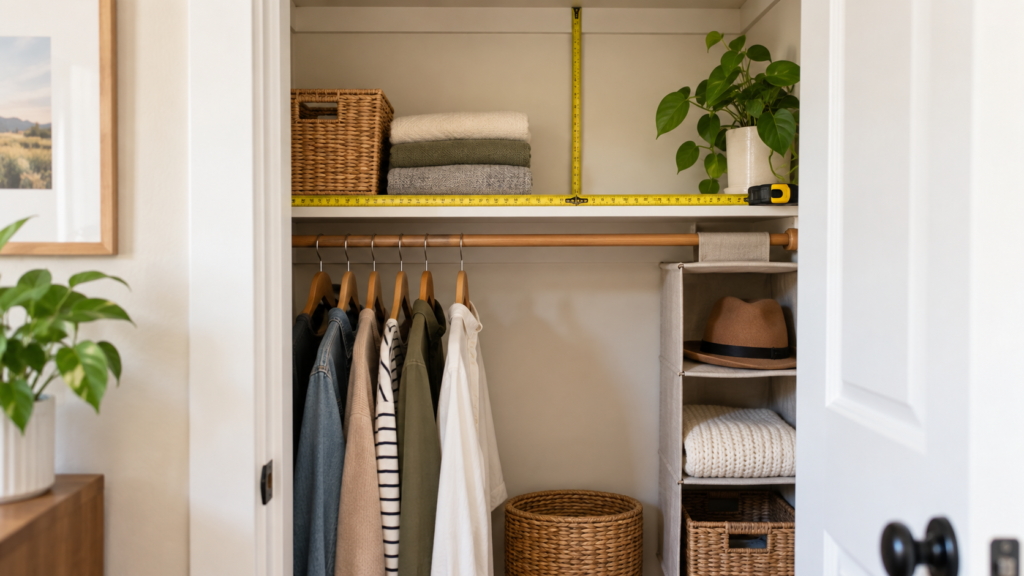
Many reach-in closets have the same basic layout: one hanging rod with one shelf above it.
That leaves a surprisingly large amount of unused space near the ceiling.
Instead of treating everything above the rod as one storage zone, consider adding a second shelf above the existing shelf.
For example, if you have roughly 30 inches between the existing shelf and ceiling, two shorter storage zones may work better than one tall opening where boxes simply get stacked on top of each other.
Use the uppermost shelf for things you don’t need every day:
- Seasonal clothing
- Extra bedding
- Travel bags
- Keepsakes
- Off-season accessories
Keep frequently used items on the lower shelf where they’re easier to reach.
The goal isn’t to fill every inch vertically. Leave enough clearance to remove bins without having to tilt, crush, or unload them.
Adjustable closet shelving system → Buy on Amazon
2. Use 12-Inch Shelves for Most Folded Clothing
For a small closet, deeper isn’t automatically better.
A shelf around 12 inches deep is a useful starting point for many folded clothing stacks, small bins, handbags, and accessories.
Going significantly deeper can create a hidden zone behind the items in front. That may technically increase capacity, but it often makes the closet harder to use.
Deeper shelves can still work well for:
- Large storage bins
- Bulky sweaters
- Bedding
- Handbags
- Seasonal clothing
Before choosing depth, measure the items you’re actually storing.
If your closet is shallow, even a few unnecessary inches of shelf depth can make hanging clothes feel crowded or interfere with the door.
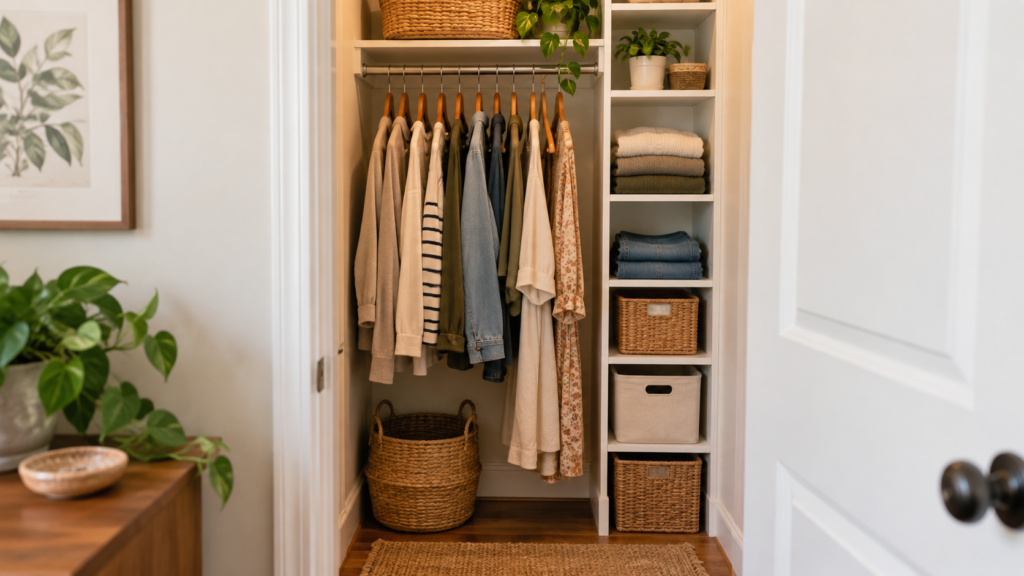
3. Add a Narrow Shelf Tower Instead of Shelving the Entire Closet
You don’t need to cover the whole back wall with shelving.
A narrow vertical shelf tower can add several storage levels while preserving most of your hanging rod.
A tower approximately 12 to 18 inches wide can be enough for:
- Folded shirts
- Jeans
- Sweaters
- Handbags
- Small bins
- Shoes
- Accessories
This works especially well when you have plenty of hanging width but almost nowhere to put folded clothes.
Place the tower at one end of the closet rather than directly in the middle unless dividing the closet into two hanging zones makes sense.
For more ways to arrange a tight closet, see our small closet organization ideas.
Narrow closet shelf tower → Buy on Amazon
4. Adjust Shelf Spacing to What You’re Storing
Equal shelf spacing looks neat, but it isn’t always efficient.
A stack of folded shirts may need far less vertical clearance than a basket full of bulky sweatshirts.
Instead of placing every shelf 12 or 14 inches apart, customize the spacing.
For example:
- Short shelves for folded shirts and pants
- Medium-height spaces for baskets
- Taller openings for handbags or bulky sweaters
- Very tall upper sections for seasonal bins
Adjustable shelving is particularly useful because your storage needs may change.
The key is to avoid large vertical gaps above short items. Six inches of unused air above every stack becomes a surprising amount of wasted space across an entire shelving unit.
5. Use Shelf Dividers Instead of Creating More Shelves
Sometimes the problem isn’t the number of shelves.
It’s that one long shelf becomes a messy horizontal pile.
Shelf dividers can separate:
- Sweaters
- Jeans
- Handbags
- Towels
- Purses
- Clothing for different family members
Dividers let you use the full shelf width without stacks collapsing into one another.
Closet shelf dividers → Buy on Amazon
They’re especially useful on a long shelf above a hanging rod where installing several permanent vertical partitions would be unnecessary.
This is one of the easiest upgrades for an existing closet because it doesn’t require changing the overall shelving layout.
6. Use Bins to Control Deep Shelves
If your closet already has deep shelves, don’t automatically replace them.
Instead, turn some of that depth into pull-out storage.
Handled bins can function almost like simple drawers. Pull the entire bin forward instead of reaching behind the items in front.
This works well for:
- Scarves
- Belts
- Hats
- Small bags
- Workout clothing
- Seasonal accessories
- Extra toiletries
- Children’s clothing
Choose containers based on the shelf’s actual dimensions rather than buying bins first and hoping they’ll fit.
Leave enough clearance above the bin to grab the handle and slide it out comfortably.
7. Add Under-Shelf Baskets for Shallow Items
An existing shelf often has a few inches of unused space underneath it.
An under-shelf basket can capture that gap without adding another permanent shelf.
They’re useful for lightweight items such as:
- Scarves
- Clutches
- Belts
- Gloves
- Small towels
- Fabric accessories
This works particularly well in rental closets because many versions simply slide over the existing shelf.
The important limitation is clearance.
Don’t install one directly above hanging clothing if the basket will press against hangers or make it difficult to remove garments from the rod.
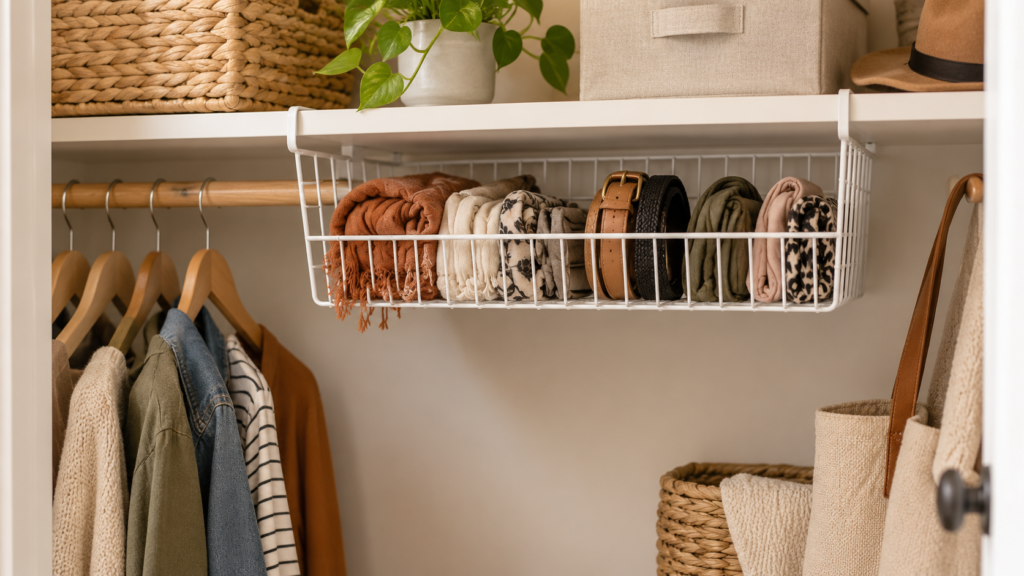
Under-shelf storage basket → Buy on Amazon
8. Add Shelving Below Short Hanging Clothes
Look underneath the clothing already hanging in your closet.
Shirts, jackets, and folded-over pants often leave a large unused area near the floor.
That space can hold:
- One or two shoe shelves
- A low shelf unit
- Storage cubes
- Baskets
- Short drawers
Before adding anything, hang one of your longer garments and measure where it ends.
You want storage underneath the clothing—not storage that forces clothes to bunch up on top of it.
If shoes are your biggest problem, our guide to shoe storage ideas for small spaces covers more ways to use low closet space efficiently.
9. Consider Double-Stacked Shelving for Folded Clothes
If part of the closet is primarily used for folded clothing rather than hanging clothes, stackable shelf units can create a simple vertical storage column.
This is often easier than installing permanent shelving.
It can also be more renter-friendly.
The main thing to watch is stability.
A tall stack of lightweight cubes or shelves should not become top-heavy, especially if heavy items are placed near the top.
Keep heavier items lower and follow the manufacturer’s instructions for securing tall units where required.
For small closets, a narrow system is usually better than a deep freestanding bookcase-style unit that consumes most of the closet floor.
10. Use the Top Shelf All the Way to the Ceiling—Carefully
The space above the highest shelf is valuable, but it’s easy to misuse.
A giant open gap encourages you to pile random items toward the ceiling.
Instead, use appropriately sized bins that can be removed safely.
Store low-frequency items at the top and keep everyday items closer to eye level.
Avoid placing extremely heavy containers overhead.
And make sure you can actually remove the bin.
A bin that perfectly fills the space from shelf to ceiling may look efficient, but you need several inches of working room to grip it, tilt it if necessary, and pull it forward.
11. Don’t Make Every Shelf the Same Depth
A small closet can benefit from mixed shelf depths.
You might use:
- Deeper upper shelves for storage bins
- Medium-depth shelves for folded clothing
- Shallow shelves for accessories
- Narrow shoe shelves near the floor
Shallower shelving can be particularly helpful near closet doors or beside hanging clothing because it reduces visual and physical crowding.
Even a shallow shelf can be useful for small items that would otherwise consume valuable drawer space.
12. Use Narrow Side Gaps for Small Shelves
Some closets have an awkward strip of wall beside the door or between the end of a hanging rod and the side wall.
Don’t assume the gap is useless.
A narrow series of shelves can hold:
- Handbags
- Hats
- Folded jeans
- Small shoes
- Accessories
- Small baskets
Because the shelves are shallow or narrow, they’re often best for specific categories rather than general storage.
This is similar to the strategy we use in our guide to organizing awkward storage spaces: fit the storage to the obstruction instead of forcing a full-size organizer into a space that wasn’t designed for one.
13. Use Adjustable Shelving When Your Needs Change Frequently
Fixed shelves can be perfectly adequate when you know what will live there long term.
Adjustable systems are better when your closet changes regularly.
You can move shelves as:
- Children’s clothing grows
- Seasons change
- Shoe collections change
- Storage bins are replaced
- Folded clothing needs increase
- Hanging needs decrease
This prevents you from permanently dedicating 15 inches of height to something that only needs 8.
Adjustability can be more valuable in a small closet than in a large one because every badly sized storage zone has a bigger effect.
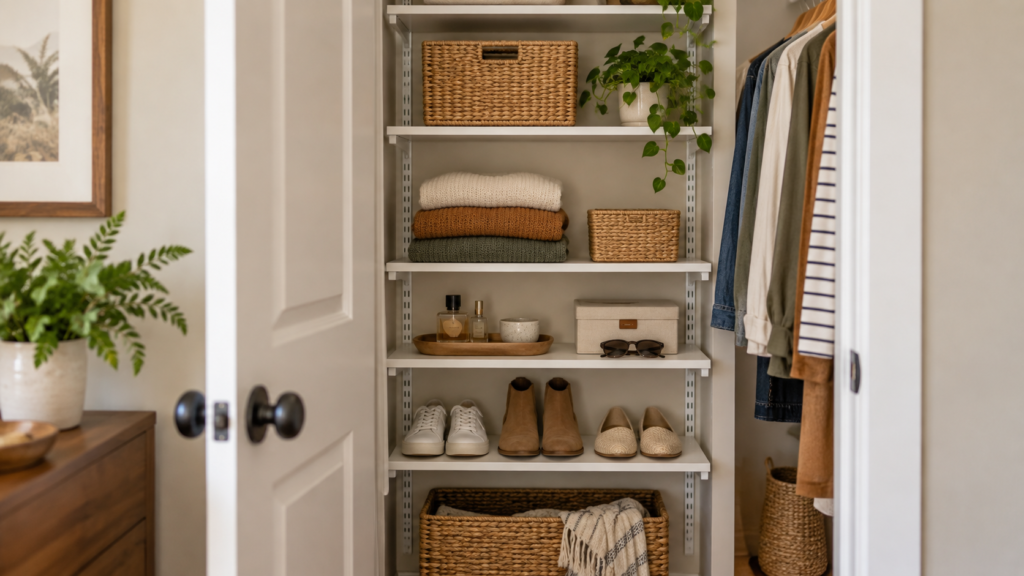
14. Don’t Sacrifice Hanging Space You Actually Need
Shelving is useful, but more shelving isn’t always an upgrade.
If most of your wardrobe needs to hang, adding a large shelf tower may simply move the problem somewhere else.
Before changing the layout, look at what you own.
Separate clothing into:
- Long hanging
- Short hanging
- Folded
- Shoes
- Accessories
- Seasonal storage
If folded items dominate, more shelves may make sense.
If dresses, coats, suits, and other long garments dominate, preserve enough full-height hanging space.
If most of your hanging clothes are shirts and short jackets, a combination of shelves and double-hang space may use the closet more efficiently.
Our guide to how to organize a small closet can help you decide how much space each category deserves.
15. Consider a Freestanding Shelf for a Rental Closet
You don’t necessarily need to drill into the walls to add usable shelving.
A narrow freestanding shelf tower can work well for renters or anyone who doesn’t want to install a permanent closet system.
Look for a unit that:
- Fits comfortably through the closet opening
- Doesn’t interfere with the door
- Leaves enough room for hanging clothing
- Uses vertical space efficiently
- Can be anchored safely if required
- Isn’t deeper than necessary
Measure both the closet interior and the door opening.
This is easy to overlook. A fully assembled organizer may fit inside the closet but still be impossible to maneuver through a narrow opening.
If you’re comparing ready-made systems, our guide to the best closet organizers under $100 focuses specifically on organizer footprint and small-closet fit.
Freestanding closet shelving unit → Buy on Amazon
16. Leave a Little Empty Space
A small closet doesn’t need to be packed to 100% capacity.
In fact, leaving some open space usually makes it more functional.
You need enough room to:
- Slide bins out
- Lift items off shelves
- Move hangers
- Reach the back
- Add or remove clothing
- See what you own
A perfectly packed shelf may maximize theoretical capacity while making everyday use miserable.
The best closet shelving layout gives your things enough space to be accessible—not merely enough space to exist.
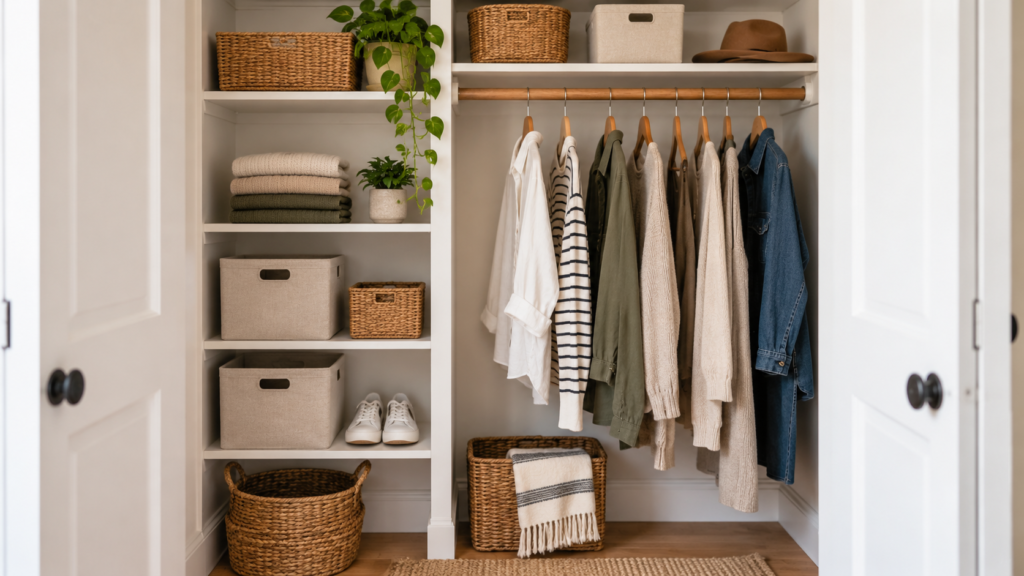
How Deep Should Small Closet Shelves Be?
There isn’t one correct shelf depth for every closet.
For many reach-in closets, around 12 inches is a practical starting point for folded clothing, accessories, and smaller containers.
Deeper shelves can work for bulky items and larger bins, but they can also create inaccessible storage behind the front row.
Before choosing depth, consider:
- Closet depth
- Door clearance
- Hanging-clothing clearance
- Item depth
- Whether you need to see or reach the back of the shelf
The best shelf is usually only as deep as the items you intend to store on it.
How Far Apart Should Closet Shelves Be?
Shelf spacing should be based on what the shelf holds rather than one universal number.
Folded clothing may need relatively little vertical room, while baskets, handbags, and bulky sweaters need more.
Measure the actual height of your typical stacks and containers, then add enough clearance to remove them comfortably.
Adjustable shelving makes this much easier because you can fine-tune spacing rather than accepting several identical openings.
Should Closet Shelves Be Fixed or Adjustable?
Both can work.
Fixed shelves make sense when:
- Storage needs are predictable
- You’re building a permanent closet
- You know the exact dimensions you need
Adjustable shelves make sense when:
- Clothing storage changes seasonally
- Several people use the closet
- You’re experimenting with the layout
- You may change storage bins
- You expect your folded-versus-hanging needs to change
For a very small closet, adjustable shelves provide extra flexibility when every few inches matter.
What Should Go on the Highest Closet Shelf?
Use the highest shelf for items you don’t need frequently.
Good candidates include:
- Off-season clothing
- Extra bedding
- Travel gear
- Keepsakes
- Special-occasion accessories
- Lightweight seasonal items
Avoid turning the top shelf into an unlabeled collection of miscellaneous boxes.
If something is difficult to reach, you should at least know exactly what’s inside it before you climb up to retrieve it.
Small Closet Shelving Works Best When Every Shelf Has a Job
The biggest mistake with small closet shelving is adding storage without deciding what that storage is supposed to hold.
Start with your belongings, measure the closet, and then design the shelving around the categories that actually need space.
A narrow shelf tower may outperform a full closet system. Two properly spaced shelves may work better than four cramped ones. A shallow shelf may be more useful than a deep one.
The goal isn’t to install the maximum possible amount of shelving.
It’s to create a closet where the shelves, hanging space, floor space, and vertical space work together—and where you can still reach everything when you need it.