
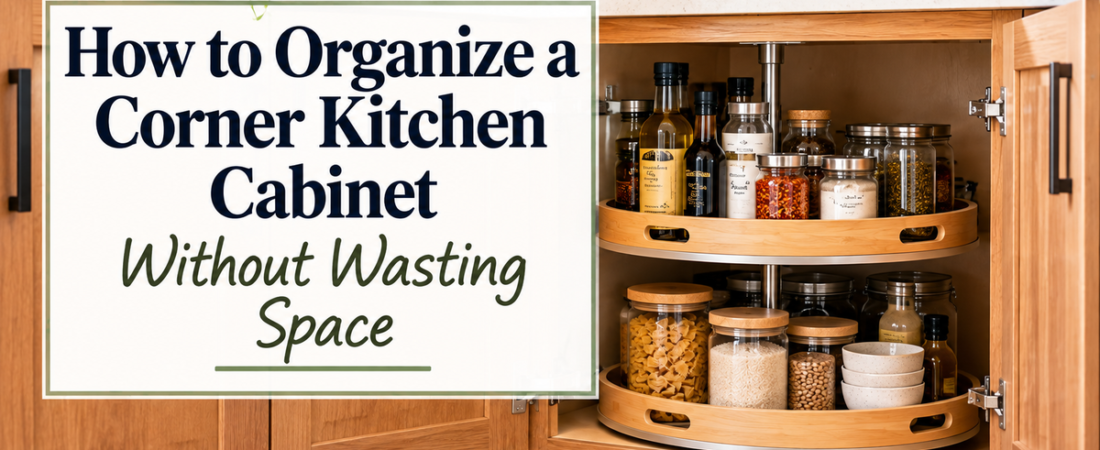
A corner kitchen cabinet can hold a surprising amount of stuff.
The problem is getting to any of it.
Deep corners, narrow door openings, awkward angles, and shelves that extend far beyond your reach can turn a large cabinet into one of the least useful storage areas in the kitchen.
The best corner cabinet organization does not necessarily fill every inch.
It makes the usable space easier to access.
That may mean adding a lazy Susan, using handled bins, installing a pull-out organizer, or simply deciding that the deepest part of the cabinet should hold things you rarely need.
Here is how to organize a corner kitchen cabinet without wasting space or constantly digging through stacks of cookware and pantry items.
Start by Figuring Out What Type of Corner Cabinet You Have
Not all corner cabinets behave the same way.
The two most common types are:
Blind corner cabinet
A blind corner cabinet usually has a relatively narrow door opening with storage extending sideways into a deep hidden section.
The biggest problem is access.
Items stored deep inside can be difficult to see and even harder to retrieve.
Diagonal corner cabinet
A diagonal corner cabinet usually has a wider angled front with shelves extending into the corner.
These tend to offer better visibility than blind corners, but they can still become deep storage pits if everything is stacked loosely.
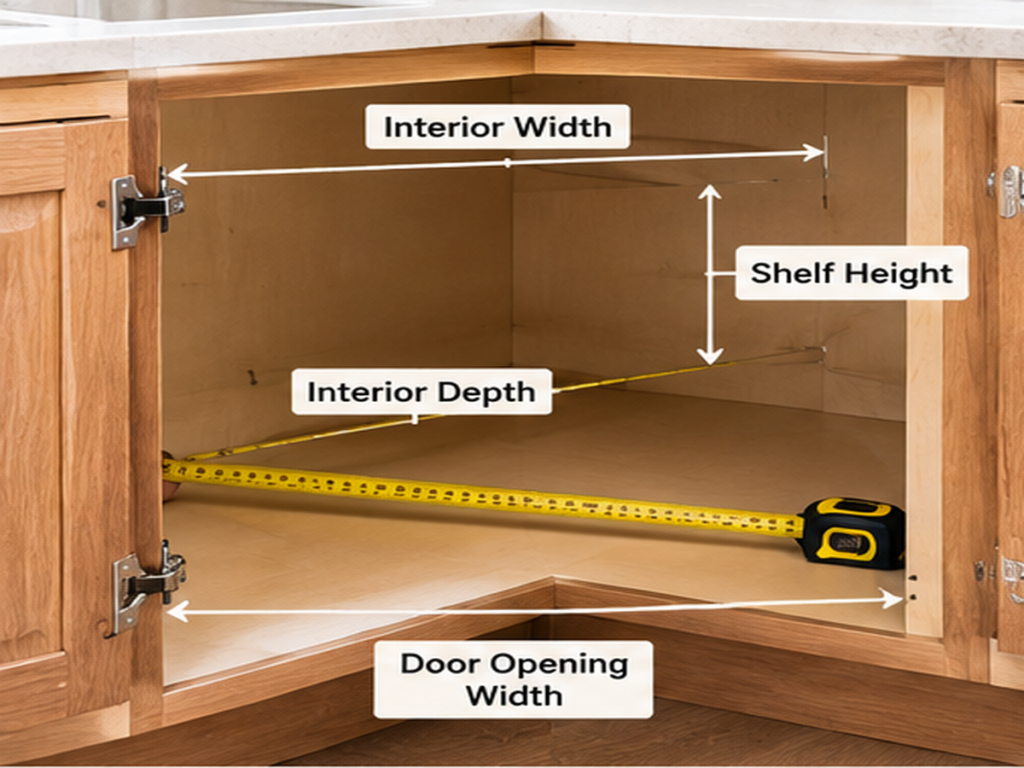
Before buying organizers, determine:
- Cabinet opening width
- Interior width
- Interior depth
- Shelf height
- Door swing
- Hinge location
- Shape of the interior
- Any pipes or obstructions
Our guide to measuring for storage organizers is especially useful here because a corner organizer may fit inside the cabinet but still be too large to pass through the door opening.
1. Empty the Entire Cabinet First
Corner cabinets are hard to organize when you are trying to work around everything already inside.
Take everything out.
Then group the contents by category.
You may find:
- Pots
- Pans
- Mixing bowls
- Small appliances
- Baking supplies
- Food-storage containers
- Pantry items
- Serving dishes
- Cleaning products
Look at how much of the cabinet is actually being used and how much has simply disappeared into the back.
This is also the best time to remove items you no longer use.
2. Keep Everyday Items Near the Opening
The easiest part of the cabinet should hold the things you use most.
That might include:
- Everyday pots
- Mixing bowls
- Food-storage containers
- Frequently used pantry goods
- Small appliances
Avoid placing high-use items in the deepest corner.
A storage system is not efficient if you have to unload half the cabinet every day.
Use the deepest areas for lower-frequency storage.
3. Use a Lazy Susan for Bottles and Pantry Items
A lazy Susan can work very well in a corner cabinet because it turns inaccessible depth into rotating storage.
Corner cabinet lazy Susan → Buy on Amazon
It is especially useful for:
- Oils
- Vinegars
- Condiments
- Spices
- Baking ingredients
- Small jars
- Cleaning products
Choose one that fits the actual cabinet shelf.
Make sure it can rotate without hitting:
- Cabinet walls
- Hinges
- Door frames
- Other stored items
A turntable that barely fits may not rotate properly once it is loaded.
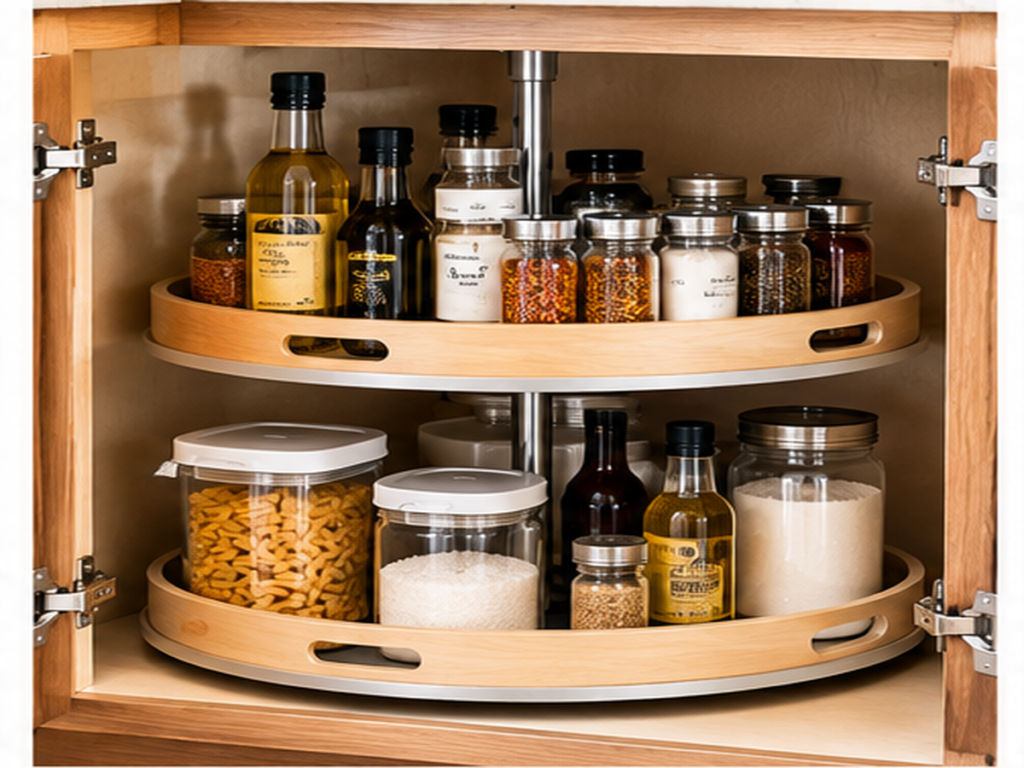
4. Use a Divided Lazy Susan for Small Categories
Small items can slide around on a large turntable.
A divided lazy Susan or containers placed on the turntable can create separate categories.
For example:
- Baking supplies
- Sauces
- Oils
- Snacks
- Spices
This keeps items from becoming one rotating pile.
The goal is to make the entire category move toward you at once.
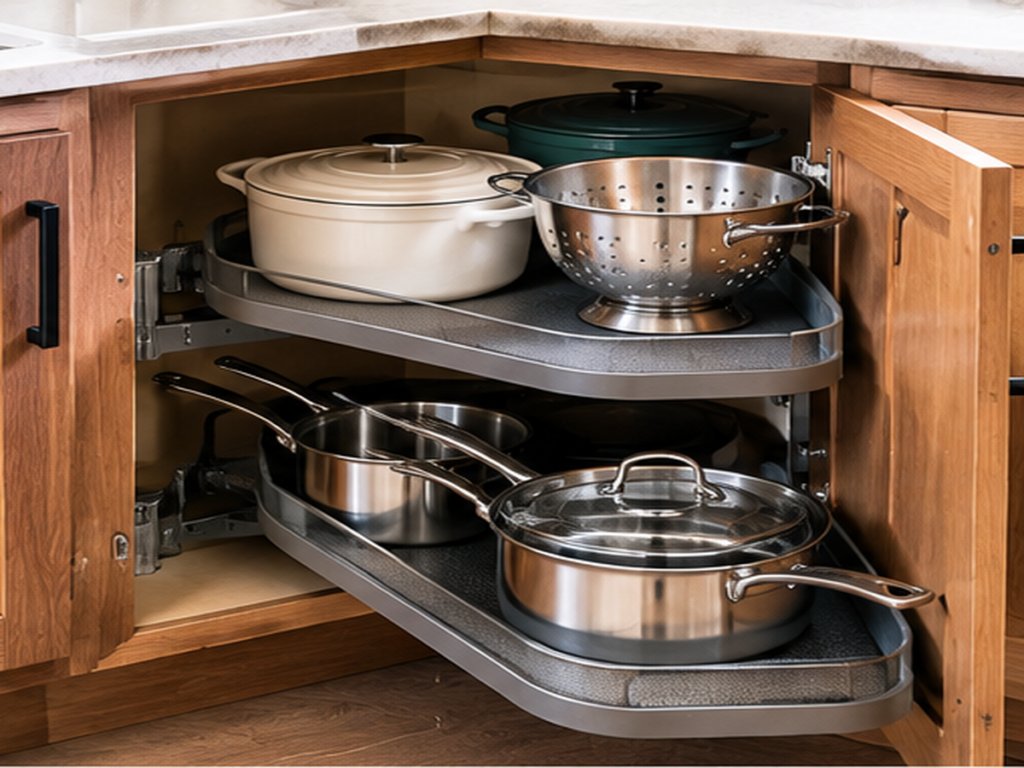
5. Consider a Kidney-Shaped Corner Organizer
Some corner cabinets are designed for kidney-shaped rotating shelves.
These systems use curved shelves that rotate through the cabinet opening.
They can work well for:
- Pots
- Pans
- Mixing bowls
- Small appliances
- Food-storage containers
The advantage is access.
Instead of reaching into the cabinet, the shelf brings stored items toward the opening.
But measure carefully.
The shape of the cabinet and door opening must match the organizer.
6. Use a Pull-Out Corner Organizer for Deep Blind Cabinets
Blind corner cabinets are often the hardest to use.
A pull-out corner organizer can bring deep storage out toward you.
Corner cabinet pull-out organizer → Buy on Amazon
Depending on the design, trays may:
- Slide forward
- Swing outward
- Pull from the hidden corner
- Move in multiple stages
These systems can make the deepest part of the cabinet much more accessible.
They are particularly useful when the cabinet stores cookware or heavier kitchen items.
However, they are also more expensive than simple bins or turntables.
Make sure the cabinet dimensions justify the investment before buying one.
7. Measure the Door Opening Before Buying a Pull-Out
This matters enough to repeat.
An organizer may fit inside the cabinet while still being impossible to install through the opening.
Measure:
- Clear door-opening width
- Interior cabinet width
- Interior depth
- Hinge interference
- Shelf supports
- Frame thickness
Use the smallest usable measurement, not the cabinet’s advertised exterior dimensions.
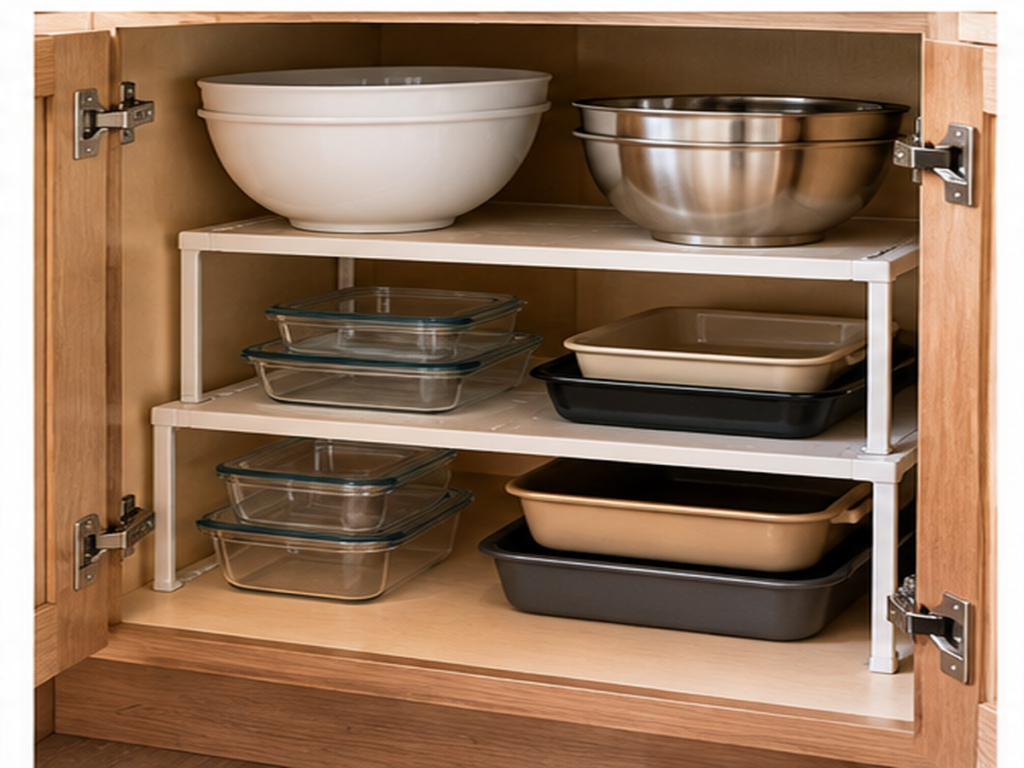
8. Use Shelf Risers to Create Another Storage Level
Corner cabinets often have tall shelf openings.
If you stack everything directly on the shelf, you may leave a large amount of unused vertical space.
Shelf risers can create another level for:
- Plates
- Bowls
- Food containers
- Pantry items
- Small cookware
Use risers where the shelf shape allows them to sit securely.
Cabinet shelf riser → Buy on Amazon
Do not force a rectangular riser into an angled area where it becomes unstable.
9. Use Handled Bins in Deep Areas
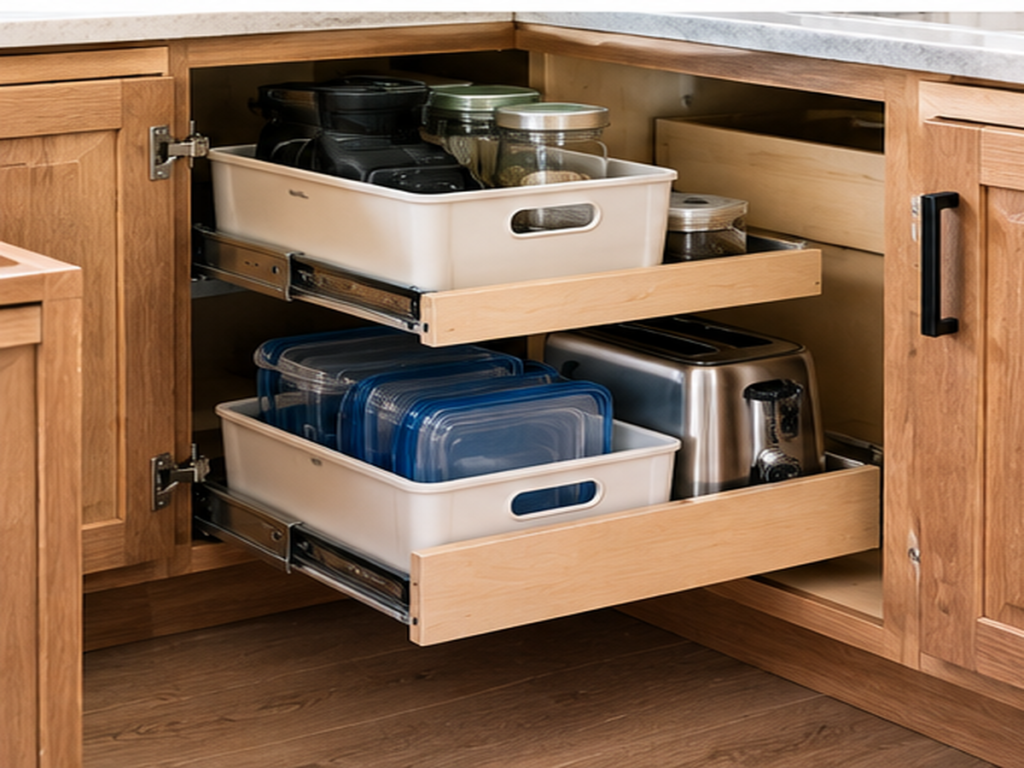
Sometimes a simple bin works better than an elaborate organizer.
A handled bin lets you pull an entire category forward.
Handled cabinet storage bins → Buy on Amazon
Good uses include:
- Baking supplies
- Snack bags
- Food-storage lids
- Seasonal kitchen items
- Small appliances
- Specialty cookware
Choose bins that are narrow enough to pass through the door.
A deep bin is only useful if you can actually remove it.
10. Use One Bin Per Category
Do not create one giant bin for miscellaneous kitchen items.
Instead, separate categories.
For example:
- Baking tools
- Food-storage lids
- Cake decorating
- Specialty utensils
- Small appliance accessories
A clear category makes it easier to pull out exactly what you need.
It also prevents the cabinet from becoming another dumping ground.
11. Store Lightweight Items in the Deepest Areas
The hardest-to-reach zone should not hold the heaviest items.
Use deep corner space for lighter things such as:
- Plastic containers
- Large mixing bowls
- Serving baskets
- Specialty bakeware
- Lightweight appliances
Avoid storing extremely heavy cookware where you have to reach sideways or deep into the cabinet to lift it.
12. Keep Heavy Cookware Closer to the Opening
Heavy pots, Dutch ovens, and cast iron should stay in easier-to-reach areas.
This reduces awkward lifting.
If the cabinet is your main cookware storage area, use the front zone for the heaviest pieces and reserve the deepest section for lighter items.
13. Avoid Loose Stacks of Pots and Pans
Stacks look space-efficient until you need the bottom pan.
If you store cookware in the corner cabinet, consider:
- Shorter stacks
- Pot organizers
- Shelf risers
- Pull-out trays
The goal is to reduce how many pieces you need to move before reaching the one you want.
14. Nest Mixing Bowls Instead of Spreading Them Across the Shelf
Mixing bowls are good corner-cabinet items because they can nest.
Keep one stack together.
Avoid scattering individual bowls across the deep shelf.
Nested categories use awkward depth better than several separate objects.
15. Use the Back for Seasonal Kitchen Items
The deepest section can work well for low-frequency kitchen items.
Examples include:
- Holiday serving dishes
- Large roasting pans
- Specialty baking tools
- Fondue equipment
- Party serving bowls
You may only need these a few times each year.
That makes them better candidates for difficult storage zones than everyday cookware.
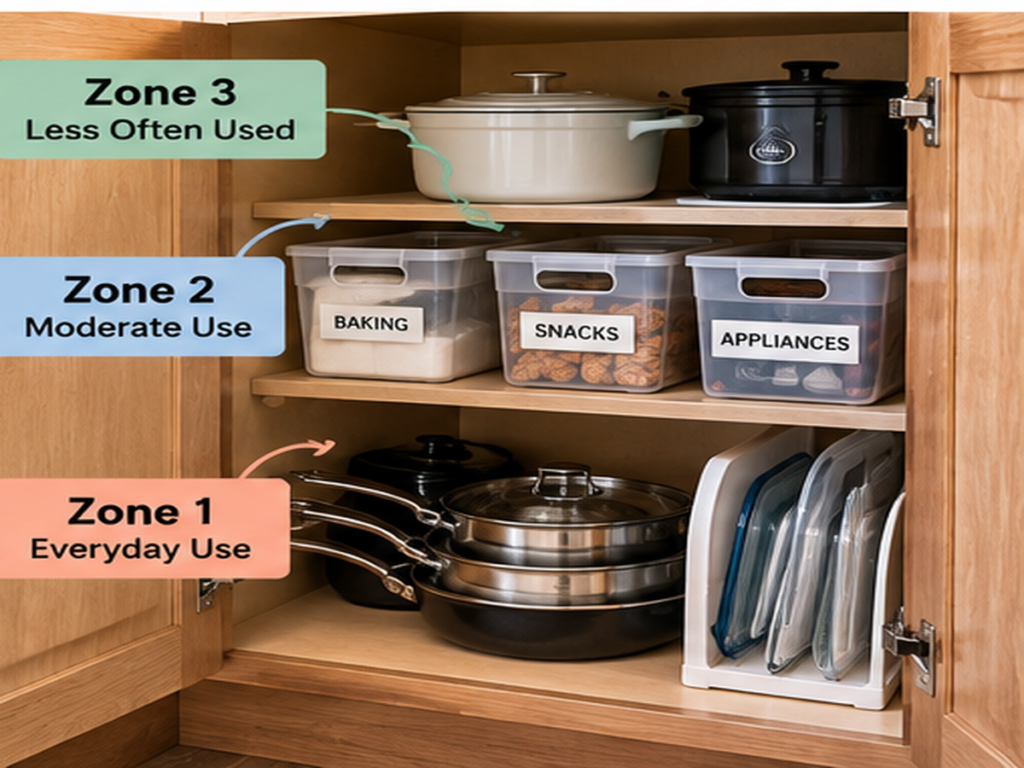
16. Use Frequency-of-Use Zones
Think of the cabinet in three zones.
Zone 1: Easy access
Store:
- Everyday cookware
- Frequently used bowls
- Common pantry items
Zone 2: Moderate access
Store:
- Baking supplies
- Specialty cookware
- Extra containers
Zone 3: Deep corner
Store:
- Seasonal items
- Rarely used serving pieces
- Lightweight backstock
This is often more useful than trying to make every part of the cabinet equally accessible.
17. Use Clear Containers When Visibility Is Poor
Corner cabinets can be dark.
Clear bins help you identify what is inside without removing every container.
They work especially well for:
- Pantry items
- Baking supplies
- Snacks
- Food-storage accessories
If you prefer opaque bins, use clear labels.
18. Label Containers You Cannot See Into
Labels are especially important when several bins look alike.
Use specific names such as:
- Baking
- Food storage
- Specialty tools
- Holiday serving
- Snacks
Avoid labels like:
- Kitchen
- Miscellaneous
- Extra
Specific categories are easier to maintain.
19. Do Not Overfill a Lazy Susan
A turntable needs room to turn.
If bottles extend beyond the edge, they may catch on the cabinet walls.
If containers are packed too tightly, everything moves when you try to remove one item.
Leave some breathing room.
A slightly less full lazy Susan is usually easier to use than one packed to maximum capacity.
20. Use Containers to Keep Items From Falling Off a Turntable
Small packets and bags may fall off a spinning shelf.
Use low-sided containers or dividers for loose items.
This is particularly helpful for:
- Spice packets
- Snacks
- Baking decorations
- Small jars
The turntable should move the category—not scatter it.
21. Check Door Clearance With the Organizer Loaded
An organizer may work perfectly when empty and fail once it is full.
After setting it up, close the doors slowly.
Make sure:
- Handles do not hit the door
- Bottles do not extend into the hinge area
- Pull-outs retract completely
- Turntables rotate freely
Adjust the layout before adding more items.
22. Keep Hinges Clear
Cabinet hinges use more space than they appear to.
Avoid placing bins or organizers where the hinge needs to move.
This is another reason to measure usable interior width rather than simply measuring wall to wall.
23. Use Narrow Organizers Near the Cabinet Opening
The front portion of a corner cabinet may have limited width.
A narrow organizer can sometimes make this area more useful for:
- Lids
- Cutting boards
- Baking sheets
- Small trays
Use the deeper corner for bulkier items and the narrow entrance for slim categories.
Corner cabinet organizer → Buy on Amazon
24. Store Lids Vertically
Pot lids and food-storage lids become messy when stacked horizontally.
Vertical organizers can make them easier to retrieve.
Use a divider or narrow bin near the front of the cabinet.
This keeps the flatter items from disappearing beneath larger cookware.
25. Avoid Buying an Organizer Before Choosing What the Cabinet Will Store
This is one of the biggest mistakes.
Do not organize the cabinet around a product.
Decide what the cabinet needs to hold first.
Then choose an organizer that supports those categories.
A beautiful turntable is useless if the cabinet needs to store large roasting pans.
A pull-out system may be unnecessary if the cabinet only holds lightweight seasonal bowls.
26. Sometimes a Simple Bin Beats an Expensive Mechanism
Pull-out corner systems can be excellent.
But they are not automatically the best option.
A handled bin may work just as well if:
- The stored category is lightweight
- You rarely need it
- The cabinet opening is narrow
- You rent
- You want a low-cost solution
Spend money where access genuinely improves daily use.
Do not install a complicated mechanism just because the cabinet is awkward.
27. Use a Simple Turntable Before Remodeling the Cabinet
If you are unsure what will work, start with the least complicated solution.
Try:
- A lazy Susan
- A handled bin
- A shelf riser
- A divider
Use the cabinet for a few weeks.
If it is still frustrating, then consider a larger pull-out organizer.
28. Keep Small Appliances Near the Front
Small appliances can be good corner-cabinet items, but only when you can lift them easily.
Keep frequently used appliances near the opening.
Examples include:
- Blender
- Hand mixer
- Food processor
- Small slow cooker
Move rarely used appliances deeper.
If appliance storage is becoming a larger issue, see our guide on how to store small kitchen appliances when cabinet space is limited.
29. Do Not Pack the Cabinet From Floor to Shelf
Empty space is not necessarily wasted space.
You need room to:
- Move bins
- Rotate turntables
- Lift cookware
- Pull organizers forward
A packed corner cabinet often holds more but functions worse.
30. Make Sure the Cabinet Can Be Cleaned
Deep cabinets collect crumbs and dust.
Choose organizers that can be removed.
Handled bins and turntables make cleaning much easier than tightly packed loose items.
At least occasionally, you should be able to empty the shelf without dismantling the entire kitchen.
What Is the Best Way to Organize a Blind Corner Cabinet?
Start by separating the front and deep sections.
Keep frequently used items near the opening.
Use the deep section for:
- Pull-out organizers
- Handled bins
- Lightweight seasonal items
A pull-out corner organizer can dramatically improve access if the cabinet dimensions allow it.
Are Lazy Susans Good for Corner Cabinets?
Yes, especially for bottles, jars, pantry goods, and small kitchen supplies.
Make sure the turntable:
- Fits the shelf
- Clears the walls
- Rotates freely
- Does not interfere with hinges
Do not overload it.
What Should You Store in the Back of a Corner Cabinet?
Use the hardest-to-reach space for things you do not need often.
Good examples include:
- Holiday serving pieces
- Large bowls
- Specialty cookware
- Lightweight seasonal items
- Backstock
Avoid putting daily-use items in the deepest corner.
How Do You Organize a Deep Corner Cabinet?
Use storage that moves toward you.
Good options include:
- Pull-out organizers
- Lazy Susans
- Handled bins
- Sliding trays
Our guide on how to organize deep kitchen cabinets covers the same access-first principle for non-corner cabinets.
How Do You Measure for a Corner Cabinet Organizer?
Measure:
- Door-opening width
- Usable interior width
- Interior depth
- Shelf height
- Hinge clearance
Do not rely only on the cabinet’s exterior size.
The organizer must fit through the opening and operate inside the cabinet.
Is a Corner Cabinet Pull-Out Worth It?
It can be if you use the cabinet frequently and the deep corner is otherwise difficult to access.
It may not be worth the cost if the cabinet only holds lightweight, rarely used items.
For those categories, handled bins or a basic turntable can be enough.
Corner Cabinet Organization Is About Access, Not Maximum Capacity
Corner cabinets usually have plenty of storage volume.
The problem is reaching it.
Keep everyday items near the opening.
Use turntables when rotation solves the problem.
Use pull-outs when the deepest space needs frequent access.
Use handled bins for simple categories.
Keep heavy items close.
Move seasonal storage deeper.
And measure the door opening before buying anything.
The best corner cabinet organization system is the one that lets you retrieve what you need without unloading half the cabinet first.
For more cabinet-specific strategies, see our kitchen cabinet organization ideas and our guide to storage ideas for awkward spaces.