
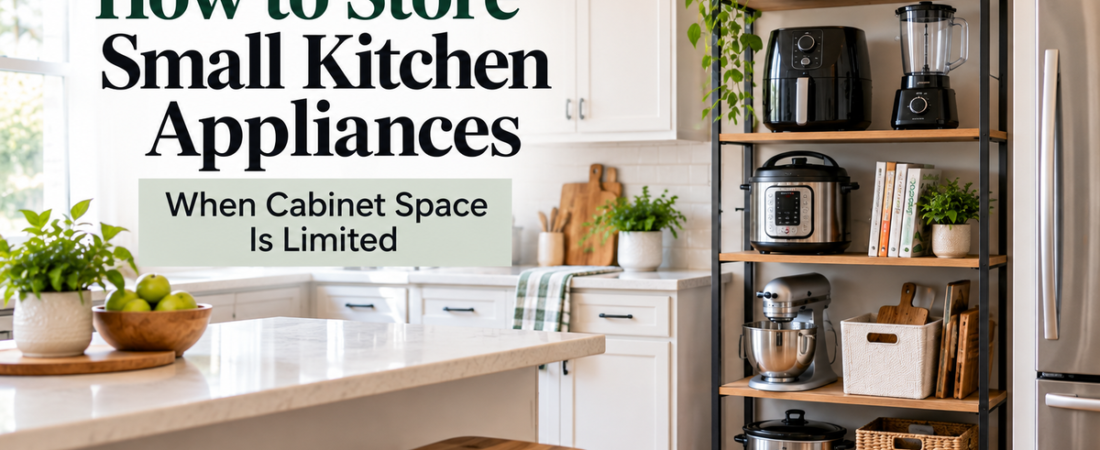
Finding enough room to store small kitchen appliances can be difficult when cabinet space is already tight.
Air fryers, slow cookers, blenders, coffee makers, mixers and pressure cookers all compete for the same limited counters and cabinets. Many are bulky, oddly shaped or heavy enough that storing them on a high shelf isn’t practical.
The best solution isn’t necessarily squeezing every appliance into a cabinet.
It’s deciding which appliances deserve everyday access, which can move into secondary storage, and what type of storage actually fits each appliance safely.
Here’s how to organize small kitchen appliances when cabinet space is limited.
Start by Sorting Appliances by How Often You Use Them
Before adding shelves, carts or cabinets, divide your appliances into three groups.
Daily-use appliances might include:
- coffee maker
- toaster
- electric kettle
- blender
Weekly-use appliances might include:
- air fryer
- Instant Pot
- slow cooker
- food processor
Occasional-use appliances might include:
- stand mixer
- waffle maker
- ice cream maker
- specialty baking appliances
Daily-use appliances should get the easiest access.
Weekly-use appliances can usually live in lower cabinets, pull-outs or nearby storage.
Occasional appliances can move to less convenient areas such as upper shelves, pantry storage or another room if necessary.
This one decision often solves more problems than buying another organizer.
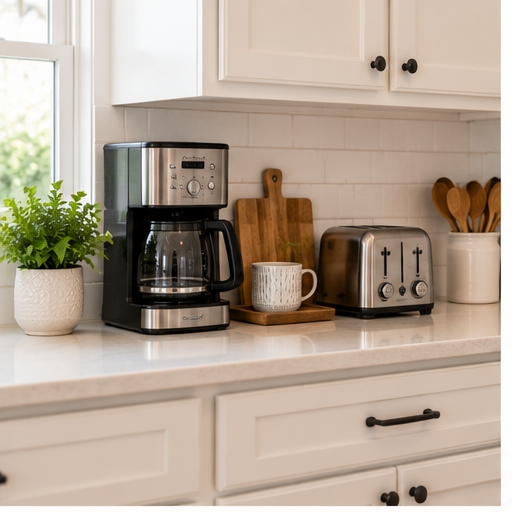
1. Keep Only Truly Daily Appliances on the Counter
Counter space is valuable in a small kitchen.
If an appliance is used almost every day, leaving it out may make sense.
If it comes out once a week, it’s probably taking up workspace that would be more useful for food prep.
Be especially strict with large appliances such as:
- stand mixers
- air fryers
- pressure cookers
- toaster ovens
Ask whether each appliance earns permanent counter space.
If not, move it somewhere that is still accessible but doesn’t occupy your main work surface.
If your kitchen is struggling with limited overall capacity, our How to Organize a Kitchen With Too Little Cabinet Space covers ways to reclaim cabinets and counters throughout the room.
2. Give Each Appliance a Permanent Home
Appliances are much harder to manage when they’re moved randomly from cabinet to cabinet.
Assign each one a specific location.
For example:
- coffee maker → counter
- blender → lower cabinet
- air fryer → appliance cart
- slow cooker → pantry shelf
- stand mixer → low sturdy shelf
A permanent home reduces the tendency to leave appliances on counters simply because putting them away is inconvenient.
3. Use Lower Cabinets for Heavy Appliances
Heavy appliances belong somewhere you can reach safely.
A large stand mixer or pressure cooker may technically fit on a high shelf, but that doesn’t make it a good storage location.
Whenever possible, store heavier appliances:
- between knee and waist height
- in sturdy lower cabinets
- on strong pull-out shelves
- on low freestanding shelving
Avoid lifting a bulky appliance from above shoulder height.
The best storage location should consider both fit and safe handling.
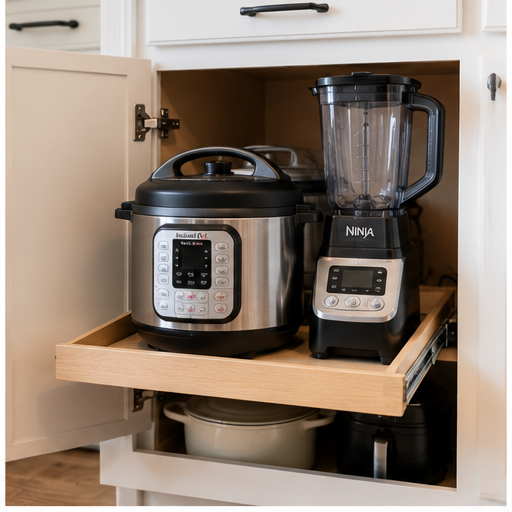
4. Add a Pull-Out Shelf Inside a Cabinet
A deep lower cabinet can be a good place for appliances, but reaching into the back is inconvenient.
A pull-out shelf or sliding organizer can bring the appliance toward you instead.
This is particularly useful for:
- blenders
- pressure cookers
- food processors
- slow cookers
Before buying a pull-out, measure the cabinet opening, not just the interior width.
Door hinges and face frames can make the usable opening narrower than the cabinet cavity.
Our How to Measure for Storage Organizers Before You Buy explains how to account for clearances like these.
Heavy-duty cabinet pull-out shelf → Buy on Amazon
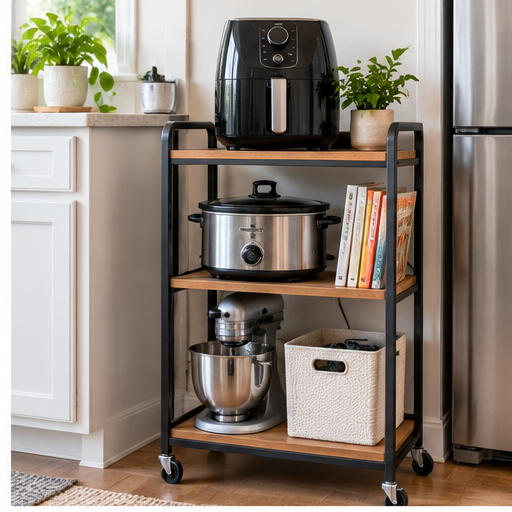
5. Use a Rolling Appliance Cart
A rolling cart can provide appliance storage when cabinets simply don’t have enough capacity.
Use the top for an appliance you’re actively using and lower shelves for others.
This works especially well for:
- air fryers
- pressure cookers
- stand mixers
- bread machines
- slow cookers
A cart can also move out of the way when the appliance isn’t needed.
But measure the cart carefully.
Check:
- total width
- depth
- height
- shelf dimensions
- wheel clearance
- load capacity
A cart that sticks too far into the kitchen can create more frustration than storage.
Heavy-duty rolling kitchen cart → Buy on Amazon
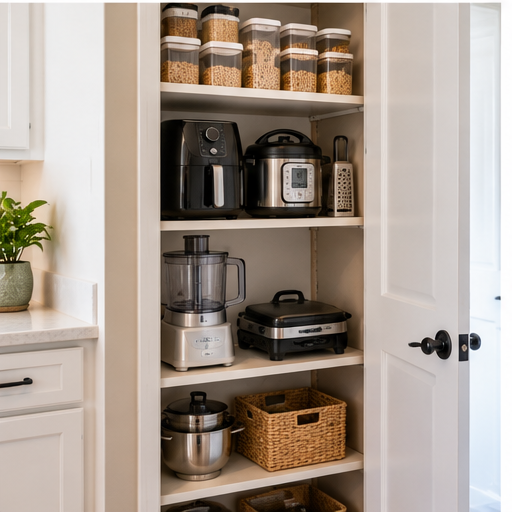
6. Use a Narrow Pantry Cabinet for Appliances
If you have a narrow stretch of unused wall, a tall pantry-style cabinet can add appliance storage without taking up as much floor width as a large cabinet.
This works particularly well for appliances that don’t need to stay on the counter.
Use:
- lower shelves for heavy appliances
- middle shelves for weekly-use appliances
- upper shelves for lighter occasional appliances
Check shelf depth carefully.
Narrow pantry storage cabinet → Buy on Amazon
Some narrow cabinets are designed for pantry food storage and may not be deep enough for bulky appliances.
7. Turn a Deep Cabinet Into an Appliance Zone
If one cabinet is deeper than the others, dedicate it to appliances rather than mixing appliances with cookware and food.
Group appliances by use.
For example:
Breakfast: toaster, waffle maker, blender
Cooking: slow cooker, pressure cooker, air fryer accessories
Baking: mixer attachments, food processor, baking appliances
This reduces the need to dig through unrelated items.
Our How to Organize Deep Kitchen Cabinets So Nothing Gets Lost has more strategies for making deep storage easier to use.
8. Store Appliance Accessories With the Appliance
Appliance accessories have a habit of ending up in unrelated drawers.
Keep:
- blender lids
- food processor blades
- air fryer racks
- mixer attachments
- pressure cooker seals
- instruction booklets
with or directly beside the appliance.
Small bins or baskets can help contain loose parts.
For sharp accessories such as food processor blades, use protective storage and keep them secure rather than loose inside a cabinet.
9. Use Shelf Risers for Smaller Appliances
If a cabinet shelf has a lot of empty vertical space, a sturdy shelf riser can create a second level.
This works best for smaller, lighter appliances such as:
- mini choppers
- sandwich makers
- small blenders
- hand mixers
Don’t use a lightweight riser for a heavy appliance unless it’s specifically rated for the weight.
The goal is to increase storage capacity without creating an unstable stack.
Heavy-duty cabinet shelf riser → Buy on Amazon
10. Use the Pantry for Occasional Appliances
If your kitchen cabinets are full but you have pantry space, move occasional-use appliances there.
Good candidates include:
- waffle makers
- ice cream makers
- specialty cookers
- holiday baking equipment
- extra blender systems
Keep everyday appliances closer to the work area.
The pantry should function as secondary storage, not a place where you constantly retrieve heavy appliances.
If your pantry itself is cramped, our 21 Small Pantry Organization Ideas That Actually Save Space can help you decide where appliances and food should compete for space.
11. Store Appliances Based on Weight, Not Just Size
A large appliance isn’t always the hardest to store.
Weight often matters more.
A bulky but lightweight appliance may be fine on an upper shelf.
A compact but heavy appliance may belong lower.
When choosing a storage location, ask:
- Can I lift it safely?
- Can I remove it without twisting?
- Do I need both hands?
- Is the shelf strong enough?
- Can I see what I’m grabbing?
Storage that requires awkward lifting usually doesn’t stay organized for long because people stop putting the appliance away.
12. Don’t Ignore Appliance Ventilation
Some appliances need airflow while they’re operating.
Do not assume an appliance can safely run inside a cabinet just because it fits there.
Air fryers, toaster ovens, coffee makers and other heat-producing appliances may require clearance around them.
Follow the manufacturer’s instructions for ventilation and operating clearances.
If you store an appliance inside a cabinet or on a cart, move it to an appropriate location before using it if required.
Storage fit and operating clearance are two different things.
13. Check the Counter Footprint Before Buying Appliances
Storage problems sometimes start before the appliance enters the kitchen.
When shopping for a new appliance, don’t look only at capacity or features.
Check its:
- width
- depth
- height
- handle projection
- lid clearance
- cord location
An appliance may fit on the counter but require additional vertical space to open the lid.
A pressure cooker, blender or coffee machine may also need space behind or above it to operate comfortably.
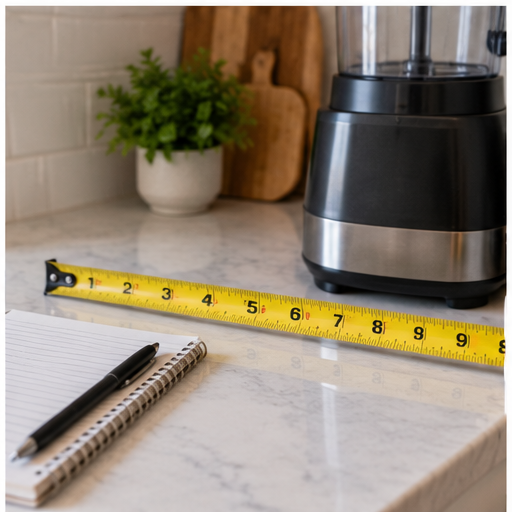
Measure the entire operating footprint, not just the appliance body.
14. Store Appliances Near Where They’re Used
Keeping appliances near their work zone reduces unnecessary carrying.
For example:
Coffee equipment: near mugs, coffee and water.
Blender: near the prep counter.
Stand mixer: near baking ingredients.
Air fryer: near a heat-safe counter area where it can operate.
Slow cooker: near an outlet and clear work surface.
This doesn’t mean every appliance needs to live on the counter.
It means storage should make sense relative to how you use the kitchen.
15. Use a Dedicated Appliance Shelf
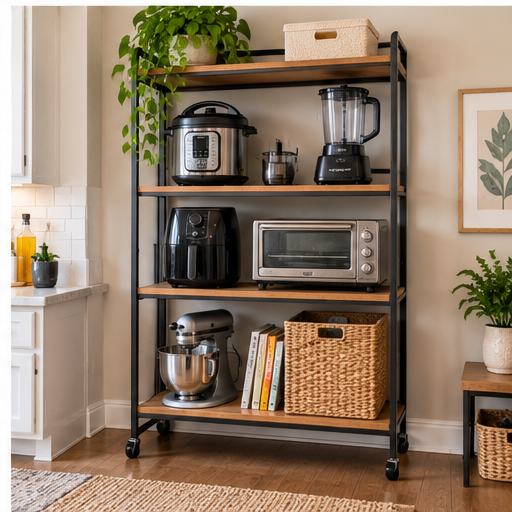
If you have an open wall or part of a pantry, one heavy-duty shelf can become a dedicated appliance zone.
This can work better than trying to scatter appliances across several cabinets.
Make sure the shelf is rated for the combined weight.
Keep heavier appliances lower.
If the shelving unit is freestanding and tall, secure it appropriately according to the manufacturer’s instructions.
Heavy-duty kitchen shelving unit → Buy on Amazon
16. Move Rarely Used Appliances Out of the Kitchen
Some appliances don’t need kitchen real estate at all.
If you use an appliance only a few times per year, consider storing it in:
- a hallway closet
- laundry room
- utility closet
- bedroom closet
- other dry storage area
Keep it protected from moisture and dust.
This is particularly useful in apartments and small homes where kitchen storage is significantly more valuable than storage elsewhere.
17. Be Willing to Let an Appliance Go
Sometimes the problem isn’t storage.
It’s too many appliances doing similar jobs.
Ask yourself whether you really need:
- both a toaster and toaster oven
- several blenders
- multiple coffee machines
- duplicate slow cookers
- an appliance you haven’t used in two years
Small kitchens benefit from equipment that earns its space.
If one appliance can perform the job of another that you rarely use, reducing the collection may be more effective than finding another organizer.
How to Decide Where Each Appliance Should Go – Store Small Kitchen Appliances
A simple system helps.
Daily + light
Counter or easy-access cabinet.
Daily + heavy
Counter or sturdy waist-level storage.
Weekly + light
Cabinet or nearby shelf.
Weekly + heavy
Lower cabinet, pull-out shelf or appliance cart.
Occasional + light
Upper cabinet or pantry.
Occasional + heavy
Low pantry shelf or secondary storage outside the kitchen.
This gives every appliance a storage location based on both frequency and physical effort.
Measure Appliances Before Buying Storage
Before adding a cart, shelf or cabinet, measure the appliance itself.
Record:
- width
- depth
- height
- cord projection
- handles
- lid or door clearance
- accessory dimensions
Then measure the storage area.
For cabinets, check:
- interior width
- usable depth
- opening width
- shelf height
- hinges
- door clearance
For carts and shelves, check:
- shelf dimensions
- shelf spacing
- maximum load
- wheel or leg footprint
An appliance can technically fit on a shelf and still be impossible to remove comfortably.
Frequently Asked Questions
Where should small kitchen appliances be stored?
Daily-use appliances can stay on the counter if they earn the space. Weekly-use appliances usually work well in lower cabinets, pull-outs or carts, while occasional appliances can move to pantry shelves or secondary storage.
How do you store appliances when you have no cabinet space?
Use a rolling cart, narrow pantry cabinet, freestanding shelving or another nearby storage area. Prioritize stable storage that can safely support the appliance’s weight.
Is it okay to store appliances in a pantry?
Yes, especially occasional-use appliances. Keep heavy appliances on lower shelves and make sure the shelving can support the weight.
Should appliances be stored on top of kitchen cabinets?
Only lightweight, infrequently used appliances should be considered for high storage, and only if they can be retrieved safely. Heavy appliances should stay lower.
Can you use an air fryer inside a cabinet?
Do not assume so. Heat-producing appliances require appropriate operating clearance and ventilation. Follow the appliance manufacturer’s instructions and move it into an appropriate operating position when necessary.
What should I do with appliance cords?
Keep cords secured with the appliance rather than allowing them to tangle with other equipment. Avoid wrapping cords tightly around appliances if the manufacturer advises against it.
Store Appliances According to How You Actually Cook
Small kitchen appliance storage works best when accessibility matches frequency.
The coffee maker you use every morning shouldn’t be buried behind a slow cooker you use twice a month.
Heavy appliances shouldn’t require dangerous lifting.
And occasional gadgets shouldn’t occupy the most valuable cabinets in the kitchen.
Start with what you use most.
Measure both your appliances and storage space.
Then choose carts, pull-outs, shelves or cabinets only where they solve a specific problem.
That approach keeps more of your counters clear without making cooking harder.