
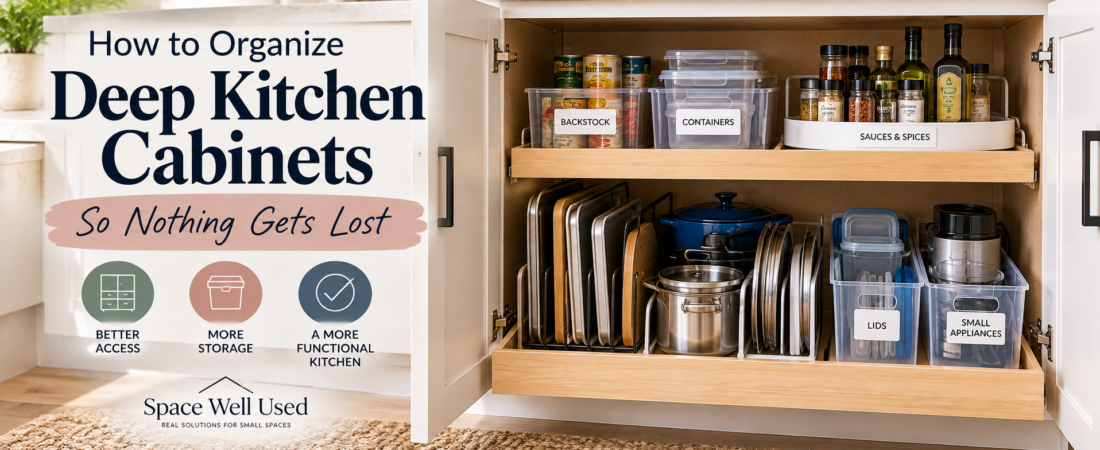
Deep kitchen cabinets look like a storage advantage until you actually try to use them, that’s why we wrote how to organize deep kitchen cabinets.
A deep lower cabinet can hold a lot—but that often means pots, food containers, appliances, and pantry items disappear behind whatever is sitting in front.
You know the pattern.
You reach for one pan and have to move three others.
A small appliance gets pushed to the back and forgotten.
Food containers migrate into a pile.
And eventually the cabinet technically holds plenty while remaining frustrating to use.
The solution is not simply to pack deep cabinets more efficiently.
The real goal is to make the full depth accessible.
That usually means bringing the back forward, separating categories, using vertical storage, and choosing organizers that fit the cabinet geometry rather than fighting it.
Here’s how to organize deep kitchen cabinets so nothing gets lost.
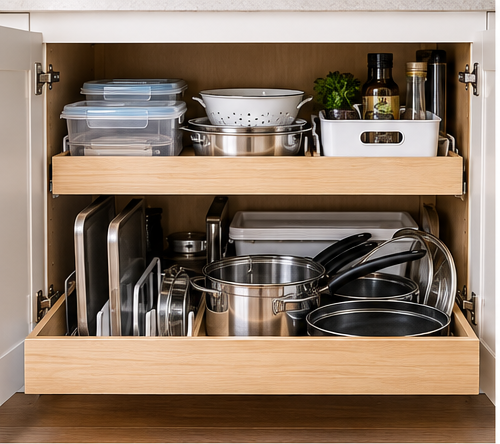
First, Measure the Cabinet Before You Add Anything
Deep cabinets are one of the easiest places to buy the wrong organizer.
Measure:
- interior width
- cabinet opening width
- usable depth
- interior height
- hinge clearance
- shelf supports
- door swing
- any plumbing or obstructions
The cabinet opening width matters just as much as the interior width.
A pull-out organizer can fit perfectly inside a 24-inch-wide cabinet and still fail because the face frame only gives you a 20-inch opening.
The same applies to hinges.
A drawer or basket may need to slide past them.
If you haven’t already, use our How to Measure for Storage Organizers Before You Buy guide before ordering anything for a deep cabinet.
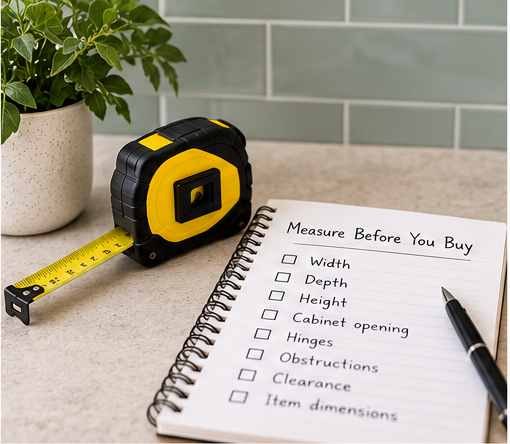
1. Use Pull-Out Organizers for the Deepest Cabinets
The best way to deal with inaccessible depth is often to stop reaching into it.
Bring the cabinet toward you instead.
Pull-out organizers work particularly well for:
- pots and pans
- mixing bowls
- food-storage containers
- pantry staples
- cleaning supplies
- small appliances
Instead of kneeling down and digging into the back, you pull the entire organizer forward.
That turns a deep cabinet into something much closer to a drawer.
Before buying one, check:
- opening width
- mounting requirements
- slide length
- hinge clearance
- weight capacity
- usable interior depth
A pull-out that is too wide by even half an inch can be unusable.
Cabinet pull-out organizer → Buy on Amazon
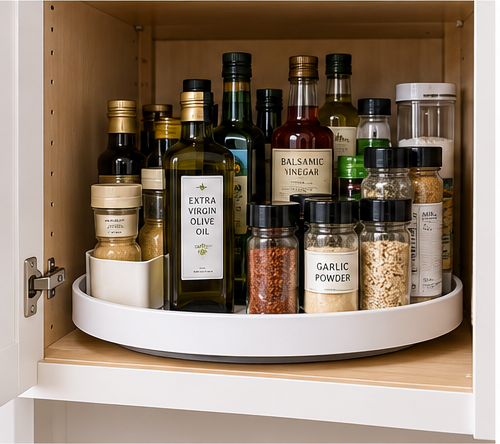
2. Use Turntables for Bottles, Jars and Small Items
Turntables are useful when a cabinet contains several small items that would otherwise hide behind each other.
Good candidates include:
- oils
- sauces
- condiments
- spices
- small jars
- supplements
- baking ingredients
A turntable works especially well in a deep upper cabinet where reaching the back is difficult.
Instead of moving several bottles, rotate the organizer until the item comes forward.
Measure the turntable diameter carefully.
A 12-inch turntable needs enough square clearance to rotate freely.
Also remember that round organizers leave some unused corner space.
That is not necessarily inefficient.
If the tradeoff is dramatically better access, the space is still being used more effectively.
Large cabinet turntable → Buy on Amazon
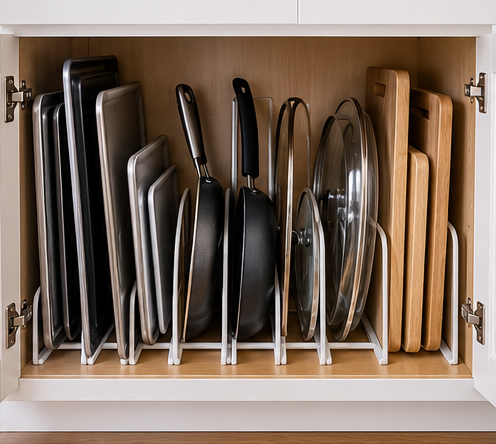
3. Store Pans and Cutting Boards Vertically
Horizontal stacks are one of the worst ways to use a deep cabinet.
If cutting boards, sheet pans, and frying pans are stacked flat, the item you want is usually underneath everything else.
Vertical dividers let you store them upright.
Vertical pan organizer → Buy on Amazon
Use them for:
- baking sheets
- cutting boards
- pan lids
- muffin tins
- frying pans
- serving trays
Now each item can slide out individually.
The deeper cabinet space becomes much easier to use because you don’t have to unload the entire stack.
If you want more general ways to make cabinets work harder, see our 15 Kitchen Cabinet Organization Ideas That Make Every Shelf Work Harder.
4. Use Deep Bins Only When They Can Pull Out
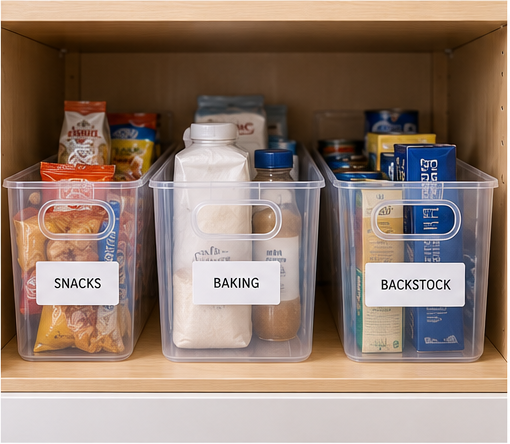
A long bin can make good use of cabinet depth.
But only if you can remove it easily.
Deep bins are useful for:
- snack foods
- baking supplies
- food-storage lids
- cleaning products
- small appliances
- grouped pantry items
The problem starts when the bin becomes a permanent box shoved into the back.
Look for handles or a shape that allows you to pull the entire bin forward.
And leave clearance around it.
If the bin fits so tightly that your fingers can’t reach the handle, it isn’t functioning as pull-out storage.
Deep cabinet storage bins → Buy on Amazon
5. Give the Back of the Cabinet a Specific Job
The back of a deep cabinet doesn’t need to hold everyday items.
You can treat it as a separate storage zone.
For example:
Front zone
Frequently used cookware, dishes, or food.
Back zone
Backup items, seasonal cookware, or rarely used supplies.
This works best when the back items are contained.
A labeled bin for BAKING BACKSTOCK is easier to manage than five random bags and boxes shoved behind everyday food.
The key is intentional storage.
If you’re using the back for low-frequency items on purpose, that’s different from accidentally losing things there.
6. Use Shelf Risers to Improve Visibility
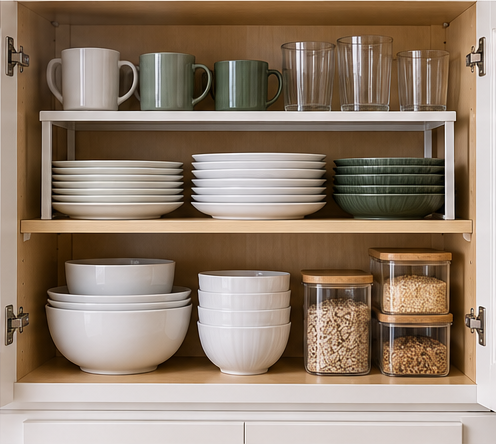
Sometimes deep cabinets have another problem: wasted height.
A shelf may be tall enough for two levels of storage, but everything sits on one surface.
Shelf risers create another layer.
Use them for:
- dishes
- mugs
- bowls
- canned goods
- food-storage containers
The important part is making sure the second level remains visible.
A shelf riser that simply creates another deep, hidden shelf does not solve much.
Try placing shorter items in front and taller items on the riser behind them.
That lets you use both height and depth while preserving visibility.
7. Use Clear Storage When You Need to See the Back
Visibility matters in deep cabinets.
Clear bins can help because you can see what is stored behind the front layer.
They work particularly well for:
- pantry foods
- baking supplies
- food containers
- small kitchen tools
You do not need to transfer every item into matching containers.
The goal is not visual perfection.
It is knowing what you own without unloading the cabinet.
8. Group Similar Items Together
Deep cabinets become chaotic quickly when unrelated categories are mixed.
Instead, assign each area a purpose.
For example:
Cookware cabinet
- frying pans
- pots
- lids
Baking cabinet
- baking sheets
- mixing bowls
- measuring tools
Food-storage cabinet
- containers
- lids
- reusable bags
Small-appliance cabinet
- blender
- mixer attachments
- food processor
Grouping by use makes it easier to know where to reach.
It also helps you notice when one category is consuming too much space.
9. Keep Heavy Items Low
Deep cabinets often encourage people to push heavy appliances or cookware toward the back.
That can make them difficult and awkward to retrieve.
Keep heavy items:
- low
- reasonably close to the front
- on pull-outs when possible
Avoid storing very heavy appliances behind lighter objects.
You should not need to lift several items just to reach a cast-iron pan or food processor.
10. Use Lid Organizers Instead of Stacking Lids
Pot lids and food-storage lids are particularly good at creating cabinet chaos.
If you stack them flat, they slide around.
If you lean them loosely, they fall over.
A vertical lid organizer can keep them separated.
You can use:
- adjustable dividers
- wire lid racks
- door-mounted lid holders
Door-mounted storage can work especially well if the cabinet has enough interior clearance.
Measure first.
A lid organizer attached to the door needs room to close without hitting the shelves or cookware inside.
Adjustable lid organizer → Buy on Amazon
11. Avoid Putting Tiny Items Loose in the Back
A deep cabinet is a terrible place for loose small items.
Things like:
- measuring cups
- small containers
- packets
- attachments
- clips
- accessories
can disappear completely.
Keep smaller items in:
- bins
- baskets
- shallow trays
- labeled containers
That way you retrieve the category instead of hunting for individual pieces.
12. Use the Cabinet Door Carefully
The inside of a deep cabinet door can add storage without using shelf space.
Potential uses include:
- lids
- measuring spoons
- cutting boards
- wraps and bags
- lightweight cleaning supplies
But door storage changes the usable interior space.
Anything mounted there needs clearance when the door closes.
This is exactly why measuring the organizer while imagining the cabinet in use matters more than measuring the empty box.
13. Don’t Store Everything at Full Depth
This sounds backwards, but sometimes a slightly shallower organizer is better.
You may have a 24-inch-deep cabinet.
That doesn’t mean every organizer should be 24 inches deep.
A 19-inch pull-out that moves smoothly may be more useful than a 23½-inch bin that constantly scrapes the back wall or gets caught on hinges.
Storage efficiency is not about filling every possible inch.
It is about making the space easy to use.
14. Use Deep Upper Cabinets Differently From Deep Lower Cabinets
Upper and lower cabinets create different access problems.
Deep upper cabinets
The challenge is usually visibility and reach.
Best solutions often include:
- turntables
- shelf risers
- clear bins
- grouped categories
Deep lower cabinets
The challenge is usually reaching down and backward.
Best solutions often include:
- pull-outs
- drawers
- vertical dividers
- large handled bins
Choose the solution based on the physical problem.
Don’t use the same organizer everywhere just because it matches.
15. Move Rarely Used Items Out of Prime Cabinets
If a deep cabinet is packed with things you barely use, organization can only do so much.
Consider moving:
- seasonal bakeware
- specialty appliances
- oversized serving pieces
- duplicate cookware
to secondary storage.
That may be:
- pantry shelving
- garage storage
- utility storage
- a high cabinet
- another appropriate room
If overall cabinet capacity is the bigger problem, our How to Organize a Kitchen With Too Little Cabinet Space focuses specifically on kitchens where the number of cabinets simply isn’t enough.
A Simple Decision Guide How to Organize Deep Kitchen Cabinets
If you’re not sure what organizer makes sense, start with the problem.
Items disappear behind each other
Use a turntable, riser, or clear bin.
You have to kneel and reach into the back
Use a pull-out organizer.
Pans and trays are stacked
Use vertical dividers.
Small items get lost
Use contained bins or trays.
Lids fall everywhere
Use a vertical lid organizer.
The cabinet is too tall
Use a shelf riser.
The cabinet is too full
Reduce inventory or move low-frequency items elsewhere.
This prevents you from buying storage products that look helpful but don’t address the actual constraint.
What to Measure Before Buying Deep Cabinet Organizers
Before ordering anything, record:
Cabinet dimensions
- interior width
- usable depth
- height
Opening dimensions
- face-frame width
- door opening
Obstacles
- hinges
- pipes
- shelf supports
- door hardware
Movement requirements
- pull-out travel
- turntable rotation
- bin removal
- door swing
Stored-item dimensions
- pan height
- appliance width
- container depth
- bottle height
If you’re unsure about any of these, revisit our How to Measure for Storage Organizers Before You Buy before purchasing.
What Not to Do With Deep Kitchen Cabinets
Avoid:
- stacking everything front to back
- putting small items behind large ones
- buying organizers before measuring
- using bins that cannot pull out
- storing heavy items high or deep
- filling every inch with no clearance
- mixing unrelated categories
- using huge bins for heavy items
- blocking hinges with organizers
And don’t assume unused space is wasted.
A few inches of clearance can make the difference between a cabinet that looks full and one that actually works.
How to Organize Deep Pantry-Style Kitchen Cabinets
Some deep kitchen cabinets function more like pantry storage.
In that case, many of the same principles apply.
Use:
- turntables
- handled bins
- risers
- categories
- front/back zones
If food storage is the main problem, see our 21 Small Pantry Organization Ideas That Actually Save Space.
The deeper the shelf, the more important it becomes to make the back accessible.
Deep Cabinets Work Best When the Storage Moves
There’s a useful pattern here.
The hardest deep cabinets are static.
Everything sits in place while you reach around it.
The easiest deep cabinets use storage that moves:
- pull-outs slide
- turntables rotate
- bins lift
- drawers extend
When the storage comes toward you, depth becomes an advantage instead of a problem.
Frequently Asked Questions
What is the best way to organize very deep kitchen cabinets?
Use organizers that improve access to the back, such as pull-out drawers, turntables, handled bins, vertical dividers, and shelf risers. Group similar items together and keep frequently used items easiest to reach.
Are pull-out organizers worth it in deep cabinets?
They can be one of the most effective solutions because they bring the full cabinet depth forward. Measure the opening, interior depth, hinges, and mounting requirements carefully before buying.
How do you organize pots and pans in a deep cabinet?
Use pull-out shelves or vertical dividers when possible. Avoid stacking many pans horizontally because retrieving one usually requires moving the others.
What should go in the back of deep cabinets?
The back is best for organized low-frequency items or backstock rather than everyday supplies. Keep those items contained in labeled bins so you know what is there.
Are turntables good for deep cabinets?
Yes, especially for bottles, jars, condiments, and other small items. They allow items at the back to rotate forward instead of requiring you to reach past everything in front.
Make the Depth Work for You
Deep kitchen cabinets are not bad storage.
They are simply storage that needs access built into the system.
Stop stacking everything front to back.
Bring the back toward you with pull-outs.
Rotate small items forward.
Store pans vertically.
Contain loose categories.
And measure carefully before adding organizers.
The best deep cabinet setup is not the one that holds the most stuff.
It’s the one where you can open the door, see what you own, reach what you need, and put it back without unloading half the cabinet.
For broader small-home storage strategies beyond the kitchen, see our 25 Storage Ideas for Small Homes That Make Every Inch Count.