

When your garage barely has enough room for your car, finding space for storage bins, seasonal decorations, tools, and outdoor equipment can feel impossible. But one of the most overlooked storage areas in a small garage isn’t along the walls or behind the door. It’s overhead.
The right overhead garage storage setup can help you reclaim valuable floor space without sacrificing parking room or access to the things you use regularly.
From ceiling-mounted racks to overhead storage for seasonal bins, there are several ways to make use of this often-wasted space. The key is choosing a solution that fits your garage’s ceiling height, structure, and available clearance.
These overhead garage storage ideas will help you figure out what belongs above your head, which storage systems are worth considering, and how to avoid common mistakes when organizing a small garage.
Is Overhead Garage Storage Worth It?
For many small garages, overhead storage can make a noticeable difference.
Instead of stacking plastic bins against a wall or squeezing them beside your vehicle, you can move items you rarely need into unused ceiling space.
Overhead storage works especially well for:
- Holiday decorations and seasonal supplies
- Lightweight camping gear
- Empty coolers and recreational equipment
- Seasonal outdoor accessories
- Infrequently used household storage bins
- Bulky but relatively lightweight belongings
However, not every garage is a good candidate for ceiling-mounted storage.
Before installing anything, you need to consider your ceiling structure, garage door movement, vehicle clearance, and the total weight the structure can safely support.
For a broader approach to organizing the entire space, start with our 15 Garage Storage Ideas for Small Garages.
1. Install Adjustable Ceiling-Mounted Storage Racks
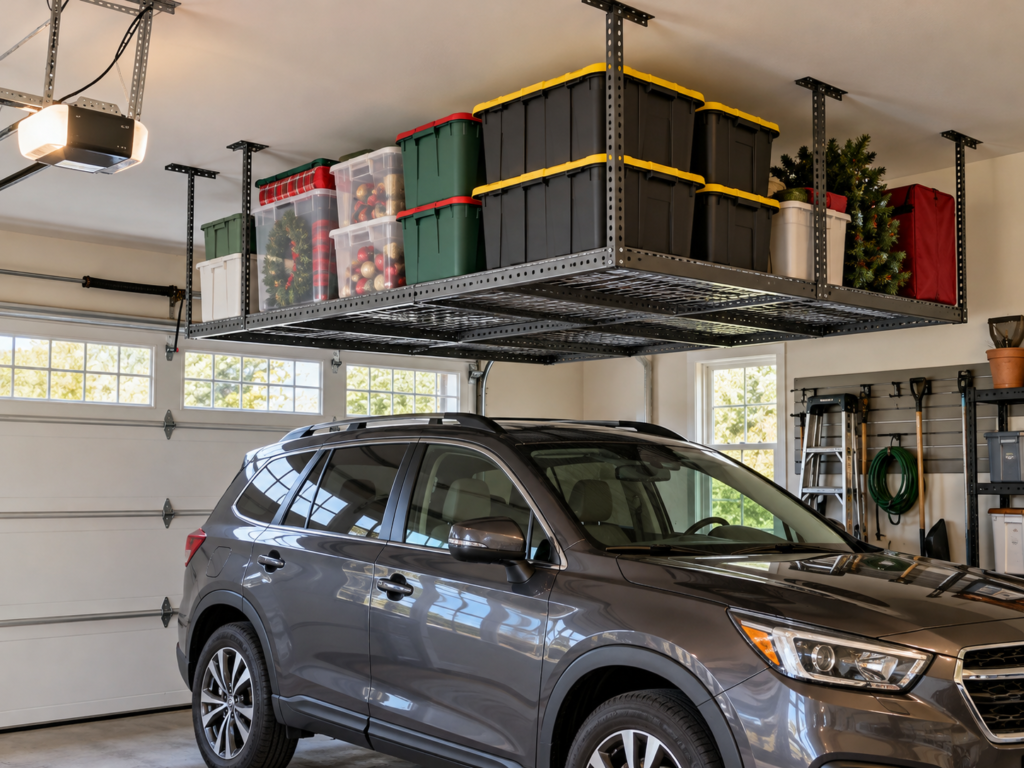
One of the most versatile overhead garage storage solutions is an adjustable ceiling-mounted rack.
These metal platforms attach to suitable structural framing and create a raised storage area for bins, boxes, and bulky seasonal items.
Many systems allow you to adjust how far the storage platform hangs below the ceiling, making it easier to work around your garage’s particular layout.
Why it works in a small garage:
- Keeps the floor clear for parking
- Consolidates seasonal storage
- Makes use of otherwise empty ceiling space
- Can accommodate multiple organized bins
- Keeps less frequently used items away from everyday clutter
The important thing is selecting a rack that fits both the available space and the structural requirements of your garage.
A rack’s advertised weight capacity is not a guarantee that your ceiling can safely support the same load.
Storage solution worth considering: An adjustable overhead garage rack, such as the FLEXIMOUNTS 4×8 ceiling storage system, can create a dedicated space for seasonal bins without using valuable floor space. Check the mounting requirements, ceiling clearance, and rack dimensions before purchasing.
Adjustable overhead garage storage rack → Buy on Amazon
2. Use Overhead Tote Storage Systems
If most of your garage clutter consists of plastic storage bins, a dedicated overhead tote system may be a better fit than a traditional platform rack.
These systems use rails or brackets designed to support compatible storage containers, often by their reinforced rims.
Rather than stacking bins on a large shelf, you slide them into designated overhead positions.
This can make individual containers easier to identify and retrieve without disturbing an entire stack.
They’re especially useful for:
- Christmas decorations
- Seasonal clothing
- Party supplies
- Camping accessories
- Lightweight seasonal equipment
Choose a system specifically designed for your exact container dimensions and rim style. Ordinary plastic bins are not automatically suitable for suspended storage.
Small-space tip: Use matching containers only after verifying compatibility. A collection of random bins may not fit the same overhead rail system.
Storage solution worth considering: An overhead tote rail system can be a practical alternative to a traditional ceiling rack if most of your garage clutter is already stored in plastic bins. Look for a system designed for your specific tote size and rim construction.
Overhead garage tote storage system → Buy on Amazon
3. Take Advantage of Space Above the Garage Door
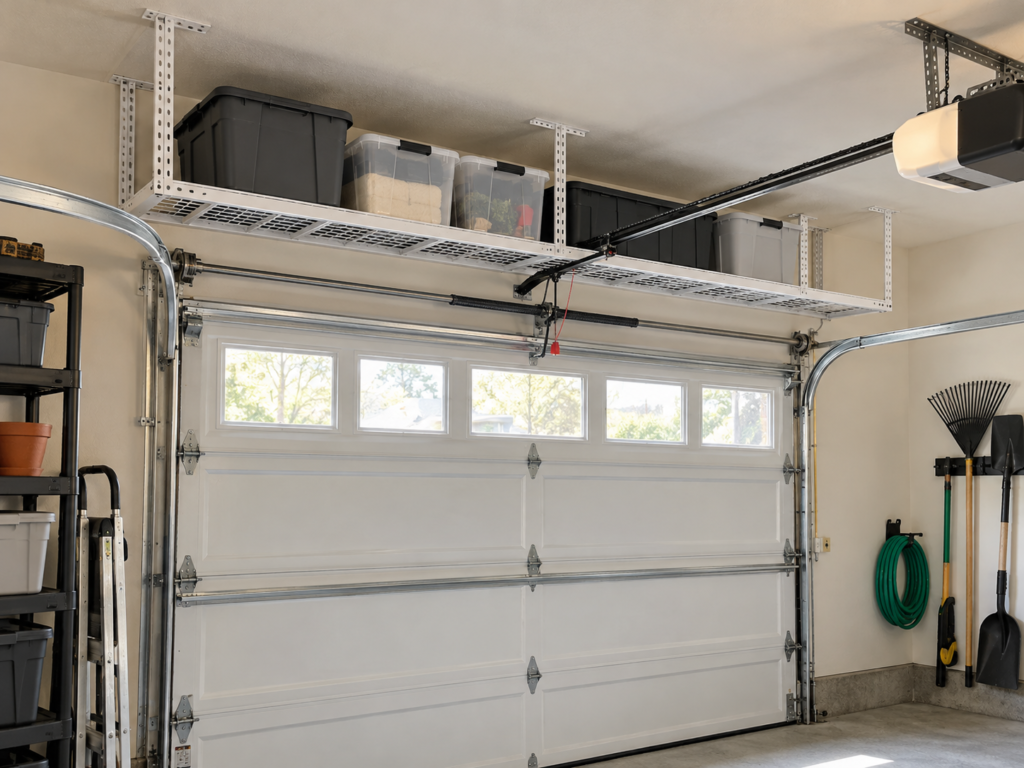
The area above the garage door is often overlooked because it doesn’t seem like usable storage space.
Depending on your garage’s construction, however, there may be room for a shallow rack or other purpose-built overhead storage system.
This location can work well for lightweight seasonal decorations or other belongings you only access a few times each year.
Before choosing this space, check:
- How high the garage door travels
- The position of the door tracks
- Clearance around the opener rail and motor
- The lowest point of the storage system
- The height of the bins you plan to store
- Whether suitable structural mounting points are available
Never assume that space above a closed garage door will remain clear when the door opens.
Watch the door complete its full opening and closing cycle, and account for its entire travel path. Don’t modify tracks, springs, cables, or opener components to make a storage rack fit.
If the space is too shallow, a different storage location is the better choice.
4. Create a Dedicated Overhead Holiday Storage Zone
Holiday decorations are ideal candidates for overhead storage because they can occupy valuable garage space while remaining unused for most of the year.
Rather than scattering decorations throughout your garage, dedicate one approved rack or storage section to seasonal supplies.
Keep related items together:
- Christmas decorations
- Halloween decorations
- Seasonal wreaths
- Lightweight holiday displays
- Seasonal party supplies
Clearly label each container and group items by holiday.
If your garage experiences extreme temperatures or moisture, keep delicate ornaments, candles, electronics, and other sensitive items somewhere more protected.
For more ways to consolidate seasonal belongings, see our Guide to Storing Christmas Decorations.
5. Choose Shallow Overhead Racks for Low Ceilings
Not every garage has enough height for a deep overhead storage platform.
If you have a relatively low ceiling, a shallow rack may offer some storage without creating an obstacle above your vehicle.
The key is to measure the complete vertical space, including the rack and anything stored on it.
For example, consider a garage with a 9-foot ceiling:
| Measurement | Example |
|---|---|
| Ceiling height | 108 inches |
| Rack drop to underside | 18 inches |
| Remaining clearance | 90 inches |
| Vehicle height | 70 inches |
| Theoretical clearance above vehicle | 20 inches |
These figures are only an illustration. The actual rack profile, vehicle roof accessories, open hatch, travel path, and safe loading access may require considerably more room.
Never size a rack from ceiling height alone.
If an overhead platform leaves inadequate vehicle or walking clearance, use a shallower design or keep storage along the wall instead.
6. Use Ceiling Storage for Lightweight, Bulky Items
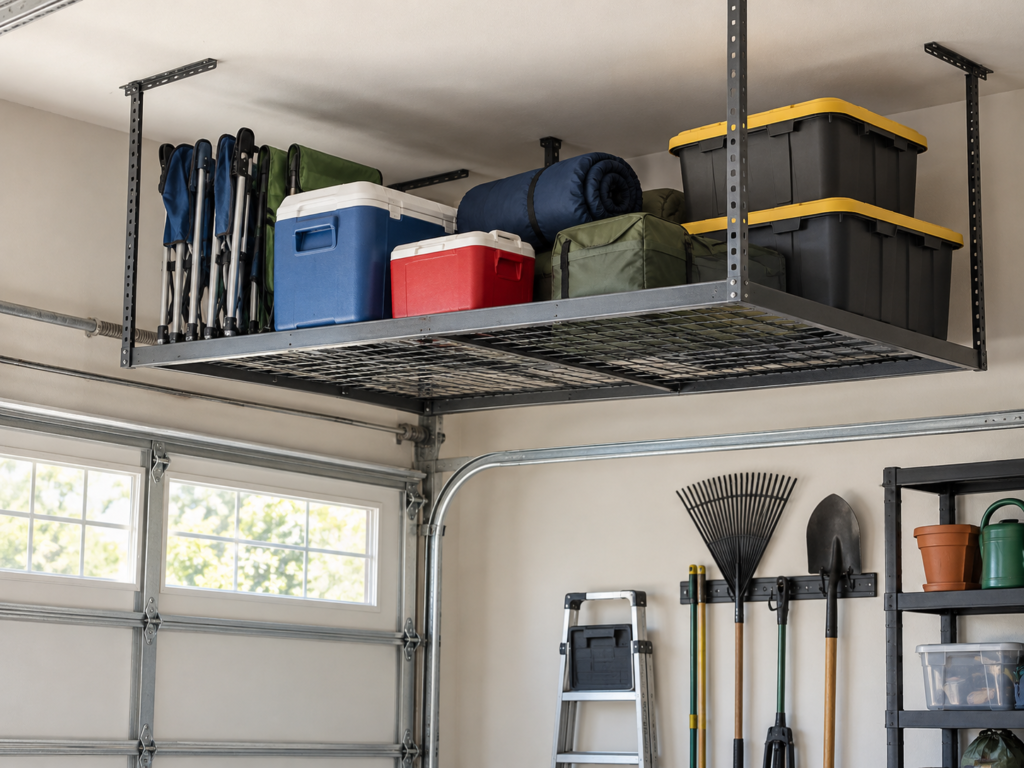
Not everything stored overhead needs to be inside a plastic bin.
Lightweight, bulky belongings can also be good candidates for an appropriately rated platform.
Examples include:
- Empty camping totes
- Lightweight folding chairs
- Empty recreational coolers
- Seasonal outdoor decorations
- Lightweight sports accessories
The goal is to move belongings that occupy plenty of floor space but don’t need to be retrieved every week.
Avoid loose items that could slide or fall. Use appropriate containment or restraints approved for the storage system.
Heavy equipment, sharp objects, glass containers, and awkward loads are generally better stored at an accessible height.
7. Consider an Overhead Pulley or Lift System
Some overhead garage storage systems include a pulley, crank, or motorized lifting mechanism.
These allow an approved storage platform or supported item to be lowered for access and then raised out of the way.
A lift system can be useful when traditional ceiling racks are difficult to reach.
Potential uses include:
- Lightweight seasonal storage
- Compatible bicycles
- Approved recreational equipment
- Specially designed storage platforms
However, pulley systems are not automatically safer than fixed racks.
They introduce moving loads and additional components, including cables, pulleys, locking mechanisms, and lifting hardware.
Choose a system rated specifically for the intended use, confirm the ceiling structure is suitable, and follow the manufacturer’s instructions.
Important: Never stand beneath a suspended load while it is moving, and never improvise a ceiling lift using ordinary rope and unapproved hardware.
Storage solution worth considering: A purpose-built garage ceiling lift can make seasonal storage easier to access without climbing to a fixed overhead platform. Choose a system with appropriate locking mechanisms and a rated capacity that suits both your belongings and garage structure.
Garage ceiling storage lift system → Buy on Amazon
8. Store Bicycles Overhead Only When Clearance Allows
Bicycles can consume a surprising amount of space in a small garage.
A properly installed ceiling-mounted bike storage system may help recover that floor area.
Depending on the system, bikes may hang from individual hooks or use a lifting mechanism designed specifically for bicycles.
Before installing overhead bike storage, consider:
- The bike’s actual weight
- The storage system’s rating
- Ceiling attachment requirements
- Tire and handlebar clearance
- Vehicle clearance
- Whether you can safely lift and lower the bike
For bicycles used every day, a wall-mounted rack may be more convenient.
Ceiling storage usually works best for occasional-use bikes, provided the structural requirements and access conditions are met.
9. Use Overhead Storage for Ladders and Long Equipment
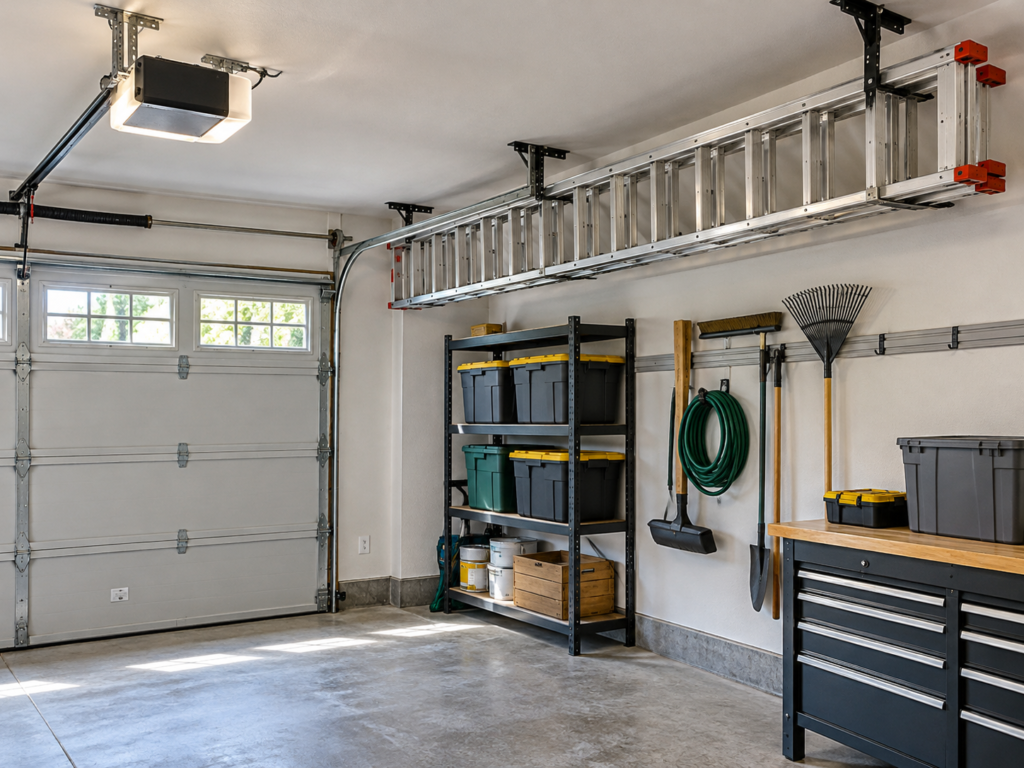
Ladders and long equipment are challenging to organize because they don’t fit neatly into standard shelving.
A purpose-built overhead ladder storage system may help keep this equipment out of the way.
Some systems hold a ladder horizontally using brackets or rails.
Before installing one, make sure the equipment is supported and restrained as required by the manufacturer.
Avoid hanging long equipment directly over vehicle doors, frequently used walking areas, or places where someone could accidentally bump it.
For heavier ladders or garages with limited clearance, wall storage is often the more practical option.
Our Garage Wall Storage Ideas guide includes alternatives for keeping long equipment off the floor without relying on the ceiling.
Storage solution worth considering: An overhead ladder storage rack can help keep extension or folding ladders off the garage floor. Look for padded supports, appropriate mounting hardware, and a weight rating suitable for your specific ladder.
Overhead garage ladder storage rack → Buy on Amazon
10. Divide Overhead Storage Into Clearly Labeled Zones
An overhead rack can become just as disorganized as a crowded garage shelf if everything gets tossed onto it without a plan.
Instead of treating overhead storage as one large catchall space, divide it into categories.
For example:
| Storage zone | What belongs there |
|---|---|
| Holiday | Seasonal decorations |
| Outdoor | Lightweight camping and recreation gear |
| Household | Rarely used household accessories |
| Seasonal | Out-of-season lightweight equipment |
Use labels large enough to read from the floor.
Place labels on the outward-facing and bottom-visible sides of compatible bins, where possible.
Keep an inventory on your phone if items aren’t easily visible.
This simple system makes it much easier to find belongings without taking down several containers.
11. Combine Ceiling Storage With Garage Wall Shelving
Overhead garage storage works best as part of a larger organization system.
You don’t necessarily want everything stored above your head.
A more practical layout separates items by how frequently you use them.
Overhead storage: Lightweight seasonal items and belongings accessed only occasionally.
Wall shelving: Supplies, equipment, and containers used monthly or weekly.
Accessible floor or lower storage: Heavy items and equipment used regularly.
Combining these approaches helps maintain usable parking space while reducing the need to retrieve things from above.
If you’re planning a complete garage layout, our Garage Shelving Ideas for Small Garages can help you organize the areas below your ceiling storage.
12. Choose Storage Bins That Fit the Rack
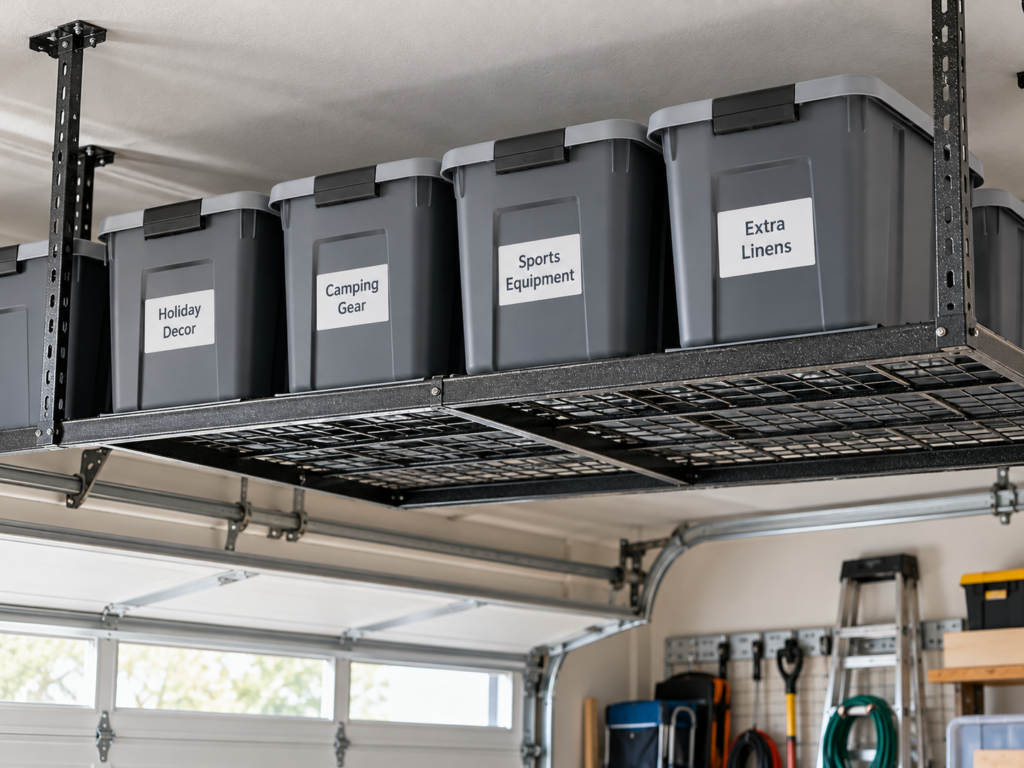
The right bins can make overhead storage significantly more practical.
Before purchasing containers, measure the usable platform dimensions and the clearance above the storage deck.
Look for bins with:
- Secure-fitting lids
- Sturdy handles
- Shapes that fit fully on the rack
- Durable materials suited to garage conditions
- Flat, stable bottoms
- Labels visible from below or from the access side
Clear containers can make contents easier to identify, while opaque bins may help limit light exposure for some belongings.
Avoid stacking containers higher than the manufacturer’s storage system allows, and don’t assume a large bin is safe to lift just because it fits.
For help selecting containers, see our Storage Bin Size Guide.
Storage solution worth considering: Heavy-duty plastic storage totes with secure-fitting lids can help protect seasonal supplies and keep overhead racks organized. Measure the containers before buying, and make sure each loaded bin is manageable to lift safely.
Heavy-duty lidded garage storage totes → Buy on Amazon
13. Plan Your Overhead Garage Storage Around Ceiling Joists
Before purchasing a ceiling-mounted storage rack, determine what kind of structural support your garage actually has.
Ceiling joists may run from front to back or side to side, and their spacing affects which mounting configurations are possible.
A finished drywall ceiling can make the framing more difficult to identify.
Check the following before installation:
- Joist direction: Determine which direction the framing runs.
- Joist spacing: Compare the actual spacing with the rack manufacturer’s requirements.
- Framing condition: Look for damage, sagging, moisture, or alterations.
- Mounting hardware: Use hardware approved for the specific rack and structure.
- Structural capacity: Confirm that the framing can safely support the intended load.
Some garages use engineered roof trusses rather than conventional ceiling joists. Trusses should not be assumed suitable for additional storage loads without appropriate structural verification.
Never mount a load-bearing overhead rack using drywall anchors alone.
Different rack models have different structural requirements. Manufacturer installation guidance, such as the FLEXIMOUNTS installation guide, illustrates why confirming joist orientation and mounting locations matters.
If you’re uncertain about the ceiling structure, have a qualified installer or structural professional evaluate it before proceeding.
14. Measure Your Garage Before Buying Overhead Storage
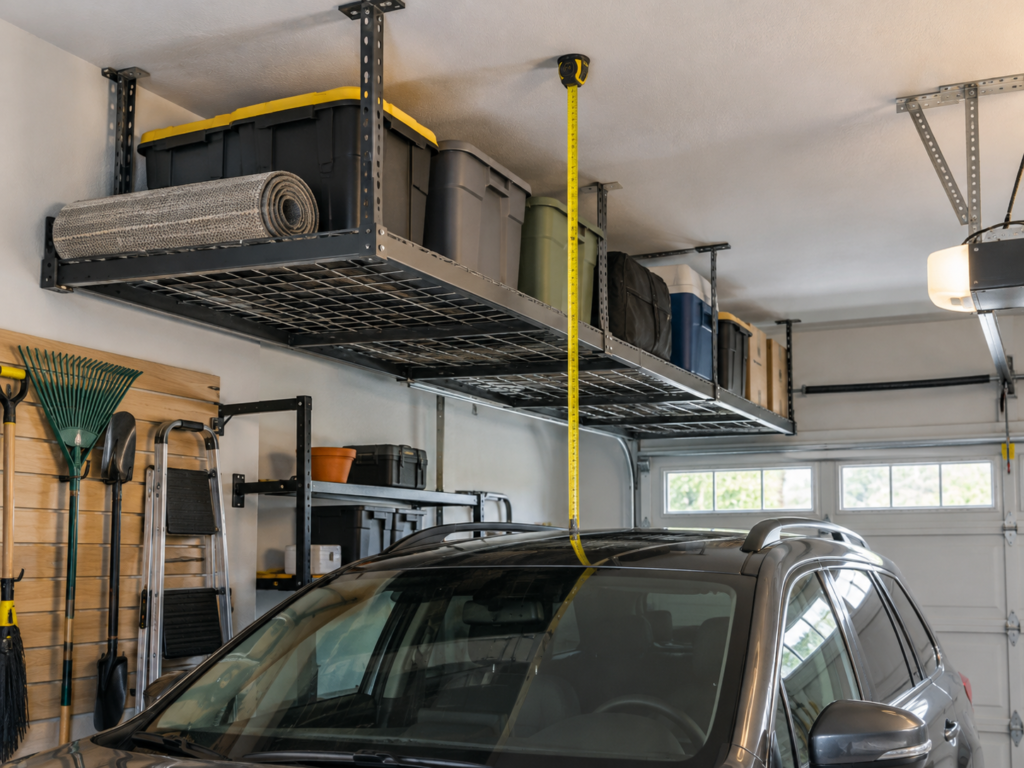
The biggest mistake when planning garage ceiling storage is shopping for a rack before measuring the available space.
A rack might fit your ceiling dimensions while still interfering with your garage door or vehicle.
Start with five measurements.
Ceiling height
Measure from the garage floor to the ceiling at the exact proposed installation location.
Garage door clearance
Observe the entire opening and closing path, including the tracks, door panels, opener rail, and moving components.
Vehicle clearance
Measure your vehicle’s height, including roof racks or rooftop accessories. Also consider open hatches and the space needed to load or unload your vehicle.
Storage rack dimensions
Check the platform’s length, width, and adjustable drop. Make sure stored containers also fit within the available space.
Structural mounting locations
Determine whether the proposed rack position aligns with the mounting locations approved by the manufacturer.
For more guidance on measuring storage products before purchasing, read How to Measure for Storage Organizers Before You Buy.
What Should You Never Store Overhead in a Garage?
Overhead storage is not appropriate for every household item.
Some belongings create unnecessary safety risks, while others may become damaged by garage temperatures or humidity.
Avoid overhead storage for:
- Gasoline, propane, paint, and other hazardous or flammable materials. These should not be placed on overhead racks. The U.S. Fire Administration recommends storing several of these materials in a shed away from the home.
U.S. Fire Administration
- Very heavy equipment. Tools, machinery, and dense boxes may be difficult to lift safely and could exceed structural limits.
- Fragile or breakable belongings. Glass items and other fragile objects can become dangerous if dropped.
- Frequently used tools or supplies. Retrieving everyday belongings from an overhead rack is inconvenient and introduces unnecessary lifting risks.
- Temperature-sensitive belongings. Electronics, certain adhesives, candles, photographs, and important documents may be damaged by garage conditions.
- Loose or unstable objects. Anything that can roll, shift, or fall should not be stored without appropriate containment.
Also avoid placing storage where it could obstruct fire sprinklers, lighting, attic access, electrical panels, or necessary walking and exit paths.
Overhead Garage Storage vs. Wall Storage: Which Is Better?
Not every garage needs ceiling-mounted racks.
Sometimes a well-designed wall storage system provides a safer and more convenient way to organize the same belongings.
| Consideration | Overhead storage | Wall storage |
|---|---|---|
| Floor space | Excellent when mounted safely | Excellent with shallow systems |
| Everyday access | Less convenient | Usually easier |
| Installation | Requires structural verification | Depends on system and wall structure |
| Heavy belongings | Often impractical to lift | Lower shelves usually preferable |
| Seasonal storage | Excellent | Good |
| Low garage ceilings | May be unsuitable | Often better |
For a small garage with plenty of ceiling height and suitable framing, overhead racks can provide valuable storage.
For a garage with low ceilings, uncertain framing, or heavy equipment, wall shelving and cabinets may be a better investment.
Common Overhead Garage Storage Mistakes to Avoid
Even a well-designed rack can become a problem when installed or used incorrectly.
Buying a rack that’s too deep
A deep rack may reduce clearance around your vehicle or garage door.
Always measure the lowest point of the installed system, not just the ceiling height.
Ignoring the manufacturer’s weight limits
The stated rack capacity is only one part of the equation. The ceiling structure and attachment points must also be suitable.
Never assume that a rack rated for a particular weight makes that load safe for your garage.
Overloading one side
Unevenly distributed storage can create stresses the system wasn’t designed to handle.
Follow the manufacturer’s loading instructions.
Storing things you need every week
Overhead storage is most useful for seasonal or occasional-access belongings.
Keep everyday tools and supplies at a more accessible height.
Forgetting how you’ll retrieve containers
A storage area isn’t practical if you need to stand on your car or climb onto shelves to reach it.
Use a suitable ladder on a stable surface, with enough room to position it safely. Avoid attempting to handle heavy or awkward containers while climbing.
Never inspecting the rack
Inspect mounting hardware and structural connections as directed by the manufacturer.
If you notice movement, cracking, deformation, or loose fasteners, stop using the rack until it has been evaluated.
Frequently Asked Questions About Overhead Garage Storage
Is overhead garage storage safe?
Overhead garage storage can be safe when the ceiling structure is suitable, the equipment is correctly installed, loads stay within all applicable limits, and the system doesn’t interfere with doors or other building features.
A qualified professional should assess uncertain structural conditions.
Can you install overhead garage storage above a garage door?
Sometimes. The available clearance depends on the garage door’s full travel path, tracks, opener, framing, and storage system dimensions.
Never install a rack where it could interfere with garage door operation.
How much weight can overhead garage storage hold?
Capacity varies widely by product and installation. Always use the manufacturer’s stated limits together with an assessment of the supporting building structure.
The lower applicable limit determines what can safely be stored.
What is the best overhead garage storage for a small garage?
For garages with suitable framing and sufficient clearance, an adjustable ceiling-mounted rack can be a flexible option.
Dedicated tote systems may be better for collections of compatible bins, while shallower platforms can work in garages where vertical space is limited.
Can you install overhead garage storage yourself?
Some systems are designed for installation by homeowners, but proper installation requires identifying suitable framing, confirming structural capacity, using approved hardware, and maintaining appropriate clearances.
Professional installation is the better choice when structural conditions are uncertain.
Final Thoughts: Make Your Garage Ceiling Work Harder
A small garage doesn’t necessarily need more square footage to become more functional.
Sometimes the biggest improvement comes from making better use of space that’s already there.
Overhead garage storage can help move seasonal decorations, storage bins, and other rarely used belongings off the floor while leaving more room for vehicles and everyday activities.
The most effective approach is to start with your garage’s actual measurements, choose an appropriate storage system, and reserve overhead space for belongings that are light enough and infrequently accessed.
The goal isn’t to store as much as possible above your head. It’s to free up floor space without making your garage harder or less safe to use.
For more ways to organize a compact garage, explore our Garage Storage Ideas for Small Garages