
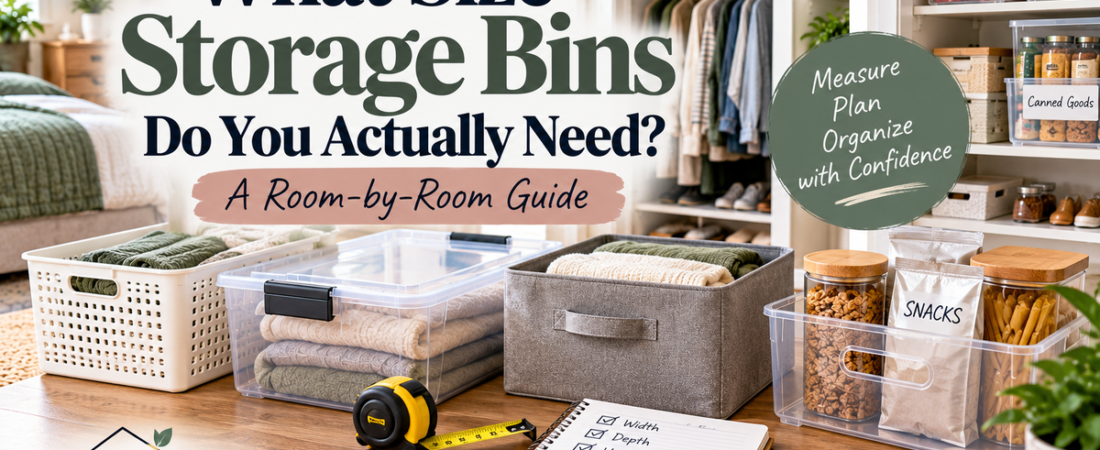
Buying storage bins should be simple. This storage bin size guide will help you choose the right dimensions for each room without wasting space.
Measure the shelf.
Find a bin that fits.
Done.
Except that is exactly how people end up with a pile of storage containers they don’t actually like using.
A bin can fit the width of a shelf but waste half the depth.
It can fit beneath a bed but scrape against a support rail.
It can fit inside a cabinet but be impossible to pull past the hinges.
It can be large enough to hold everything but become so heavy that nobody wants to move it.
So if you’re wondering what size storage bins you actually need, there isn’t one universal answer.
The right dimensions depend on:
- where the bin is going
- what you’re storing
- how you need to access it
- whether it slides, stacks, lifts or stays put
- how much clearance the space requires
This room-by-room guide will help you determine the right proportions and usable dimensions before you buy.
Start With the Space, Not the Bin – Storage Bin Size Guide
The wrong approach is:
Find a nice bin → figure out where to use it.
The better approach is:
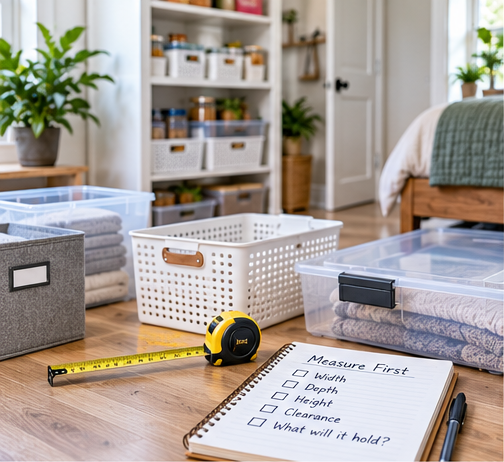
Identify the storage problem → measure the available space → measure what you’re storing → choose the bin shape that fits both.
That distinction matters.
A deep rectangular bin might be excellent for pantry snacks.
The same shape may be terrible for heavy canned food.
A wide shallow bin might be perfect under a bed.
It may waste enormous amounts of space on a tall closet shelf.
If you haven’t measured the space yet, start with our How to Measure for Storage Organizers Before You Buy.
That guide covers usable width, depth, height, openings, hinges, plumbing, drawer clearance and other dimensions that affect whether an organizer actually works.
The Three Dimensions That Matter
Every bin has three basic dimensions:
Width
Side to side.
This determines how many bins can sit next to each other.
Depth
Front to back.
This determines how much of a shelf or cabinet depth the bin uses.
Height
Bottom to top.
This determines whether the bin fits beneath shelves, beds, clothing or other obstructions.
But those numbers alone don’t tell you whether the bin will be useful.
You also need to consider:
- handles
- lids
- wheels
- tapered sides
- stacking lips
- clearance for your hands
- space required to remove the bin
That is why exact-fit bins can actually be worse than slightly smaller ones.
Leave Clearance Around the Bin
If a shelf is exactly 12 inches wide, should you buy a 12-inch-wide bin?
Usually not.
You need enough room to:
- grab the handle
- slide the bin
- lift it
- account for slightly uneven walls or shelving
- avoid scraping neighboring organizers
The necessary clearance depends on the bin.
A stationary decorative basket may need very little.
A pull-out bin needs more.
A lidded bin you lift from a high shelf needs enough room for your hands.
A bin with wheels needs enough floor clearance to roll smoothly.
Don’t focus on filling every fraction of an inch.
Focus on comfortable use.
Measure the Items Going Inside
This is the part that keeps bin shopping from becoming guesswork.
Before choosing a bin, measure representative items from the category.
If you’re storing pantry food, measure:
- cereal boxes
- chip bags
- jars
- pasta boxes
- snack packages
If you’re storing clothes, measure:
- folded sweaters
- shoes
- jeans
- rolled towels
If you’re storing household supplies, measure:
- cleaning bottles
- paper goods
- craft supplies
- toys
You don’t need to measure every object individually.
You need enough information to understand the category’s general proportions.
Tall Bin or Shallow Bin?
Think about how you access the contents.
Tall bins work well when:
- items stand upright
- the bin is not excessively heavy
- the entire bin slides out
- vertical containment prevents items from falling over
Examples:
- snack bags
- cleaning bottles
- rolls of paper goods
- lightweight backstock
Shallow bins work well when:
- you need to see everything
- you’re storing heavier items
- the bin sits beneath furniture
- items are stacked in one layer
Examples:
- under-bed clothing
- canned goods
- shoes
- drawer contents
- baking supplies
A deeper container isn’t automatically a better container.
Clear Bins vs. Opaque Bins
Size isn’t the only decision.
Visibility affects how well a bin works.
Clear bins
Useful when:
- you need to see inventory
- contents change frequently
- the bin lives inside a cabinet or closet
- you’re trying to prevent duplicate purchases
Opaque bins
Useful when:
- the bin remains visible in the room
- the contents are visually messy
- you want storage to blend with the décor
In open storage, a slightly less efficient opaque basket may be worth it if it makes the room feel calmer.
In a deep pantry, visibility may matter more.
What Size Pantry Bins Do You Need?
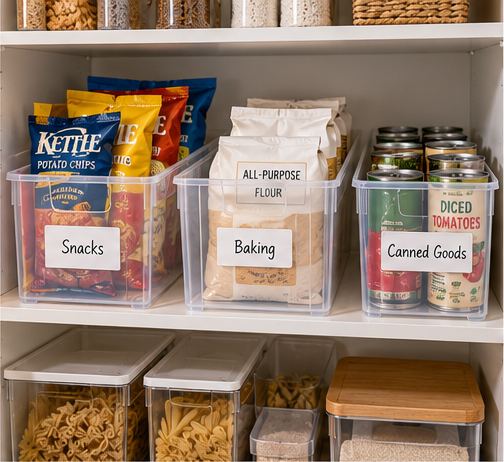
Pantries usually benefit from long, relatively narrow bins because shelves tend to be deeper than they are tall.
But don’t buy based on a generic pantry-bin size.
Clear pantry storage bins → Buy on Amazon
Measure:
- shelf width
- usable shelf depth
- shelf spacing
- opening width
- category size
Then decide how many categories you want per shelf.
For example, if one shelf is going to hold:
- breakfast foods
- snacks
- baking supplies
you may want three narrower bins rather than one huge bin.
A long bin works well when the category contains:
- snack bags
- pasta
- packets
- baking ingredients
- small boxes
For heavy cans, a giant deep bin is usually less practical.
It becomes difficult to pull out.
Use shorter or shallower bins for dense, heavy food.
For more pantry-specific ideas, see our 21 Small Pantry Organization Ideas That Actually Save Space.
What Size Bins Work for Deep Pantry Shelves?
Deep pantry shelves create a special problem.
You want to use the depth, but you also need to reach the back.
A good deep-shelf bin should usually:
- use much of the available depth
- remain narrow enough to pull out individually
- have an accessible handle
- not become too heavy when full
Do not choose one enormous bin just because it fills the shelf perfectly.
Several narrower pull-out bins are often easier to use.
What Size Closet Bins Do You Need?
Closets have different storage zones.
Each one needs a different proportion.
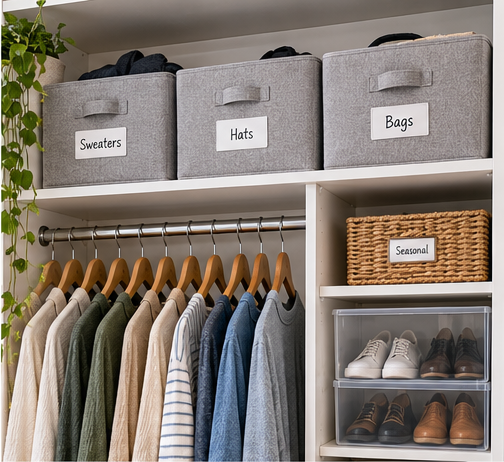
Upper closet shelves
These often work well with medium or large lightweight bins.
Closet storage bins → Buy on Amazon
Good for:
- seasonal clothes
- hats
- bags
- spare linens
The bin should be light enough to lift safely from overhead.
Lower shelves
These can handle heavier or more frequently used categories.
Beneath hanging clothes
Measure the actual distance beneath the garments.
Don’t use the empty rod-to-floor measurement.
If shirts hang 28 inches below the rod, that reduces the available bin height.
For general small-closet storage ideas, see our 17 Small Closet Organization Ideas That Make the Most of Limited Space.
Use Several Smaller Bins Instead of One Huge Closet Bin
Huge closet bins seem efficient.
Then you fill one with:
- sweaters
- jeans
- accessories
- scarves
- random seasonal items
and the category becomes meaningless.
Smaller bins create clearer zones.
For example:
Bin 1: winter accessories
Bin 2: swimwear
Bin 3: handbags
That usually makes retrieval easier.
The right bin size is partly determined by how narrowly you want to define the category.
What Size Under-Bed Bins Do You Need?
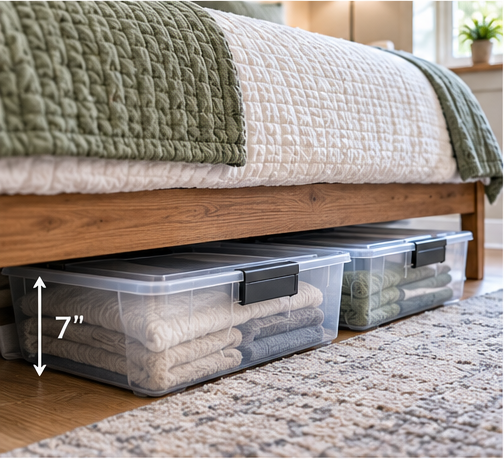
Under-bed storage is mostly about height first.
Measure the lowest obstruction beneath the bed.
That may be:
- center rail
- support leg
- frame hardware
- slats
Then subtract enough clearance for the bin to slide easily.
After that, measure:
- usable width between legs
- available depth
- direction the bin will pull out
Wide shallow bins usually work better than tall bins under a bed.
Use them for:
- seasonal clothing
- bedding
- shoes
- extra linens
If the bed has plenty of depth, two shorter bins may be easier to manage than one enormous bin stretching all the way underneath.
Wheels Change the Required Height
If an under-bed bin has wheels, include the wheels in the total height.
This seems obvious.
It’s also easy to overlook when the product listing emphasizes the container dimensions separately.
A 6-inch bin on 1-inch wheels is not a 6-inch-high storage solution.
It’s closer to 7 inches overall.
Low-profile under-bed storage bins → Buy on Amazon
What Size Bathroom Bins Do You Need?
Bathroom storage tends to work better with smaller bins because many bathroom categories are small.
Examples:
- skincare
- hair products
- first aid
- extra soap
- dental supplies
- washcloths
Instead of one giant toiletries bin, separate categories.
Smaller bins make it easier to:
- see contents
- remove one category
- fit around plumbing
- use narrow shelves
If the bathroom has little built-in storage, see our 15 Small Bathroom Storage Ideas for Bathrooms With No Storage.
What Size Under-Sink Bins Do You Need?
Under-sink storage is almost never a simple rectangle.
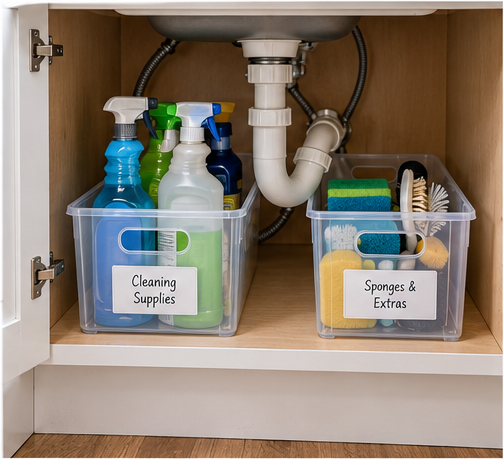
Plumbing divides the cabinet into smaller usable zones.
Narrow under-sink storage bins → Buy on Amazon
Measure:
- width on each side of the drain
- usable depth
- height beneath pipes
- location of supply lines
- hinge clearance
Often, two narrow bins work better than one large bin.
For example:
Left side: cleaning sprays
Right side: sponges and dishwasher supplies
This lets the bins fit around plumbing rather than fighting it.
For more ways to handle this awkward space, see our 15 Under-Sink Organization Ideas That Maximize Every Inch.
Tall Bottles Need Tall Bins—But Not Too Tall
Cleaning sprays and bottles need enough side height to remain upright.
But if the bin walls are excessively tall, labels become difficult to see and bottles become harder to remove.
Ideally, the bin contains the bottles without completely hiding them.
What Size Kitchen Cabinet Bins Do You Need?
Kitchen cabinet bins depend heavily on whether the cabinet is:
- upper
- lower
- deep
- shallow
Upper cabinets
Smaller bins work well for:
- packets
- spices
- baking supplies
- lightweight pantry goods
Avoid very tall opaque bins that prevent you from seeing what’s inside.
Deep lower cabinets
Long pull-out bins can help bring items forward.
But don’t fill them with extremely heavy cookware or canned food.
If deep cabinets are the main problem, see our How to Organize Deep Kitchen Cabinets So Nothing Gets Lost.
What Size Refrigerator Bins Do You Need?
Refrigerator bins need enough airflow around them.
Don’t fill every inch of the shelf.
Measure:
- shelf width
- shelf depth
- shelf height
- door clearance
Then match the bin to the category.
Narrow bins
Good for:
- yogurt
- cheese
- drink cans
- snacks
Wide shallow bins
Good for:
- meal-prep items
- produce
- grouped leftovers
Avoid bins so deep that food disappears behind other food.
Our 11 Refrigerator Organization Ideas That Make Food Easier to Find covers more ways to organize refrigerator zones.
What Size Laundry Room Bins Do You Need?
Laundry products often need taller bins or baskets because bottles are tall.
Good categories include:
- detergent
- stain remover
- dryer products
- cleaning cloths
But weight matters.
A huge bin filled with detergent bottles becomes very heavy.
Use smaller bins for liquids.
Larger baskets work better for lightweight items such as:
- dryer balls
- cleaning cloths
- empty laundry bags
For more laundry-specific ideas, see our 17 Small Laundry Room Organization Ideas That Make the Most of Every Inch.
What Size Entryway Bins Do You Need?
Entryway storage often stays visible.
That means appearance matters more.
Bins and baskets work well for:
- gloves
- hats
- dog supplies
- scarves
- children’s accessories
Choose proportions based on the furniture.
A shallow bench cubby needs a shallow basket.
A tall open shelf may handle a taller bin.
If you’re trying to stop entryway clutter from spreading into the house, see our 17 Entryway Organization Ideas for Small Spaces That Stop Clutter at the Door.
What Size Toy Bins Do You Need?
Toy storage is another area where bigger isn’t always better.
Large bins work well for:
- stuffed animals
- large building sets
- bulky toys
Smaller bins work better for:
- toy cars
- art supplies
- puzzle pieces
- small figures
The younger the user, the more important accessibility becomes.
A bin isn’t useful if a child can’t lift it or see what’s inside.
Think About Weight Before Choosing Capacity
A larger bin holds more.
That can be a disadvantage.
Imagine filling a huge storage bin with books.
Or canned goods.
Or cleaning products.
You may have created a container that technically works but is miserable to move.
For heavy categories, favor:
- smaller bins
- shorter bins
- bins that stay on shelves
- pull-outs rather than lift-out containers
For lightweight categories, larger bins are often fine.
Stackable Bins Need a Different Calculation
If you plan to stack bins, the total height matters.
For example:
Three 7-inch bins
does not automatically equal exactly 21 inches.
Stacking lips, lids and feet may change the total.
Check the manufacturer’s stacked dimensions if available.
Also think about access.
If you constantly need the bottom bin, a four-bin stack may be annoying.
Stacking works best for:
- seasonal categories
- backstock
- infrequently used items
Don’t Forget the Handles
Handles affect both:
- the exterior dimensions
- the clearance required to use the bin
A molded handle may add width.
A front pull handle may add depth.
And even recessed handles require room for your fingers.
When comparing product dimensions, look for the maximum exterior measurement, not just the container body.
Tapered Bins Have Less Usable Space Than They Look Like
Many attractive baskets and bins taper inward toward the bottom.
That means:
Top width: large
Bottom width: smaller
This matters with rigid objects.
A bin might be advertised as 14 inches wide but have only 11 inches of usable width at the bottom.
If you’re storing:
- books
- files
- rectangular boxes
- appliances
check the base dimensions if possible.
How Much of the Shelf Should a Bin Use?
You don’t need to fill 100% of the available space.
A bin that uses most of the depth while leaving some front or rear clearance may function better.
Likewise, three bins that fill 90% of a shelf width can be better than bins that fill 99% and scrape against one another.
Storage efficiency is about access, not mathematical packing density.
A Simple Storage Bin Decision Process
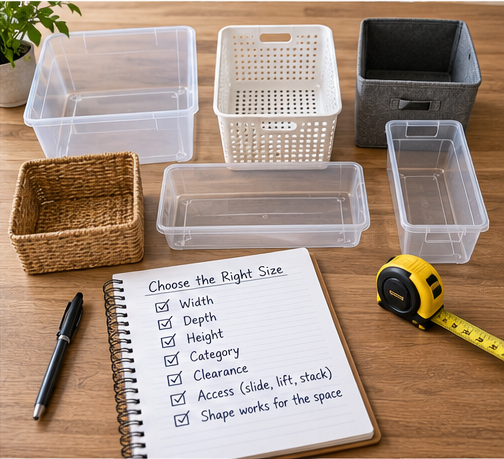
Before buying a bin, answer these questions:
1. Where will it go?
Pantry, closet, under bed, bathroom, cabinet?
2. What are the usable dimensions?
Width, depth and height after accounting for obstacles.
3. What will it store?
Measure representative items.
4. How heavy will the category become?
Heavy categories need smaller containers.
5. How will you access it?
Slide, lift, stack or leave in place?
6. Does it need to be visible?
Clear bins help with inventory.
Opaque bins reduce visual clutter.
7. How much clearance does it need?
Leave space for handles and movement.
8. Does the shape match the category?
Tall bottles need different proportions than folded sweaters.
Retractable tape measure → Buy on Amazon
What Not to Do When Buying Storage Bins
Avoid:
- buying bins before measuring
- buying sets just because they match
- assuming larger is better
- filling heavy categories into huge bins
- ignoring handles
- ignoring tapered sides
- choosing bins that exactly match shelf dimensions
- forgetting lids or wheels
- using deep bins that cannot pull out
- stacking bins you need to access constantly
And don’t assume every shelf needs a bin.
Sometimes open shelving works perfectly well.
A bin should solve an organization problem.
It shouldn’t exist merely because storage bins look organized.
Frequently Asked Questions
What is the best size storage bin for a pantry?
There is no universal best size. Measure the shelf and choose proportions based on what you’re storing. Long narrow bins often work well for lightweight packaged food, while smaller bins are more practical for heavier canned goods.
Should storage bins fill the entire depth of a shelf?
Not necessarily. Using much of the depth can increase capacity, but the bin still needs to be easy to pull out and access. A slightly shallower bin can sometimes function better.
How do I know what size bin fits under my bed?
Measure from the floor to the lowest obstruction beneath the bed, then measure the available width and depth between supports. Leave enough clearance for the bin to slide comfortably.
Are large storage bins better?
Only for lightweight or bulky categories. Large bins filled with heavy items can become difficult to lift and use.
Should I buy all the same size storage bins?
Usually not. Different categories and storage areas often require different proportions. Matching bins can look nice, but function should determine the size.
How much clearance should I leave around a storage bin?
There is no single required amount. Leave enough space for the bin to slide, lift, rotate or be gripped comfortably without scraping surrounding surfaces.
Choose the Bin After You Understand the Problem
There isn’t a magic list of storage-bin sizes every home needs.
And that’s actually useful.
It means you don’t have to buy a 12-pack of matching containers and hope they work everywhere.
Measure the space.
Measure what you’re storing.
Think about weight.
Think about movement.
Think about visibility.
Then choose the bin.
The best storage bin is not the one that perfectly fills the shelf.
It’s the one that makes the stored category easy to see, easy to reach and easy to put away.
For a broader look at making limited storage work throughout the home, see our 25 Storage Ideas for Small Homes That Make Every Inch Count.