
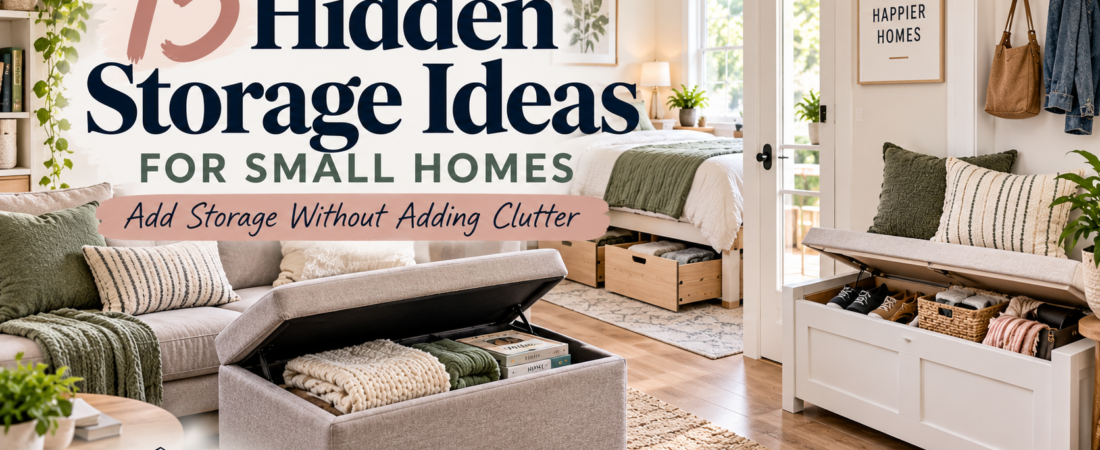
Small homes need storage, that’s why we wrote Hidden Storage Ideas for Small Homes.
But they don’t necessarily need more visible storage.
That’s the problem with a lot of organization advice.
You add another shelf.
Then another basket.
Then a rolling cart.
Then hooks.
Then open shelving.
Eventually, you’ve technically created more places to put things—but the room starts looking like storage itself.
Hidden storage takes a different approach.
Instead of adding more visible containers, it uses spaces and furniture that already exist—or adds storage that blends into the room.
That might mean:
- drawers beneath a bed
- storage inside an ottoman
- a bench with a hidden compartment
- cabinets that look like furniture
- shallow storage behind doors
- concealed space beneath seating
The goal isn’t to hide everything you own.
It’s to keep everyday spaces feeling calmer while still giving necessary belongings somewhere practical to go.
Here are 15 hidden storage ideas for small homes that can add capacity without adding visual clutter.
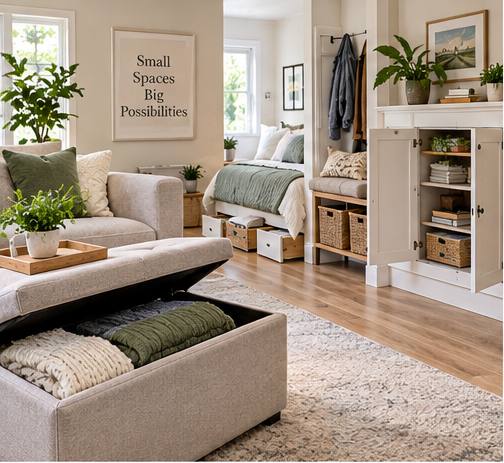
What Makes Storage “Hidden”?
Hidden storage doesn’t necessarily mean secret compartments.
It simply means the storage doesn’t dominate the room visually.
A storage bench looks like a bench.
A bed with drawers still looks like a bed.
A closed cabinet hides the categories inside it.
A lidded ottoman can store blankets while still functioning as furniture.
That matters in a small home because visual clutter can make limited space feel even smaller.
Open storage is useful when you need quick access.
Hidden storage is useful when the stored category doesn’t need to remain visible.
The best small-space setup usually combines both.
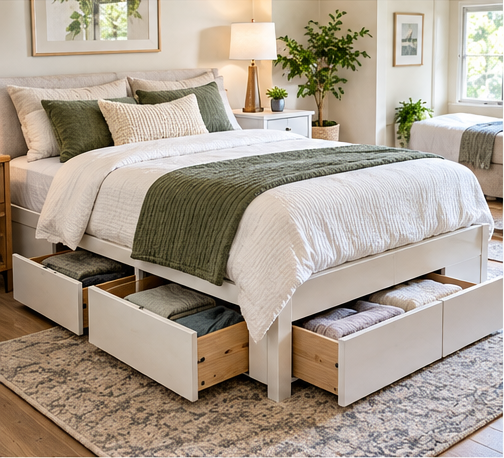
1. Use a Storage Bed
A bed already occupies one of the largest footprints in a bedroom.
If the frame includes storage, that same footprint can do two jobs.
Storage beds may include:
- side drawers
- foot-end drawers
- lift-up platforms
- built-in cubbies
They’re useful for:
- seasonal clothing
- extra bedding
- shoes
- spare towels
- bags
- rarely used items
Before buying one, check how the storage opens.
A drawer-style bed needs clearance beside or beyond the bed.
A lift-up platform needs enough overhead room to operate safely.
The bed may fit the bedroom perfectly while the storage itself doesn’t.
Storage bed with built-in storage → Buy on Amazon
2. Use Low-Profile Bins Under an Existing Bed
You don’t need a new bed to use the space beneath it.
Low-profile bins can create hidden storage under a standard frame.
Use them for:
- off-season clothes
- shoes
- bedding
- gift wrap
- accessories
- extra linens
Measure the lowest point beneath the bed before buying anything.
Center supports and rails can sit lower than the outer frame.
Containers with handles or wheels are especially useful because they make the hidden storage easier to retrieve.
If you’re working with a bedroom that has little or no closet space, see our 17 Small Bedroom Storage Ideas When You Don’t Have a Closet.
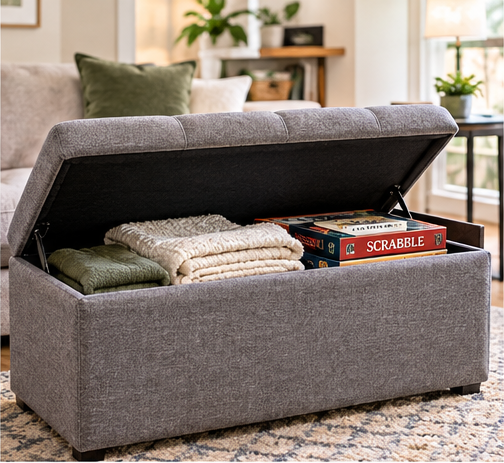
3. Choose an Ottoman With Storage Inside
An ottoman can function as:
- footrest
- extra seat
- coffee table
- hidden storage
That makes it especially useful in a small living room.
Use the interior for:
- blankets
- games
- toys
- magazines
- electronics
- seasonal décor
A hinged lid is convenient when you need frequent access.
A removable lid may work well if the ottoman doubles as a table.
Just don’t fill it with extremely heavy items if you regularly need to move the ottoman.
Storage ottoman → Buy on Amazon
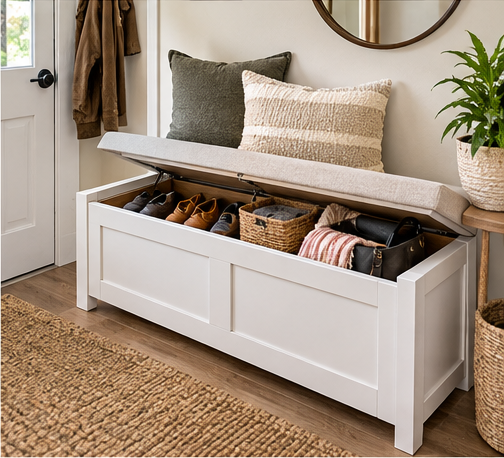
4. Use a Storage Bench
A bench can hide a surprising amount of storage.
Storage bench with hidden compartment → Buy on Amazon
Useful locations include:
- entryway
- bedroom
- beneath a window
- dining area
- hallway
Use it for:
- shoes
- bags
- blankets
- seasonal accessories
- children’s items
- extra linens
An entryway bench is particularly useful because it can contain the things that would otherwise pile up near the door.
Choose the opening style based on the location.
A top-opening bench needs space above it.
A bench with drawers needs clearance in front.
For more ways to make tight entry areas work harder, see our 17 Entryway Organization Ideas for Small Spaces That Stop Clutter at the Door.
5. Use Furniture With Built-In Drawers
Furniture that already has a job is some of the best storage furniture in a small home.
Look for:
- coffee tables with drawers
- console tables with cabinets
- nightstands with drawers
- side tables with enclosed storage
- desks with built-in compartments
This is usually better than adding another stand-alone organizer.
Why?
Because the footprint was already going to be used.
A coffee table with drawers does not require more floor space than a coffee table without them.
That’s the principle you want in a small room:
make existing furniture earn its footprint.
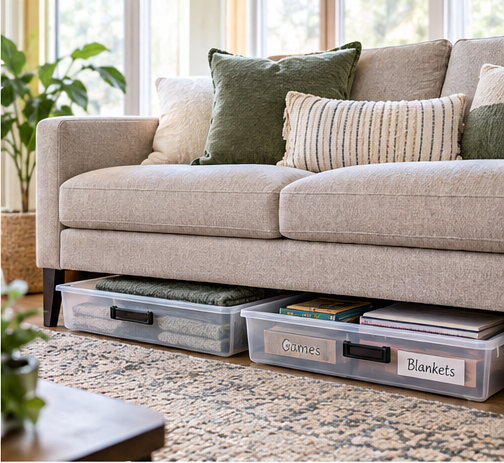
6. Use the Space Under a Sofa
Some sofas have enough clearance for shallow storage.
This can work for:
- board games
- extra blankets
- toys
- craft supplies
- seasonal décor
- rarely used household items
Low-profile zippered bags can work when rigid bins are too tall.
If containers are visible from across the room, choose ones that blend into the space.
Otherwise, hidden storage can start looking surprisingly unhidden.
7. Use a Lift-Top Coffee Table
A lift-top coffee table can create storage and a usable work surface in the same footprint.
The top lifts upward and toward you, often revealing a concealed compartment underneath.
Use it for:
- remotes
- chargers
- laptops
- notebooks
- games
- magazines
- everyday living-room clutter
This can be especially useful in an apartment where the living room also serves as:
- office
- dining area
- homework zone
Check the lift mechanism and overall dimensions carefully.
The table needs enough clearance to open without colliding with the sofa or surrounding furniture.
Lift-top coffee table with storage → Buy on Amazon
8. Hide Storage Behind Cabinet Doors
Closed cabinets are one of the simplest forms of hidden storage.
Instead of displaying every item on open shelves, use a cabinet that visually blends with the room.
This works in:
- living rooms
- dining areas
- bedrooms
- hallways
- bathrooms
A narrow cabinet can hide:
- office supplies
- linens
- electronics
- cleaning products
- craft supplies
- household backstock
In a small home, closed storage can reduce visual noise dramatically.
Just be careful with depth.
A cabinet doesn’t need to be enormous to be useful.
Sometimes a relatively shallow cabinet provides plenty of storage without intruding into the walkway.
9. Use the Space Behind Doors
The space behind a door can disappear from view when the door is open.
That makes it useful for shallow storage.
Options include:
- hooks
- narrow racks
- hanging organizers
- wall-mounted baskets
Depending on the room, use it for:
- accessories
- toiletries
- cleaning products
- shoes
- scarves
- bags
Measure the clearance between the open door and wall before adding anything.
If the organizer prevents the door from opening fully, you’ve solved one problem by creating another.
For more ideas involving doors and other overlooked areas, see our 12 Storage Ideas for Awkward Spaces You’re Probably Wasting.
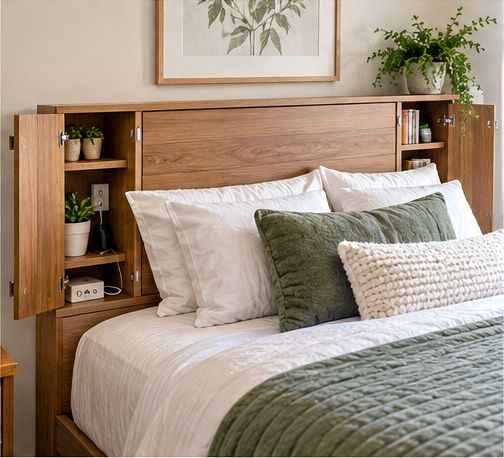
10. Use a Headboard With Storage
A headboard can provide surprisingly useful hidden or semi-hidden storage.
Storage headboard → Buy on Amazon
Some designs include:
- side compartments
- shelves
- sliding panels
- cabinets
This can reduce the need for large nightstands.
Use it for:
- books
- chargers
- glasses
- small electronics
- nighttime essentials
Be careful with deep headboard systems.
They can push the bed farther into the room.
A headboard that adds six or eight inches of depth may matter significantly in a tiny bedroom.
11. Use Toe-Kick Drawers
The recessed area beneath lower cabinets is often completely unused.
In some kitchens, that space can be converted into shallow toe-kick drawers.
They’re useful for flat or low-profile items such as:
- baking sheets
- serving trays
- linens
- reusable bags
- rarely used flat kitchen tools
This is a more involved storage upgrade than adding a bin or shelf, but it can create capacity without changing the visual footprint of the kitchen.
It works especially well when every cabinet matters.
For more ways to improve limited cabinetry, see our How to Organize a Kitchen With Too Little Cabinet Space.
12. Use the Space Inside a Staircase
If your home has stairs, the structure may contain significant unused volume.
Depending on the construction, under-stair areas can sometimes become:
- drawers
- cabinets
- shelving
- closets
- pull-out storage
This can be particularly valuable in a small home because it turns structural space into storage without adding furniture.
But this is one of the ideas where professional evaluation may be necessary.
Don’t cut into stair structures without understanding:
- framing
- electrical wiring
- plumbing
- load-bearing components
The storage opportunity may be excellent, but the structure comes first.
13. Use Concealed Storage in a Dining Bench
Banquette seating and dining benches can hide storage beneath the seat.
This works well for:
- table linens
- serving pieces
- seasonal dishes
- small appliances
- household overflow
A built-in banquette can be especially efficient because it replaces chairs while adding storage.
Freestanding storage benches can create a similar effect without construction.
Keep frequently used dining items easy to access.
Don’t bury the napkins beneath six boxes of seasonal décor.
14. Use Decorative Boxes as Concealed Storage
Not every hidden-storage solution needs to involve furniture.
Decorative boxes can contain smaller categories while still looking intentional on a shelf.
Use them for:
- cords
- chargers
- documents
- remote controls
- craft supplies
- small electronics
- personal items
Choose box dimensions based on what will actually go inside.
A set of matching decorative boxes isn’t helpful if none of them fit the items you need to hide.
And label them discreetly if necessary.
A beautiful box is less useful when nobody remembers what’s inside it.
15. Create Hidden Storage in Existing Dead Space
Walk through your home and look for spaces that already exist but aren’t useful.
Examples include:
- beneath furniture
- beneath benches
- behind doors
- recessed wall areas
- unused cabinet cavities
- under stairs
- beneath window seats
- high enclosed cabinetry
The best hidden storage often comes from solving a specific problem rather than shopping for a specific product.
Ask:
What keeps becoming visible because it has nowhere to go?
Then look for nearby concealed space that could hold that category.
This is a much better approach than filling every empty area with organizers.
Hidden Storage vs. Open Storage
Neither one is automatically better.
They solve different problems.
Hidden storage works best for:
- visually messy categories
- seasonal items
- backups
- linens
- toys
- electronics
- paperwork
- rarely used belongings
Open storage works best for:
- everyday items
- frequently used dishes
- books
- attractive objects
- items you need to see to remember
The problem begins when everything becomes open storage.
A tiny home filled with visible baskets, racks, hooks and shelves can feel much more crowded than it actually is.
Likewise, hiding every daily-use item behind doors can make the home frustrating to use.
Use each type where it makes sense.
Furniture That Works Harder in Small Homes
When you’re buying furniture for a small home, ask whether the piece can do more than one thing.
Examples:
Bed
Sleep + clothing storage
Ottoman
Footrest + seating + blanket storage
Bench
Seating + shoe storage
Coffee table
Table + concealed living-room storage
Nightstand
Bedside surface + drawers
Dining bench
Seating + linen storage
Console
Display surface + household storage
Dual-purpose furniture isn’t automatically worth buying.
A badly designed storage ottoman can be worse than a good normal ottoman.
But when the furniture works well in both roles, it reduces the number of separate pieces your home needs.
What to Measure Before Buying Hidden Storage Furniture
Hidden storage still has to fit.
Measure:
- overall width
- overall depth
- overall height
- lid opening
- drawer extension
- door swing
- walkway clearance
- furniture clearance
Also check the usable interior dimensions.
A storage bench may look huge from the outside but have a surprisingly small compartment because of framing, padding, or hardware.
The same applies to ottomans and lift-top tables.
If you’re unsure how to evaluate those dimensions, use our How to Measure for Storage Organizers Before You Buy.
Don’t Hide Things So Well That You Forget Them
Hidden storage has one obvious downside.
You can’t see what’s inside.
That makes it easy to forget what you own.
Avoid turning concealed storage into a dumping ground.
Assign categories.
For example:
Storage ottoman: blankets and games
Under-bed drawer: winter clothes
Entryway bench: shoes and bags
Dining bench: table linens
Now you know where to look.
A simple label inside a drawer or under a lid can also help.
The goal is concealed organization, not concealed chaos.
What Not to Store in Hidden Compartments
Some items need ventilation, accessibility, or safer storage conditions.
Avoid hiding things where they:
- block vents
- obstruct electrical equipment
- interfere with plumbing access
- create moisture problems
- create excessive weight
- become difficult to retrieve safely
Also think about emergency access.
Important documents, medications, or safety equipment may need a more appropriate dedicated location rather than disappearing into furniture storage.
A Simple Hidden Storage Strategy – hidden storage ideas for small homes
If you’re trying to reduce visible clutter, start with the room that bothers you most.
Ask:
What is currently visible that I wish wasn’t?
Maybe it’s blankets.
Shoes.
Toys.
Paperwork.
Electronics.
How often do I need it?
Daily items need reasonably easy access.
Seasonal items can go deeper.
What furniture already occupies space nearby?
Can the bed, bench, coffee table, or nightstand provide the storage instead?
Is there overlooked concealed space?
Look beneath furniture, behind doors and inside structural cavities.
Then solve one category at a time.
This prevents you from filling the home with storage furniture before you know what you’re trying to store.
Frequently Asked Questions
What is the best hidden storage for a small apartment?
Under-bed storage, storage ottomans, benches, lift-top coffee tables and furniture with drawers are particularly useful because they add storage without requiring a separate storage footprint.
How can I create hidden storage without remodeling?
Use dual-purpose furniture, under-bed bins, storage benches, ottomans, closed cabinets and shallow organizers behind doors. These add concealed storage without changing the structure of the home.
Is hidden storage better than open shelving?
Not always. Hidden storage works well for visually cluttered or low-frequency items, while open storage is better for items you use frequently. A combination usually works best.
How do I add storage without making a room feel smaller?
Prioritize furniture with built-in storage, concealed compartments and existing unused space. Avoid adding too many freestanding racks, shelves and baskets that increase visual clutter.
What furniture provides the most storage in a small home?
Storage beds, wardrobes, benches, lift-top coffee tables and tall enclosed cabinets can provide substantial storage relative to the floor space they use.
Hide the Clutter, Not the Function
The best hidden storage doesn’t feel clever just for the sake of being clever.
It solves a problem.
Blankets disappear into the ottoman instead of piling on the sofa.
Seasonal clothes move under the bed instead of crowding the closet.
Shoes go inside the entryway bench instead of spreading across the floor.
Everyday clutter gets contained without filling the room with more visible organizers.
That’s what makes hidden storage so useful in small homes.
You’re not trying to cram belongings into secret compartments everywhere.
You’re using the space you already have more intelligently—while allowing the room to still feel like a place to live, not just a place to store things.
For more whole-home ideas, see our 25 Storage Ideas for Small Homes That Make Every Inch Count