
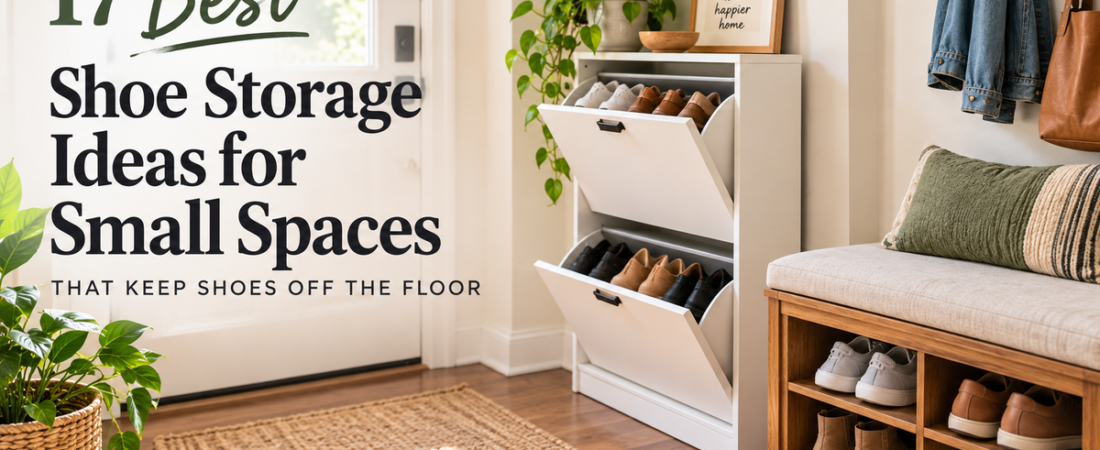
Shoes have a way of taking over small spaces surprisingly fast. A few pairs by the front door become a pile, closet floors disappear under sneakers and boots, and suddenly you’re stepping over shoes just to get through the room.
The good news is that effective shoe storage ideas for small spaces don’t necessarily require a bigger closet or a large piece of furniture. The key is choosing storage that matches the number and type of shoes you actually own while making better use of vertical space, doors, walls and overlooked areas.
Before buying anything, take a quick inventory of your shoes and measure the space where you want to store them. A shoe organizer that’s only a few inches too deep can turn a narrow entryway into an obstacle course.
Here are 17 practical ways to store shoes when floor space is limited.
1. Use a Narrow Shoe Cabinet
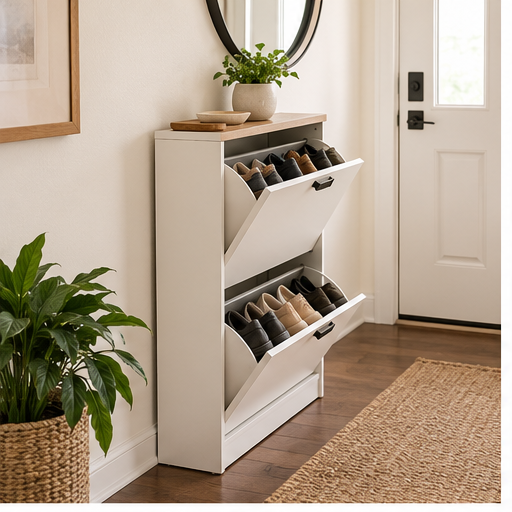
A narrow shoe cabinet is one of the best options when you need to store several pairs without giving up much floor space.
Unlike traditional shelving, many slim shoe cabinets hold shoes at an angle or inside tilt-out compartments. That allows the cabinet to stay relatively shallow while still providing useful capacity.
These work particularly well in entryways, hallways and against bedroom walls.
Measure first: Pay close attention to the cabinet’s depth and the amount of room needed to open its doors or tilt-out compartments. A cabinet that physically fits against the wall may still interfere with a walkway once it’s open.
If your entryway is already fighting coats, bags, keys and other clutter, our 17 Entryway Organization Ideas for Small Spaces can help you organize the entire drop zone rather than just the shoes.
Narrow tilt-out shoe cabinet → Buy on Amazon
2. Go Vertical With a Tall Shoe Rack
When you can’t spread storage outward, go upward.
A tall, narrow shoe rack can hold significantly more shoes than a traditional two-tier rack while using roughly the same amount of floor space.
This works especially well in a closet corner, beside a dresser or in a small entryway where you have unused wall height.
Just make sure the rack is stable. Very tall, narrow organizers can become top-heavy, particularly when heavier shoes or boots are stored near the top.
Whenever possible, put heavier footwear on the lower shelves and lighter shoes higher up.
Tall vertical shoe rack → Buy on Amazon
3. Add Shoe Storage Under the Bed
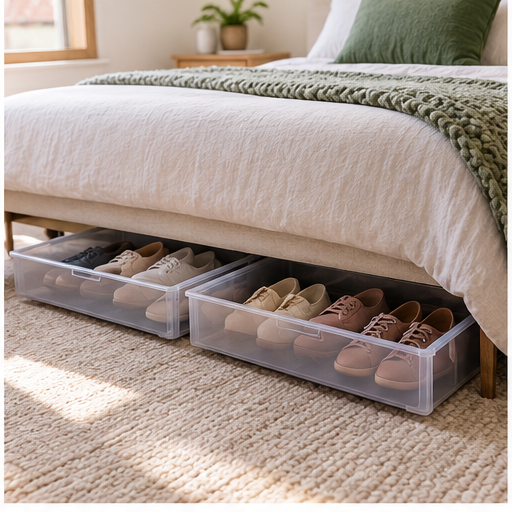
If your closet floor is already full, look underneath your bed.
Low-profile under-bed containers are particularly useful for seasonal shoes, special-occasion footwear and pairs you don’t need every day.
But don’t buy an under-bed organizer based on the advertised height of your bed frame alone.
Measure from the floor to the lowest obstruction underneath the bed. Center supports, slats and hardware can reduce the usable clearance.
Leave yourself a little extra space so the container slides out easily instead of scraping against the frame every time you use it.
For more ideas that use spaces you already have, see our 15 Hidden Storage Ideas for Small Homes.
Low-profile under-bed shoe organizer → Buy on Amazon
4. Hang Shoes Over a Door
An over-the-door shoe organizer can create storage without consuming any floor space at all.
It’s particularly useful in bedrooms, closets and apartments where you’re not allowed to install permanent shelving.
Pocket organizers work best for relatively lightweight shoes such as flats, sandals and smaller sneakers.
Bulkier shoes may fit poorly and cause the organizer to sag.
Also check the clearance above your door before buying. Some over-door hooks are thick enough to prevent tightly fitted doors from closing properly.
5. Use the Back of a Closet Door
You don’t necessarily need to hang shoes over a visible bedroom or hallway door.
The inside of a closet door can provide the same vertical storage while keeping the shoes hidden when the closet is closed.
This is particularly useful in a small bedroom where visible storage can make the room feel more cluttered.
Before adding an organizer, check that it won’t collide with shelves, hanging clothes or anything else inside the closet when the door closes.
6. Stack Shoe Organizers Instead of Spreading Them Out
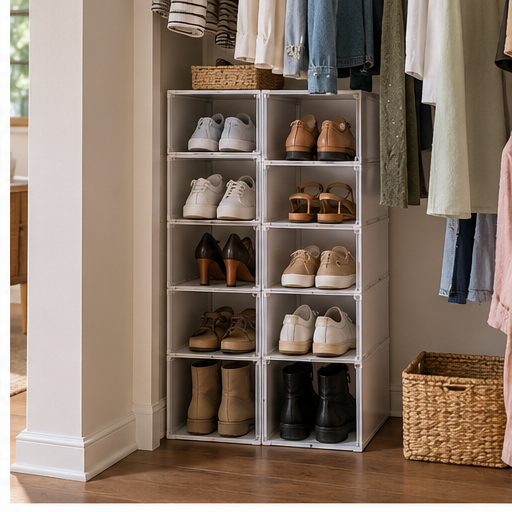
Small stackable shoe shelves or cubbies let you build upward as your collection grows.
Instead of placing a long rack across most of the closet floor, you might stack two or three smaller units vertically in one section.
This also gives you more flexibility than one large fixed organizer.
If you’re working with an especially cramped closet, our 17 Small Closet Organization Ideas covers ways to use the rest of the closet more efficiently too.
Stackable shoe organizer → Buy on Amazon
7. Put Everyday Shoes on a Small Entryway Rack
Not every pair you own needs to live beside the front door.
In fact, trying to store the household’s entire shoe collection in a small entryway is often what creates the problem.
Use a compact rack for the shoes people actually wear during the current week and move everything else to closets, bedrooms or seasonal storage.
Think of the entryway as a daily-use shoe zone, not permanent shoe storage.
For a two-person household, that might mean four to eight pairs rather than 20.
For a larger family, assign a limited number of spaces to each person.
This simple rule can make a small rack considerably more effective.
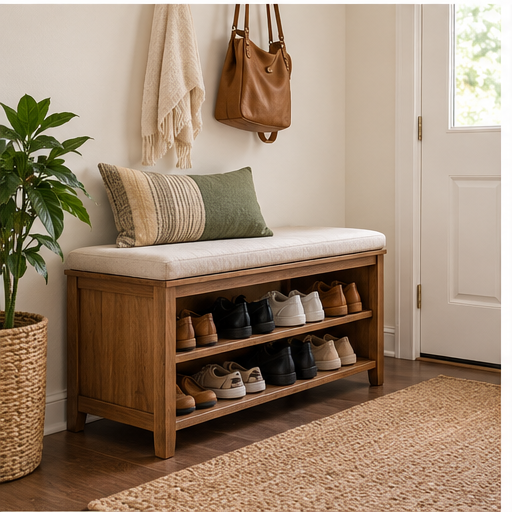
8. Choose a Shoe Bench With Storage Underneath
If you already need somewhere to sit while putting shoes on, make that furniture perform two jobs.
A compact storage bench can provide seating on top and shoe storage underneath.
Open shelves make everyday footwear easy to grab. Concealed compartments create a cleaner appearance but may require a little more room to open.
The important part in a small entryway is depth.
A deep bench can protrude too far into the walkway even if its width looks perfect.
Measure the available floor depth and make sure you still have comfortable passage after the bench is installed.
9. Use the Lowest Closet Shelf for Shoes
Closet shelves are often designed around clothing rather than shoes.
If you have an adjustable shelving system, lowering the bottom shelf can create a dedicated shoe zone without requiring another piece of furniture.
You may even be able to fit two levels of shoes where you previously had one.
The trick is leaving enough vertical clearance for the footwear you’re storing.
Flats need very little height. High-top sneakers and ankle boots need considerably more.
Design the spacing around your actual shoes rather than trying to make every shelf identical.
10. Add a Second Level With a Shoe Shelf Riser
If your shoes sit in a single row with a large amount of empty space above them, you’re wasting vertical capacity.
A small shelf riser can create another storage level.
This works particularly well for flats, sandals and low-profile sneakers.
Measure the available shelf height first. Two layers only help if you can comfortably remove shoes from both levels.
If the upper shelf is so tight that you have to move everything around to reach the bottom row, you’ve increased capacity at the expense of usability.
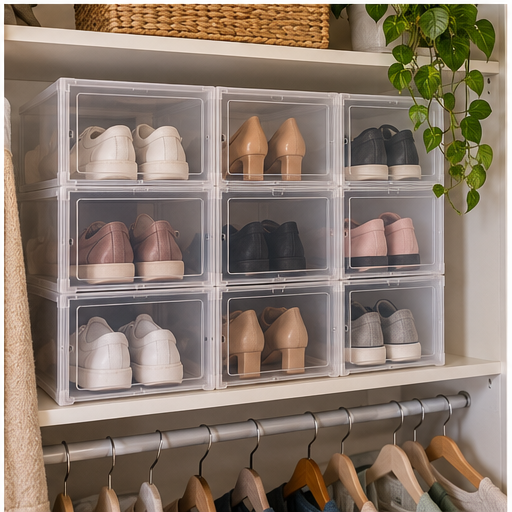
11. Use Clear Shoe Boxes for Pairs You Wear Less Often
Clear stackable shoe boxes can work well when shoes need to be protected but still visible.
They’re especially useful on higher closet shelves where open shoes would otherwise collect dust.
Visibility matters more than it sounds.
When shoes disappear inside identical opaque boxes, it’s easy to forget what you own. Clear fronts let you identify a pair without unstacking everything.
Before ordering a large set, measure both your available shelf and your largest shoes.
Exterior box dimensions can be considerably larger than the usable interior dimensions.
Our How to Measure for Storage Organizers Before You Buy guide explains how to account for usable dimensions, clearance and organizer geometry before purchasing storage products.
Stackable clear shoe boxes → Buy on Amazon
12. Store Shoes Heel-to-Toe
Sometimes you don’t need another organizer at all.
Alternating shoes heel-to-toe can reduce the width required for a row of footwear because the widest parts of neighboring shoes aren’t sitting directly beside one another.
The amount of space saved depends on the shape of the shoes, but it’s an easy trick to test before buying anything.
It works particularly well on closet shelves and narrow shoe racks.
13. Use an Awkward Corner for Vertical Shoe Storage
A narrow corner beside a dresser, closet system or entryway cabinet may be too small for ordinary furniture but perfect for a compact shoe tower.
Measure both dimensions of the available footprint rather than just the width.
A corner may look empty because nothing fits there, but a narrow organizer can still protrude farther than expected.
We cover more spots like this in 12 Storage Ideas for Awkward Spaces You’re Probably Wasting.
14. Move Seasonal Shoes Out of Prime Storage
Winter boots don’t need to occupy your easiest-to-reach shelf in July.
Likewise, sandals don’t deserve prime entryway space during a Wisconsin winter.
Rotate footwear seasonally so your most accessible storage holds what you’re actually wearing now.
Off-season shoes can move to:
- under-bed storage
- upper closet shelves
- labeled containers
- less-accessible closet areas
Just make sure shoes are clean and completely dry before storing them for an extended period.
15. Keep Boots Upright Instead of Letting Them Collapse
Tall boots are awkward because they use significant vertical space and often slump over, taking up even more room.
Boot shapers or simple inserts can keep the shafts upright so pairs remain contained within their actual footprint.
Store tall boots on the floor or on a shelf with enough vertical clearance rather than forcing them into cubbies designed for ordinary shoes.
If boots are something you only wear seasonally, consider moving them out of your prime everyday shoe zone entirely.
16. Separate Everyday Shoes From the Rest of Your Collection
One of the biggest shoe-storage mistakes is treating every pair as equally important.
They’re not.
Divide your shoes into three categories:
Daily: Shoes you’re currently wearing several times per week.
Occasional: Dress shoes, specialty footwear and pairs you use periodically.
Seasonal: Winter boots, sandals or other footwear that isn’t currently in rotation.
Give your best storage location to the daily category.
Occasional shoes can go higher, lower or farther away. Seasonal footwear can move into deeper storage.
This reduces the amount of shoe storage you need in the most valuable areas of your home.
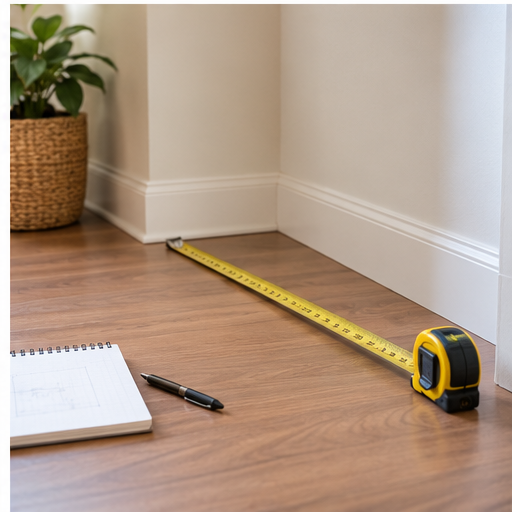
17. Measure the Space Before Choosing the Organizer
This is the step that prevents most shoe-storage mistakes.
Before buying a shoe rack, cabinet, bench or set of boxes, measure:
- available width
- usable depth
- available height
- baseboards
- door swing
- drawer or cabinet clearance
- nearby vents
- the width of the walkway
- the dimensions of your largest shoes
Depth is particularly important in small spaces.
A shoe cabinet that’s only 10 or 12 inches deep may work beautifully in a narrow hallway where a traditional 15- or 16-inch-deep piece of furniture would feel intrusive.
But product dimensions alone aren’t enough.
Ask yourself what happens when you use it.
Can the cabinet open?
Can you pull out the bottom drawer?
Can someone walk past while you’re getting shoes?
Can the closet door still close?
That’s the difference between an organizer that technically fits and one that actually works.
How Much Shoe Storage Do You Actually Need?
Before buying more storage, count the shoes you’re trying to accommodate.
Then separate them by frequency of use.
If you own 25 pairs but only wear six regularly, you probably don’t need an entryway organizer that holds 25 pairs.
You need convenient storage for six pairs and secondary storage for the remaining 19.
That distinction matters in small homes because easy-access space is more valuable than total storage space.
Reserve the most convenient areas for what you use frequently and push everything else toward less accessible storage.
What Type of Shoe Storage Works Best in a Small Space?
The best option depends on the constraint you’re dealing with.
Very narrow entryway:
Consider a shallow tilt-out cabinet or tall vertical rack.
Tiny closet:
Use stackable organizers, shelf risers or the inside of the closet door.
Small bedroom:
Use under-bed storage, closet-door storage or a narrow vertical organizer.
Rental:
Prioritize freestanding, stackable and over-door options that don’t require permanent installation.
Large shoe collection:
Separate everyday footwear from occasional and seasonal pairs rather than trying to keep everything together.
Family entryway:
Limit each person’s daily shoe allocation and move excess pairs elsewhere.
The goal isn’t to find the organizer that holds the most shoes.
It’s to find the one that stores the shoes you need without consuming space you need for something else.
Frequently Asked Questions – Shoe Storage Ideas for Small Spaces
How do you store a lot of shoes in a small space?
Use vertical storage, under-bed space, doors and seasonal rotation rather than trying to keep every pair on the floor. Tall shoe racks, stackable organizers and clear shoe boxes can increase capacity without dramatically increasing the storage footprint.
What’s the best shoe storage for a narrow entryway?
A shallow shoe cabinet or narrow vertical rack usually makes better use of a tight entryway than a deep horizontal rack. Measure the walkway before buying anything and account for the space needed to open doors, drawers or tilt-out compartments.
How deep should shoe storage be?
There isn’t one ideal depth because footwear and organizer designs vary. Measure your largest shoes and compare those dimensions with the organizer’s usable interior dimensions, not just its exterior measurements. Tilt-out cabinets can sometimes provide shoe storage with a shallower overall footprint than traditional shelves.
Where should you store shoes if you don’t have a closet?
Consider under-bed containers, a narrow freestanding cabinet, an over-door organizer, a compact shoe bench or vertical shelving. If you’re dealing with a bedroom that lacks a closet entirely, our 17 Small Bedroom Storage Ideas When You Don’t Have a Closet covers clothing and other storage problems beyond shoes.
Is it better to store shoes in boxes or on a rack?
Use a rack for shoes you wear frequently because they’re easier to see and access. Boxes are better for occasional or seasonal footwear that needs protection from dust. Clear or front-opening boxes make stored shoes easier to identify without dismantling a stack.
Make Your Shoe Storage Fit the Space You Actually Have
Small-space shoe storage isn’t really about finding one giant organizer capable of holding everything you own.
It’s about matching different shoes to different levels of access.
Keep everyday footwear convenient. Move seasonal pairs out of prime storage. Use vertical space before consuming more floor space, and measure carefully before adding furniture or organizers.
A few inches of depth can make the difference between storage that improves a room and storage that becomes another obstacle.
And if shoes are only one part of your storage problem, start with our 25 Storage Ideas for Small Homes That Make Every Inch Count for more ways to find usable space throughout your home.